



Question: In August 2 0 1 1 , in the midst of the Cadbury integration, Rosenfeld made public her intention to split Kraft into a North
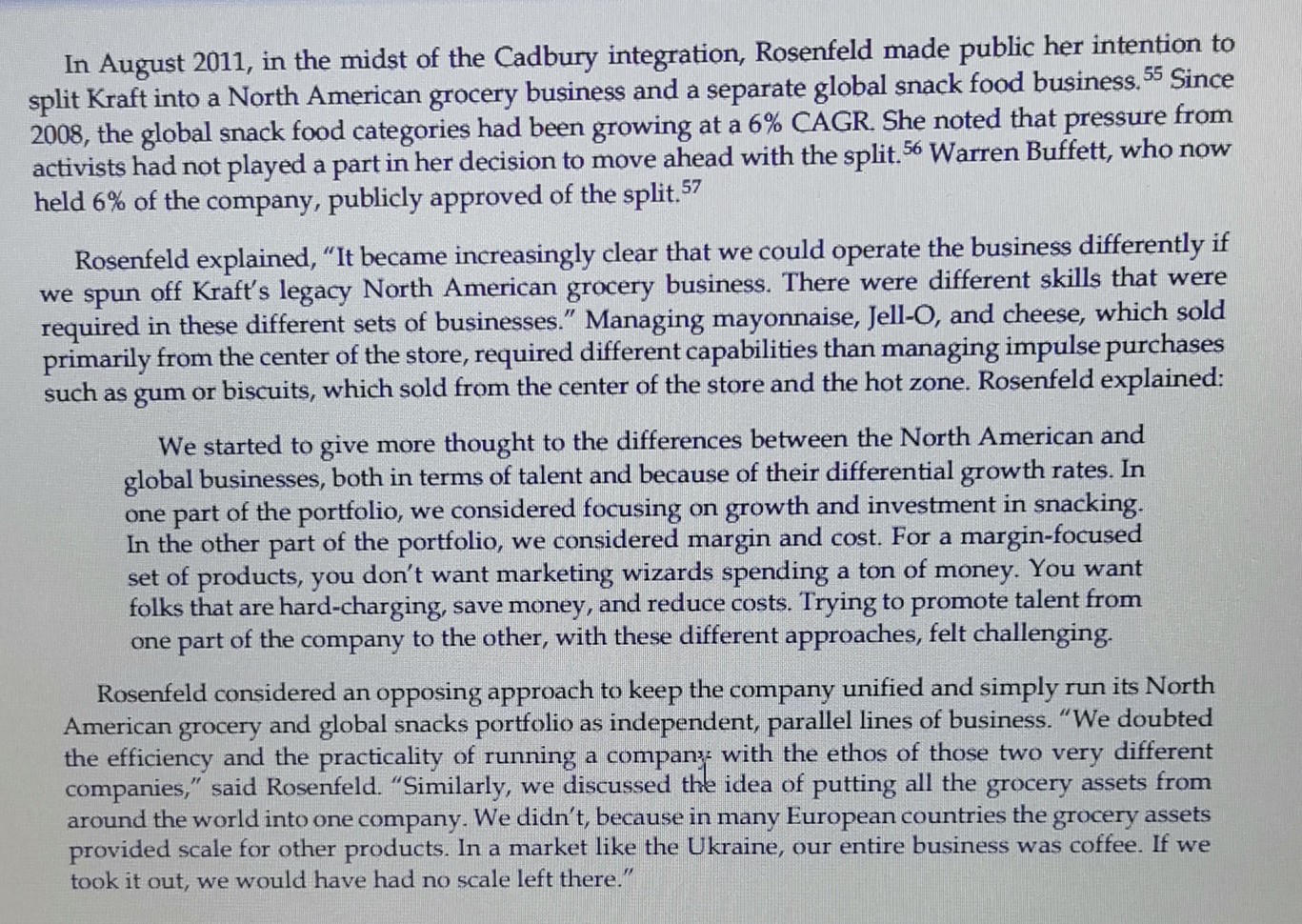
In August in the midst of the Cadbury integration, Rosenfeld made public her intention to split Kraft into a North American grocery business and a separate global snack food business. Since the global snack food categories had been growing at a CAGR. She noted that pressure from activists had not played a part in her decision to move ahead with the split. Warren Buffett, who now held of the company, publicly approved of the split.
Rosenfeld explained, It became increasingly clear that we could operate the business differently if we spun off Kraft's legacy North American grocery business. There were different skills that were required in these different sets of businesses." Managing mayonnaise, JellO and cheese, which sold primarily from the center of the store, required different capabilities than managing impulse purchases such as gum or biscuits, which sold from the center of the store and the hot zone. Rosenfeld explained:
We started to give more thought to the differences between the North American and global businesses, both in terms of talent and because of their differential growth rates. In one part of the portfolio, we considered focusing on growth and investment in snacking. In the other part of the portfolio, we considered margin and cost. For a marginfocused set of products, you don't want marketing wizards spending a ton of money. You want folks that are hardcharging, save money, and reduce costs. Trying to promote talent from one part of the company to the other, with these different approaches, felt challenging.
Rosenfeld considered an opposing approach to keep the company unified and simply run its North American grocery and global snacks portfolio as independent, parallel lines of business. We doubted the efficiency and the practicality of running a companz: with the ethos of those two very different companies," said Rosenfeld. "Similarly, we discussed the idea of putting all the grocery assets from around the world into one company. We didn't, because in many European countries the grocery assets provided scale for other products. In a market like the Ukraine, our entire business was coffee. If we took it out, we would have had no scale left there."
Step by Step Solution
There are 3 Steps involved in it
1 Expert Approved Answer
Step: 1 Unlock

Question Has Been Solved by an Expert!
Get step-by-step solutions from verified subject matter experts
Step: 2 Unlock
Step: 3 Unlock