



Question: in c++ C Chepy Study Guibeds O: Prop an L-1 doax - it x EUR C Secure | https://one drivelivecom/Edit asp sid=97FOGSFBDE1281261 LS11092&app=WordpowdPid=31fd 1d2e MWH
in c++
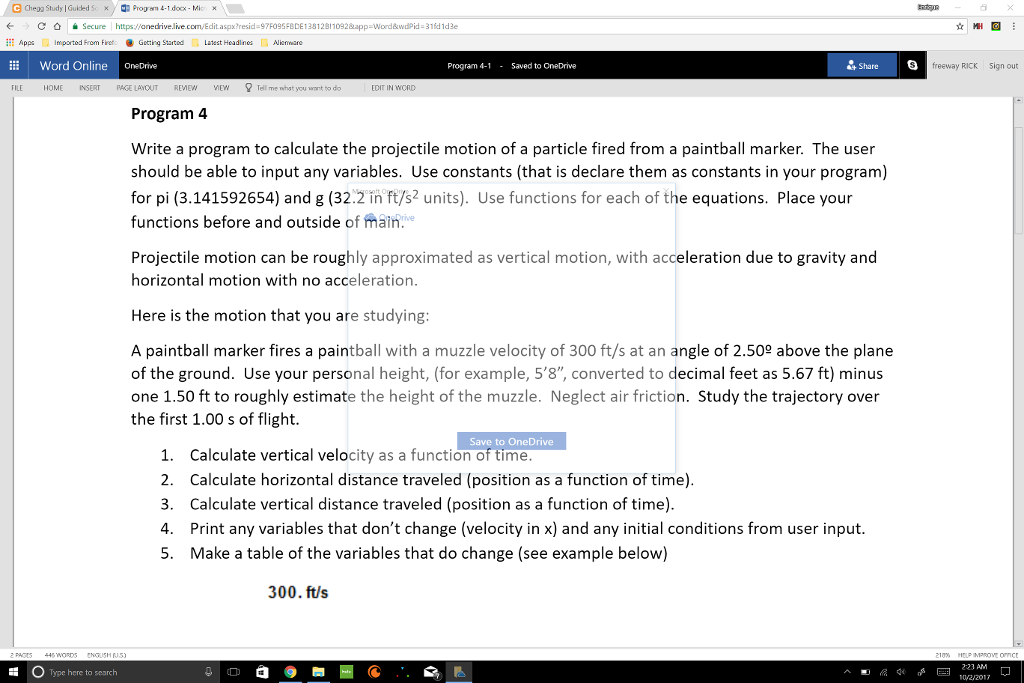
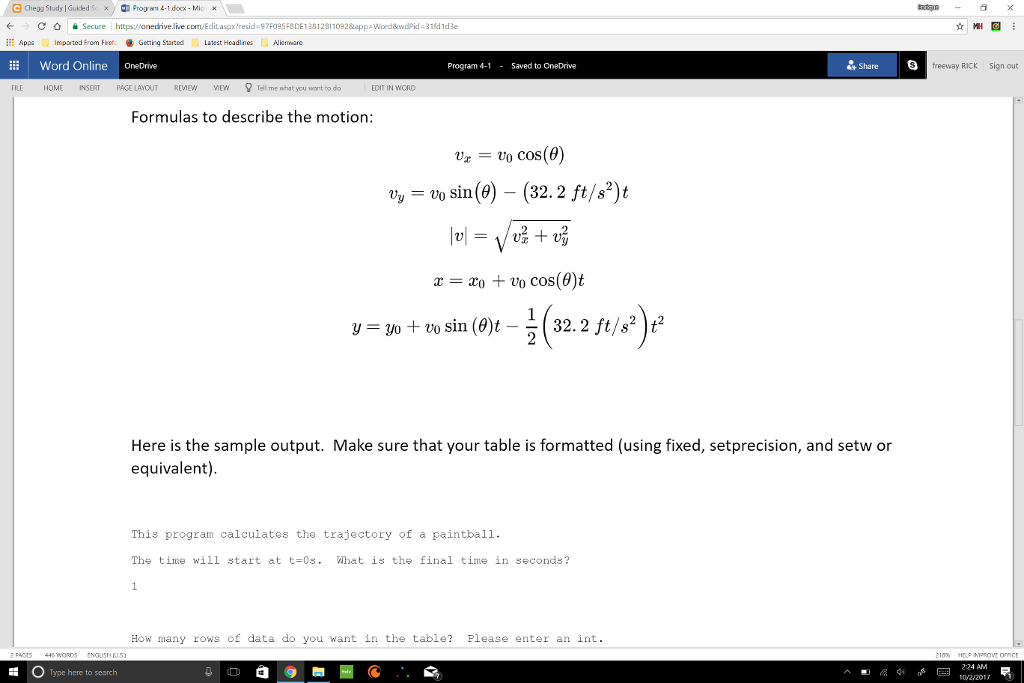
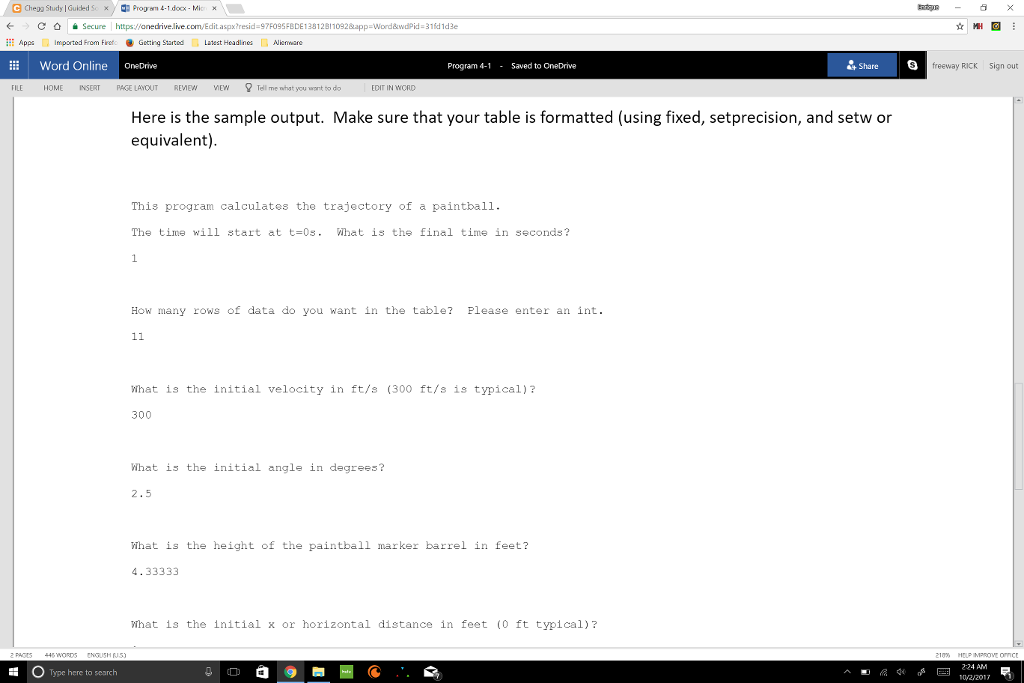
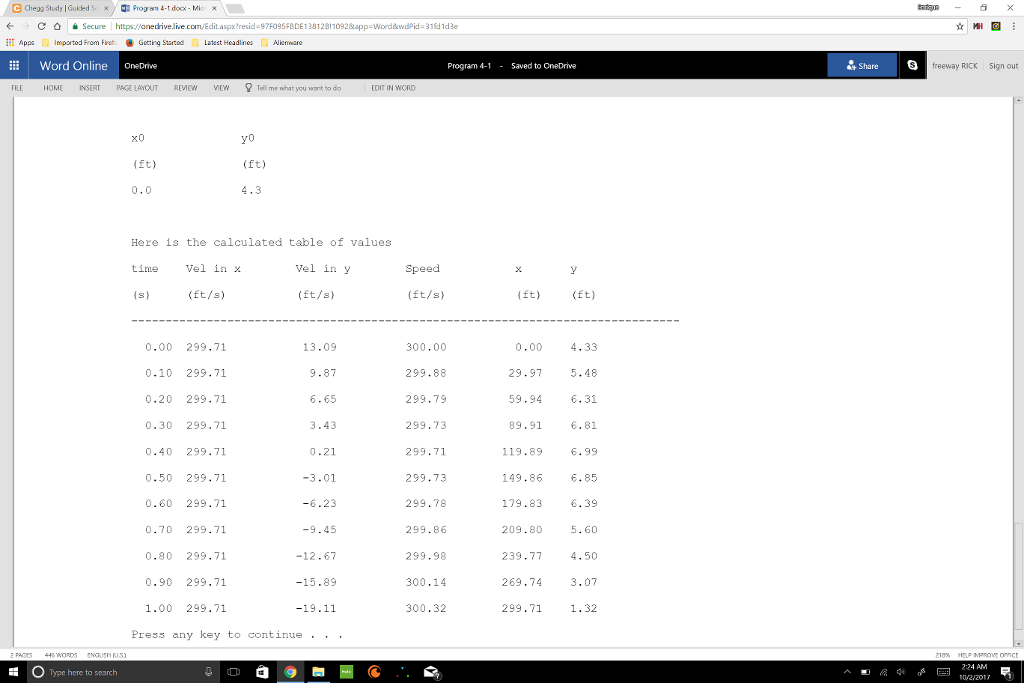
C Chepy Study Guibeds O: Prop an L-1 doax - it x EUR C Secure | https://one drivelivecom/Edit asp sid=97FOGSFBDE1281261 LS11092&app=WordpowdPid=31fd 1d2e MWH Imported from fire a Gecting started Latest Headlines Word Online OneDrive Program 4-1 - Saved to OneDrive & Share freeway RICK Sign out IOMI INSERT REVIEW what you want to do EDIT IN WORD Program 4 Write a program to calculate the projectile motion of a particle fired from a paintball markerThe user should be able to input any variables. Use constants (that is declare them as constants in your program) for pi (3.141592654) and g (32. 2 in ft/s2 units). Use functions for each of the equations. Place your functions before and outside of mainie Projectile motion can be roughly approximated as vertical motion, with acceleration due to gravity and horizontal motion with no acceleration . Here is the motion that you are studying: Save to OneDrive A paintball marker fires a paintball with a muzzle velocity of 300 ft/s at an angle of 2.50p above the plane of the ground. Use your personal height(for example, 5'8, converted to decimal feet as 5.67 ft) minus one 1.50 ft to roughly estimate the height of the muzzle. Neglect air friction. Study the trajectory over the first 1.00s of flight. 1. Calculate vertical velocity as a function of time. 2. Calculate horizontal distance traveled (position as a function of time). 3. Calculate vertical distance traveled (position as a function of time) 4. Print any variables that don't change (velocity in x) and any initial conditions from user input. 5. Make a table of the variables that do change (see example below) 300. ft/s 2-3 AM Type here to search C Chepy Study Guibeds O: Prop an L-1 doax - it x EUR C Secure | https://one drivelivecom/Edit asp sid=97FOGSFBDE1281261 LS11092&app=WordpowdPid=31fd 1d2e MWH Imported from fire a Gecting started Latest Headlines Word Online OneDrive Program 4-1 - Saved to OneDrive & Share freeway RICK Sign out IOMI INSERT REVIEW what you want to do EDIT IN WORD Program 4 Write a program to calculate the projectile motion of a particle fired from a paintball markerThe user should be able to input any variables. Use constants (that is declare them as constants in your program) for pi (3.141592654) and g (32. 2 in ft/s2 units). Use functions for each of the equations. Place your functions before and outside of mainie Projectile motion can be roughly approximated as vertical motion, with acceleration due to gravity and horizontal motion with no acceleration . Here is the motion that you are studying: Save to OneDrive A paintball marker fires a paintball with a muzzle velocity of 300 ft/s at an angle of 2.50p above the plane of the ground. Use your personal height(for example, 5'8, converted to decimal feet as 5.67 ft) minus one 1.50 ft to roughly estimate the height of the muzzle. Neglect air friction. Study the trajectory over the first 1.00s of flight. 1. Calculate vertical velocity as a function of time. 2. Calculate horizontal distance traveled (position as a function of time). 3. Calculate vertical distance traveled (position as a function of time) 4. Print any variables that don't change (velocity in x) and any initial conditions from user input. 5. Make a table of the variables that do change (see example below) 300. ft/s 2-3 AM Type here to search
Step by Step Solution
There are 3 Steps involved in it

Get step-by-step solutions from verified subject matter experts