







Question: In C++ maximum subsequence sum problem input file and algorithm: https://bit.ly/2NEpZxK algorithm is in the link. no textbook needed. 1. Description of the Assignment For
In C++ maximum subsequence sum problem
input file and algorithm: https://bit.ly/2NEpZxK algorithm is in the link. no textbook needed.
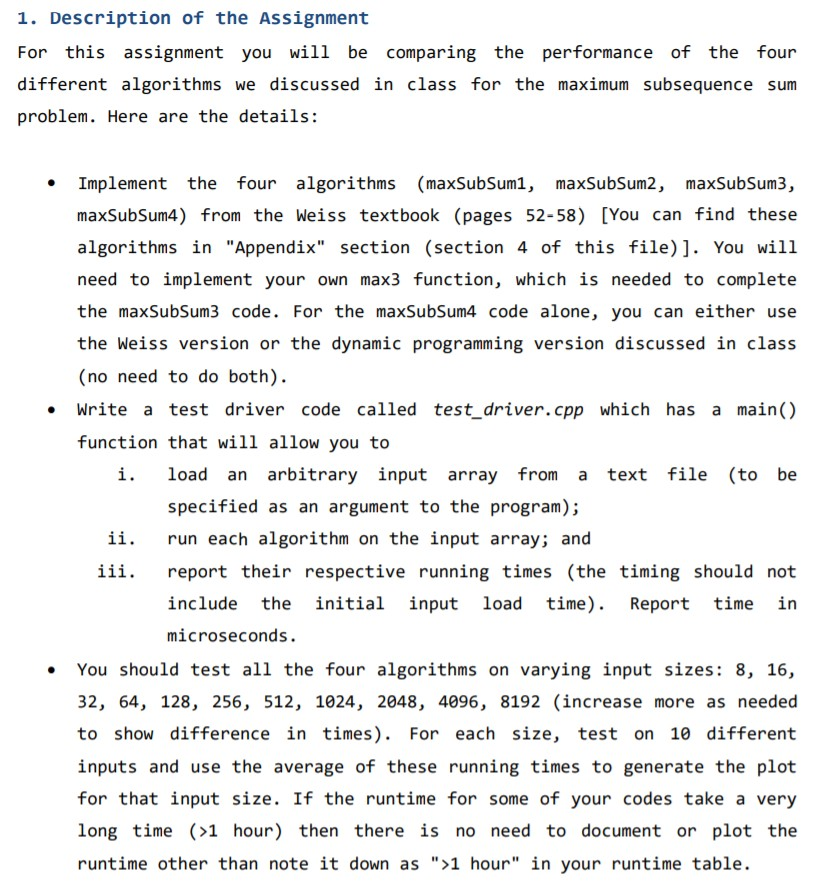
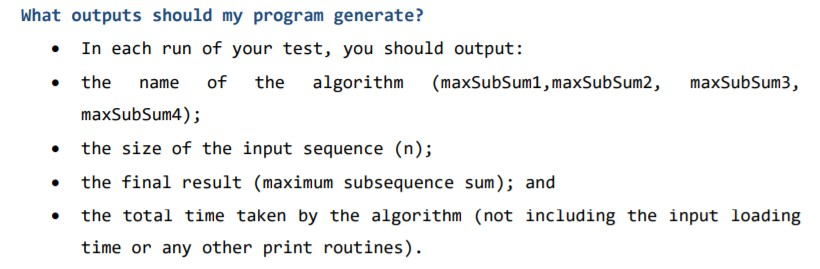
1. Description of the Assignment For this assignment you will be comparing the performance of the four ifferent algorithms we discussed in class for the maximum subsequence sum problem. Here are the details: Implement the four algorithms (maxSubSum1, maxSubSum2, maxSubSum3, maxSubSum4) from the Weiss textbook (pages 52-58) [You can find these algorithms in "Appendix" section (section 4 of this file)]. You will need to implement your own max3 function, which is needed to complete the maxSubSum3 code. For the maxSubSum4 code alone, you can either use the Weiss version or the dynamic programming version discussed in class (no need to do both) Write a test driver code called test_driver.cpp which has a main() function that will allow you to i. load an arbitrary input array from a text file (to be specified as an argument to the program); run each algorithm on the input array; and report their respective running times (the timing should not include the initial input load time). Report time in microseconds. You should test all the four algorithms on varying input sizes: 8, 16, 32, 64, 128, 256, 512, 1024, 2048, 4096, 8192 (increase more as needed to show difference in times). For each size, test on 10 different inputs and use the average of these running times to generate the plot for that input size. If the runtime for some of your codes take a very long time (1 hour) then there is no need to document or plot the runtime other than note it down as ">1 hour" in your runtime table. 1. Description of the Assignment For this assignment you will be comparing the performance of the four ifferent algorithms we discussed in class for the maximum subsequence sum problem. Here are the details: Implement the four algorithms (maxSubSum1, maxSubSum2, maxSubSum3, maxSubSum4) from the Weiss textbook (pages 52-58) [You can find these algorithms in "Appendix" section (section 4 of this file)]. You will need to implement your own max3 function, which is needed to complete the maxSubSum3 code. For the maxSubSum4 code alone, you can either use the Weiss version or the dynamic programming version discussed in class (no need to do both) Write a test driver code called test_driver.cpp which has a main() function that will allow you to i. load an arbitrary input array from a text file (to be specified as an argument to the program); run each algorithm on the input array; and report their respective running times (the timing should not include the initial input load time). Report time in microseconds. You should test all the four algorithms on varying input sizes: 8, 16, 32, 64, 128, 256, 512, 1024, 2048, 4096, 8192 (increase more as needed to show difference in times). For each size, test on 10 different inputs and use the average of these running times to generate the plot for that input size. If the runtime for some of your codes take a very long time (1 hour) then there is no need to document or plot the runtime other than note it down as ">1 hour" in your runtime table
Step by Step Solution
There are 3 Steps involved in it

Get step-by-step solutions from verified subject matter experts
 Study Help