



Question: In C or C++ Language A named pipe (FIFO) remains in the system even after your processes end. So you should delete it with the
In C or C++ Language
A named pipe (FIFO) remains in the system even after your processes end. So you should delete it with the unlink function before starting a new run. Otherwise, you could start with the FIFO in an unknown state from the previous run
- A producer process that opens a FIFO for writing will hang until a consumer process opens it for reading.
- A producer process may have written several values to a FIFO before a consumer process reads them. Check if the consumer read more than one value and be sure to print all of them. If you print the number of bytes that were read each time, you'll be able to tell how many values were read.
- A consumer process can hang after all the producer processes have finished. The other consumer processes may have read the end-of-file markers leaving this consumer process to block forever on its read. The solution is to use a non-blocking read. After opening the pipe for reading, call fcntl(fd, F_SETFL, O_NONBLOCK), where fd is the file descriptor. (You'll have to #include
) Then each time you read, the call will return immediately. Always record the size returned by the read. If the size is a positive number, you successfully read that many bytes. If the size is 0, you read an end-of-file. If the size is -1, check the system variable errno. (You'll have to #include ) If errno is equal to the system constant EAGAIN, the buffer was empty, so sleep for a second and try to read again. If errno is equal to any other value, you had a read failure.
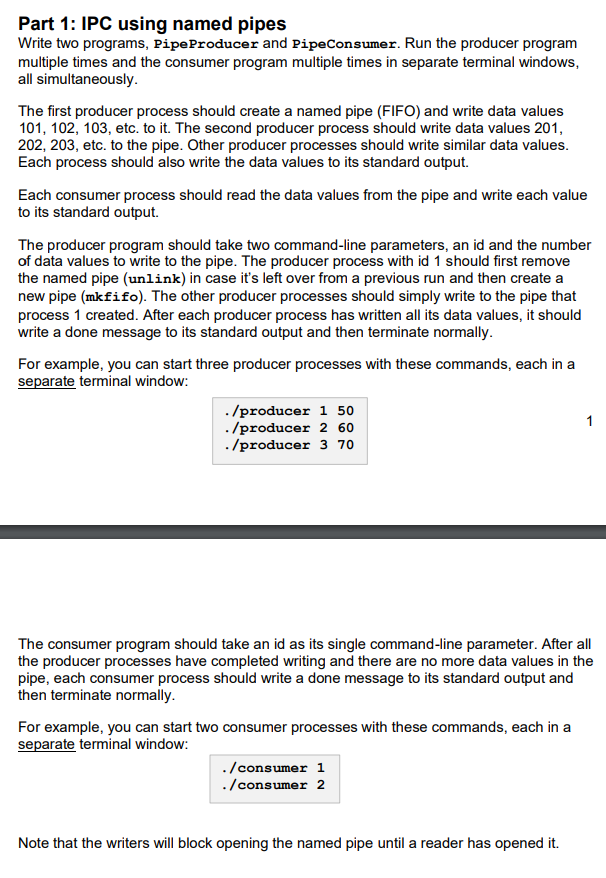
Part 1: IPC using named pipes Write two programs, Pipe Producer and Pipe Consumer. Run the producer program multiple times and the consumer program multiple times in separate terminal windows, all simultaneously. The first producer process should create a named pipe (FIFO) and write data values 101, 102, 103, etc. to it. The second producer process should write data values 201, 202, 203, etc. to the pipe. Other producer processes should write similar data values. Each process should also write the data values to its standard output. Each consumer process should read the data values from the pipe and write each value to its standard output The producer program should take two command-line parameters, an id and the number of data values to write to the pipe. The producer process with id 1 should first remove the named pipe (unlink) in case it's left over from a previous run and then create a new pipe (mkfifo). The other producer processes should simply write to the pipe that process 1 created. After each producer process has written all its data values, it should write a done message to its standard output and then terminate normally. For example, you can start three producer processes with these commands, each in a separate terminal window: ./producer 1 50 ./producer 2 60 ./producer 370 1 The consumer program should take an id as its single command-line parameter. After all the producer processes have completed writing and there are no more data values in the pipe, each consumer process should write a done message to its standard output and then terminate normally. For example, you can start two consumer processes with these commands, each in a separate terminal window: ./consumer 1 ./consumer 2 Note that the writers will block opening the named pipe until a reader has opened it. Part 1: IPC using named pipes Write two programs, Pipe Producer and Pipe Consumer. Run the producer program multiple times and the consumer program multiple times in separate terminal windows, all simultaneously. The first producer process should create a named pipe (FIFO) and write data values 101, 102, 103, etc. to it. The second producer process should write data values 201, 202, 203, etc. to the pipe. Other producer processes should write similar data values. Each process should also write the data values to its standard output. Each consumer process should read the data values from the pipe and write each value to its standard output The producer program should take two command-line parameters, an id and the number of data values to write to the pipe. The producer process with id 1 should first remove the named pipe (unlink) in case it's left over from a previous run and then create a new pipe (mkfifo). The other producer processes should simply write to the pipe that process 1 created. After each producer process has written all its data values, it should write a done message to its standard output and then terminate normally. For example, you can start three producer processes with these commands, each in a separate terminal window: ./producer 1 50 ./producer 2 60 ./producer 370 1 The consumer program should take an id as its single command-line parameter. After all the producer processes have completed writing and there are no more data values in the pipe, each consumer process should write a done message to its standard output and then terminate normally. For example, you can start two consumer processes with these commands, each in a separate terminal window: ./consumer 1 ./consumer 2 Note that the writers will block opening the named pipe until a reader has opened it
Step by Step Solution
There are 3 Steps involved in it

Get step-by-step solutions from verified subject matter experts