







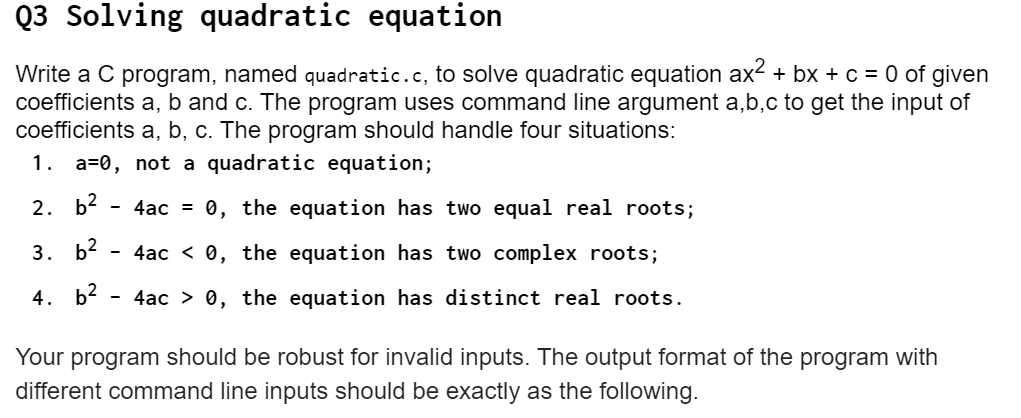
Question: in C: Output: command: gcc quadratic.c -o quadratic command: quadratic 0,1,2 (0.000000)x^2+(1.000000)x+(2.000000)=0 is not a quadratic equation command: quadratic 1,-4,4 (1.000000)x^2+(-4.000000)x+(4.000000)=0 has two equal real
in C: 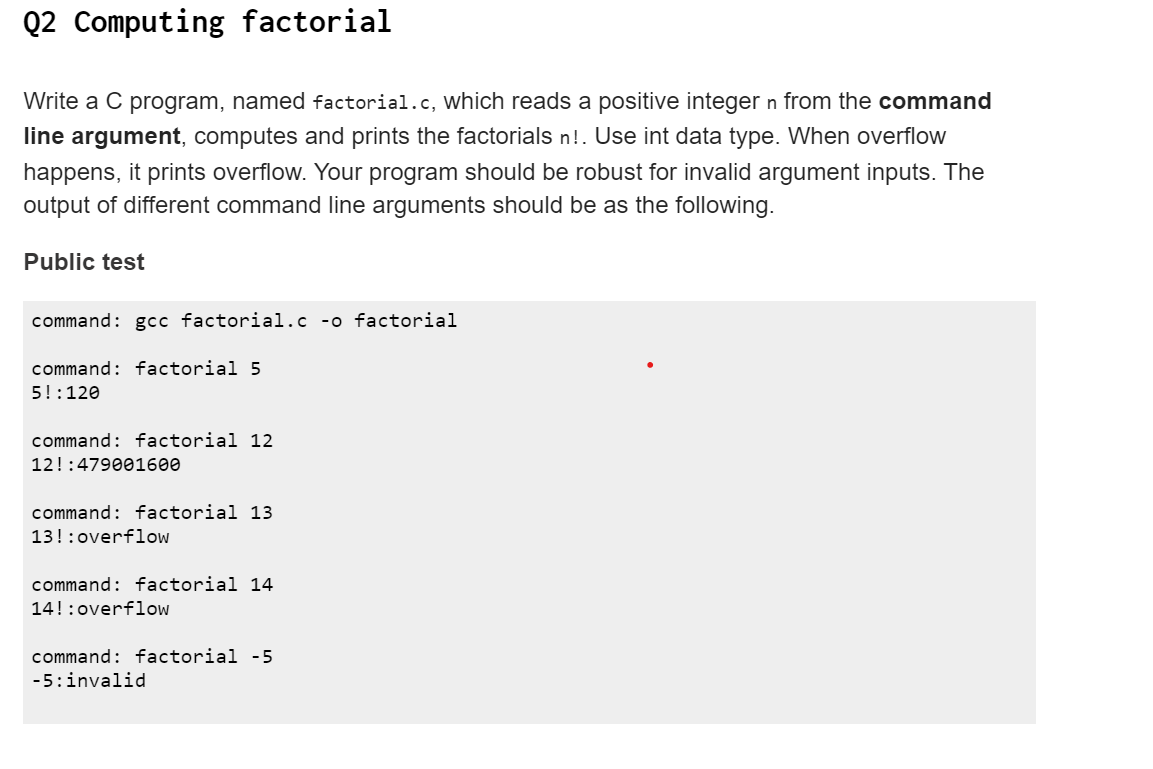
 Output:
command: gcc quadratic.c -o quadratic command: quadratic 0,1,2 (0.000000)x^2+(1.000000)x+(2.000000)=0 is not a quadratic equation command: quadratic 1,-4,4 (1.000000)x^2+(-4.000000)x+(4.000000)=0 has two equal real roots: 2.000000 command: quadratic 1,2,2 (1.000000)x^2+(2.000000)x+(2.000000)=0 has two complex roots: -1.000000+1.000000i, -1.000000-1.000000i command: quadratic 1,-1,-6 (1.000000)x^2+(-1.000000)x+(-6.000000)=0 has two distinct real roots: 3.000000, -2.000000 command: quadratic argument input:missing command: quadratic a,b,c input:invalid
Q2 Computing factorial Write a C program, named factorial.c, which reads a positive integer n from the command line argument, computes and prints the factorials n !. Use int data type. When overflow happens, it prints overflow. Your program should be robust for invalid argument inputs. The output of different command line arguments should be as the following. Write a C program, named quadratic.c, to solve quadratic equation ax2+bx+c=0 of given coefficients a,b and c. The program uses command line argument a,b,c to get the input of coefficients a, b, c. The program should handle four situations: 1. a=0, not a quadratic equation; 2. b24ac=0, the equation has two equal real roots; 3. b24ac0, the equation has distinct real roots. Your program should be robust for invalid inputs. The output format of the program with different command line inputs should be exactly as the following
Step by Step Solution
There are 3 Steps involved in it

Get step-by-step solutions from verified subject matter experts
 Study Help