







Question: IN C++. Per Cheg Rules, One question per post- questions with sub-parts are fine, but posts with multiple questions will be closed. 12. This question
IN C++. Per Cheg Rules, "One question per post- questions with sub-parts are fine, but posts with multiple questions will be closed."
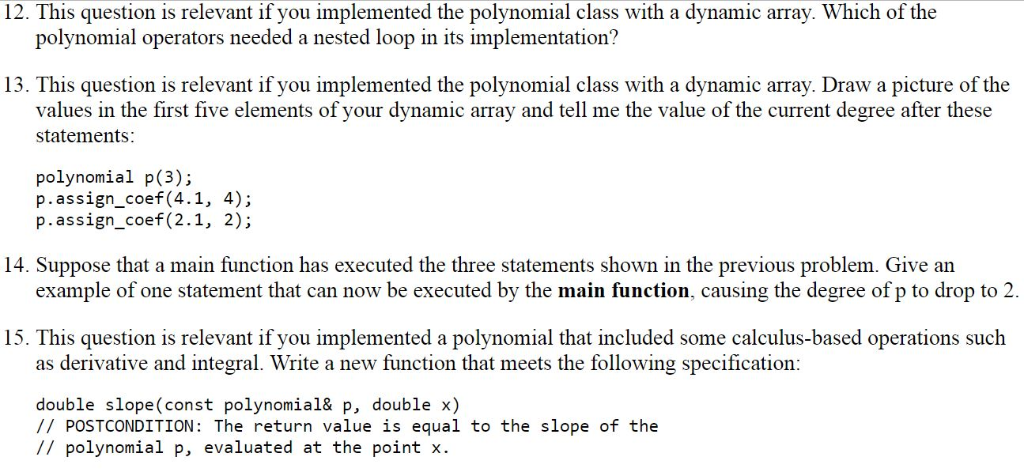
12. This question is relevant if you implemented the polynomial class with a dynamic array. Which of the polynomial operators needed a nested loop in its implementation? 13. This question is relevant if you implemented the polynomial class with a dynamic array. Draw a picture of the values in the first five elements of your dynamic array and tell me the value of the current degree after these statements polynomial p(3); p.assign_coef (4.1, 4); p.assign_coef (2.1, 2); 14. Suppose that a main function has executed the three statements shown in the previous problem. Give an example of one statement that can now be executed by the main function, causing the degree of p to drop to 2. 15. This question is relevant if you implemented a polynomial that included some calculus-based operations such as derivative and integral. Write a new function that meets the following specification: double slope (const polynomial& p, double x) // POSTCONDITION The return value is equal to the slope of the // polynomial p, evaluated at the point x. 12. This question is relevant if you implemented the polynomial class with a dynamic array. Which of the polynomial operators needed a nested loop in its implementation? 13. This question is relevant if you implemented the polynomial class with a dynamic array. Draw a picture of the values in the first five elements of your dynamic array and tell me the value of the current degree after these statements polynomial p(3); p.assign_coef (4.1, 4); p.assign_coef (2.1, 2); 14. Suppose that a main function has executed the three statements shown in the previous problem. Give an example of one statement that can now be executed by the main function, causing the degree of p to drop to 2. 15. This question is relevant if you implemented a polynomial that included some calculus-based operations such as derivative and integral. Write a new function that meets the following specification: double slope (const polynomial& p, double x) // POSTCONDITION The return value is equal to the slope of the // polynomial p, evaluated at the point x
Step by Step Solution
There are 3 Steps involved in it

Get step-by-step solutions from verified subject matter experts
 Study Help