







Question: In C + + Project Topics Topics that will be covered in this project: Linked Lists Stacks Queues Classes How is Rupee Played: 5 0
In C
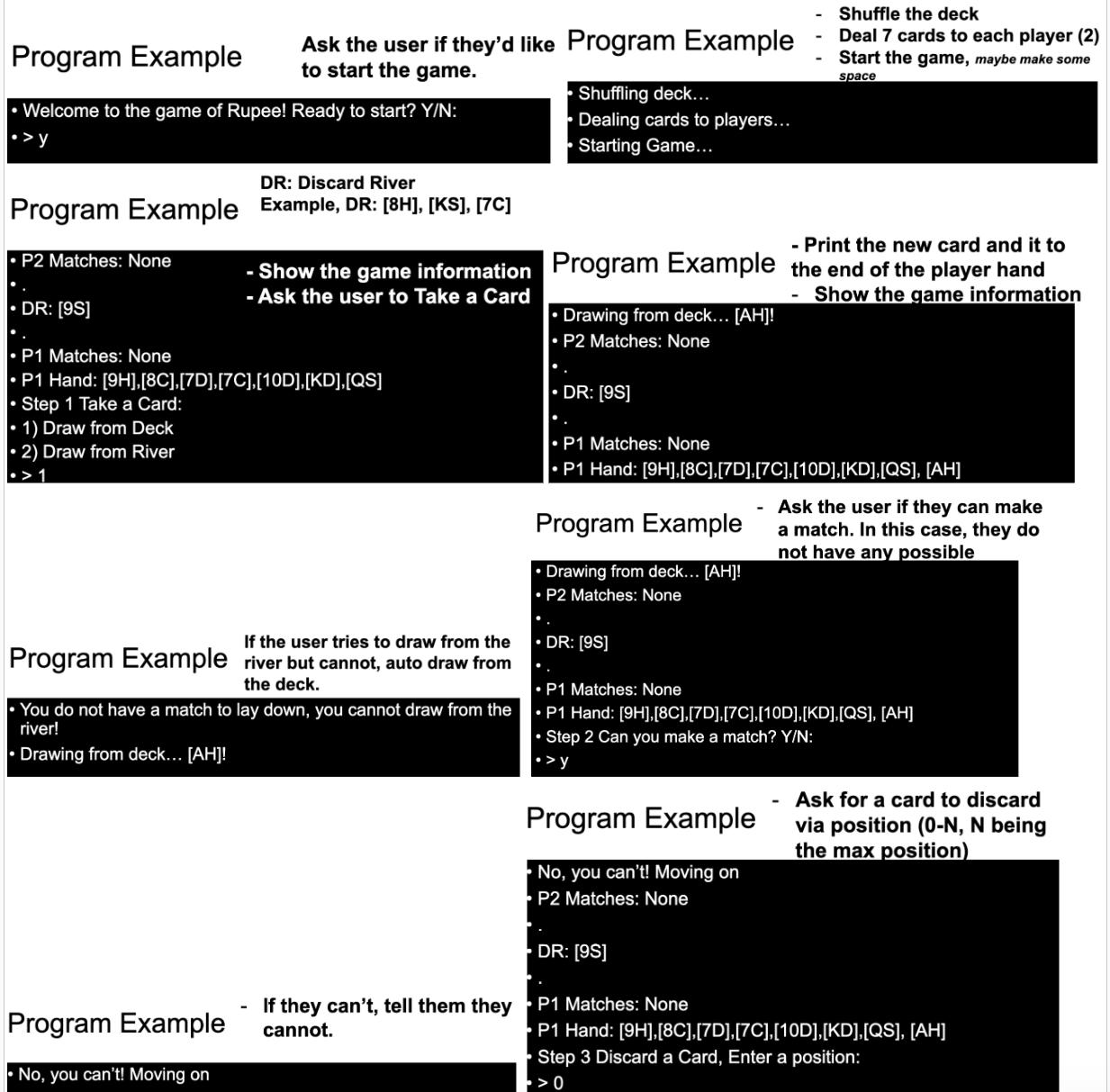
Project Topics Topics that will be covered in this project: Linked Lists Stacks Queues Classes How is Rupee Played: Rummy, the original game Rupee is based on is one where you need to match either the same value or sets of progressive values of the same suit to score points. First to wins. Each player must assess their hand as well as a river revealed cards in some sequence to make matches. If a player has a hand of cards that contains the following, they may place them down as a match, similar to Go Fish: Minimum three cards of the same value, maximum four cards. Minimum three cards of the same suit in some order, no maximum other than the cap being the high card, in this case its the Ace. How is Rupee Played? Each card has a value and a suit. Both are assessed in this game First, you start with a standard deck. A standard deck has cards. To ensure fairness, this deck must be shuffled. Or in programming terms, the order of its elements should be randomized. Each player is then given seven cards to hold in their hand. Remember, theres only cards in the deck, a finite number. After shuffling and doling out the player hands, the top card is added to the discard river. You will see how this comes into play. Each turn a player will do the following: Take a cards either from the top of the deck if nothing else can be done, or from the discard river if a match can be made that turn. Lay down any matches. During a player turn, if a match can be made, they can choose to lay it down to score points. Discard a card. At the end of every turn, the player must choose one card to add to the discard river. Card Matches: Card Matches come in two different forms: numerical, and sequential. The minimum number required to make a match for each category is three cards. The maximum number of cards in a numerical match is four. All cards must be the same numerical value but can differ in suit. The maximum number of cards in a sequential match is NA N being the starting card value, A being the highest card, the Ace. The lowest card is card value All cards in a sequential match must be the same suit and in sequential order. For example, the combination would be invalid without the value present for the sequence to be complete. Each card has a point value... Cards are worth points Cards K are worth points And Ace cards are worth points! If a player, during their turn has a match, They can lay down those cards for points. These cards are no longer in play. How to End the Round: To end the round, one player must get rid of all the cards in their hand. When the round ends, if a player has card matches laid down, they get points! See the previous slides for card point values. When the round ends, if a player has cards in their hand, they lose the point value each card holds thats in their hand. Game End: Normally, the next round would start, and the game would end when once player reaches points. In our version, we will decide the winner at the end of each round. So the goal of the game is to get rid of your cards as fast as possible, while also making as many matches as possible. In this case, Player Wins! They made the most matches and got rid of all their cards first, causing Player to lose points. Taking Cards from the Deck: Lets say the game is being played, and P wants to take a card. They can take from the discard river if what they take will make a match in their hand, in this case that is not possible. P will then choose to take a card from the deck, subtracting the total amount. You can get a match this way, its just unlikely and uncertain. P will then choose a card from their hand to discard. They do not need the H Seven of Hearts so they will add it to the front of the discard river. Taking Cards from the River: Lets say P also takes a card from the deck. They will then discard a card from their hand and add it to the discard river, just like P did previously It is now Ps turn to take a card. There is an opportunity to take from the river to lay down a match immediately! There are two aces in the discard river, and one in Ps hand. If P wants to take this ace While also taking this ace at the same time... P will need to take the entire discard river. Whenever you draw from the river, you must take everything else ahead of it Say you wanted the you would need to take the card at position one, up to the front of the discard river here its position NOTE: Players cannot start taking from the river on a card they cannot use. In this example, P would have to take the card starting at position since position has a card that cannot be used to make a match on that turn.
Step by Step Solution
There are 3 Steps involved in it
1 Expert Approved Answer
Step: 1 Unlock

Question Has Been Solved by an Expert!
Get step-by-step solutions from verified subject matter experts
Step: 2 Unlock
Step: 3 Unlock
 Study Help