







Question: In computer programming, an integer overflow occurs when an arithmetic operation attempts to create a numeric value that is outside of the range that
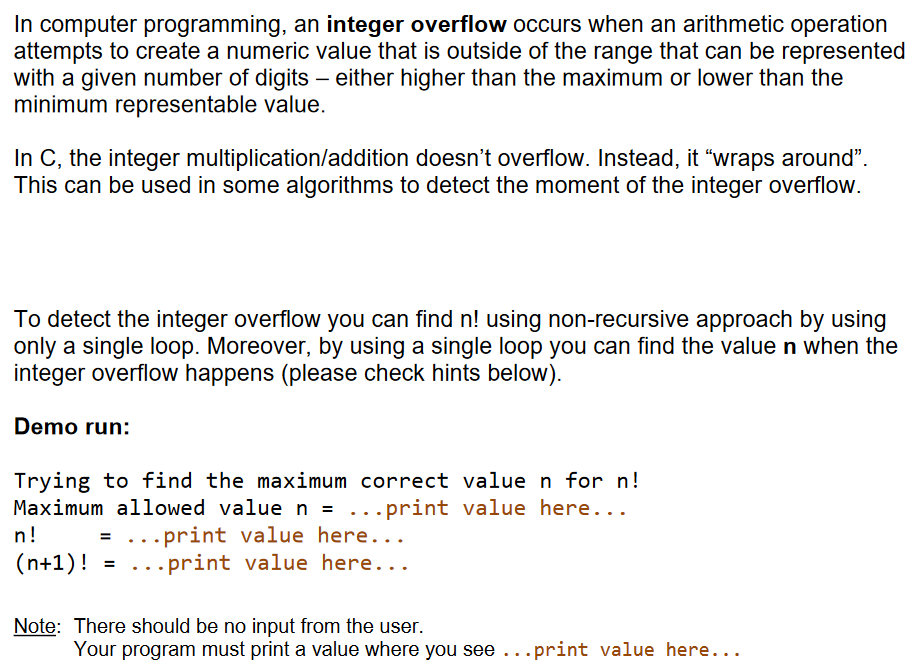
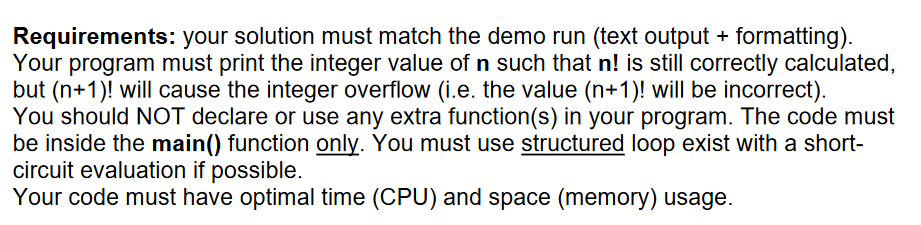
In computer programming, an integer overflow occurs when an arithmetic operation attempts to create a numeric value that is outside of the range that can be represented with a given number of digits - either higher than the maximum or lower than the minimum representable value. In C, the integer multiplication/addition doesn't overflow. Instead, it "wraps around". This can be used in some algorithms to detect the moment of the integer overflow. To detect the integer overflow you can find n! using non-recursive approach by using only a single loop. Moreover, by using a single loop you can find the value n when the integer overflow happens (please check hints below). Demo run: Trying to find the maximum correct value n for n! Maximum allowed value n = ...print value here... n! = ...print value here... (n+1)! = ..print value here... Note: There should be no input from the user. Your program must print a value where you see ...print value here... Requirements: your solution must match the demo run (text output + formatting). Your program must print the integer value of n such that n! is still correctly calculated, but (n+1)! will cause the integer overflow (i.e. the value (n+1)! will be incorrect). You should NOT declare or use any extra function(s) in your program. The code must be inside the main() function only. You must use structured loop exist with a short- circuit evaluation if possible. Your code must have optimal time (CPU) and space (memory) usage. In computer programming, an integer overflow occurs when an arithmetic operation attempts to create a numeric value that is outside of the range that can be represented with a given number of digits - either higher than the maximum or lower than the minimum representable value. In C, the integer multiplication/addition doesn't overflow. Instead, it "wraps around". This can be used in some algorithms to detect the moment of the integer overflow. To detect the integer overflow you can find n! using non-recursive approach by using only a single loop. Moreover, by using a single loop you can find the value n when the integer overflow happens (please check hints below). Demo run: Trying to find the maximum correct value n for n! Maximum allowed value n = ...print value here... n! = ...print value here... (n+1)! = ..print value here... Note: There should be no input from the user. Your program must print a value where you see ...print value here... Requirements: your solution must match the demo run (text output + formatting). Your program must print the integer value of n such that n! is still correctly calculated, but (n+1)! will cause the integer overflow (i.e. the value (n+1)! will be incorrect). You should NOT declare or use any extra function(s) in your program. The code must be inside the main() function only. You must use structured loop exist with a short- circuit evaluation if possible. Your code must have optimal time (CPU) and space (memory) usage.
Step by Step Solution
3.44 Rating (154 Votes )
There are 3 Steps involved in it
Analysis of the Images The images provide a programming problem statement about detecting integer ov... View full answer

Get step-by-step solutions from verified subject matter experts
 Study Help