







Question: in determining whether to keep or drop Craddock Cup, review the Overhead-expense allocations made from CYSL to Craddock Cup to see if they should be
in determining whether to keep or drop Craddock Cup, review the Overhead-expense allocations made from CYSL to Craddock Cup to see if they should be revised or eliminated.
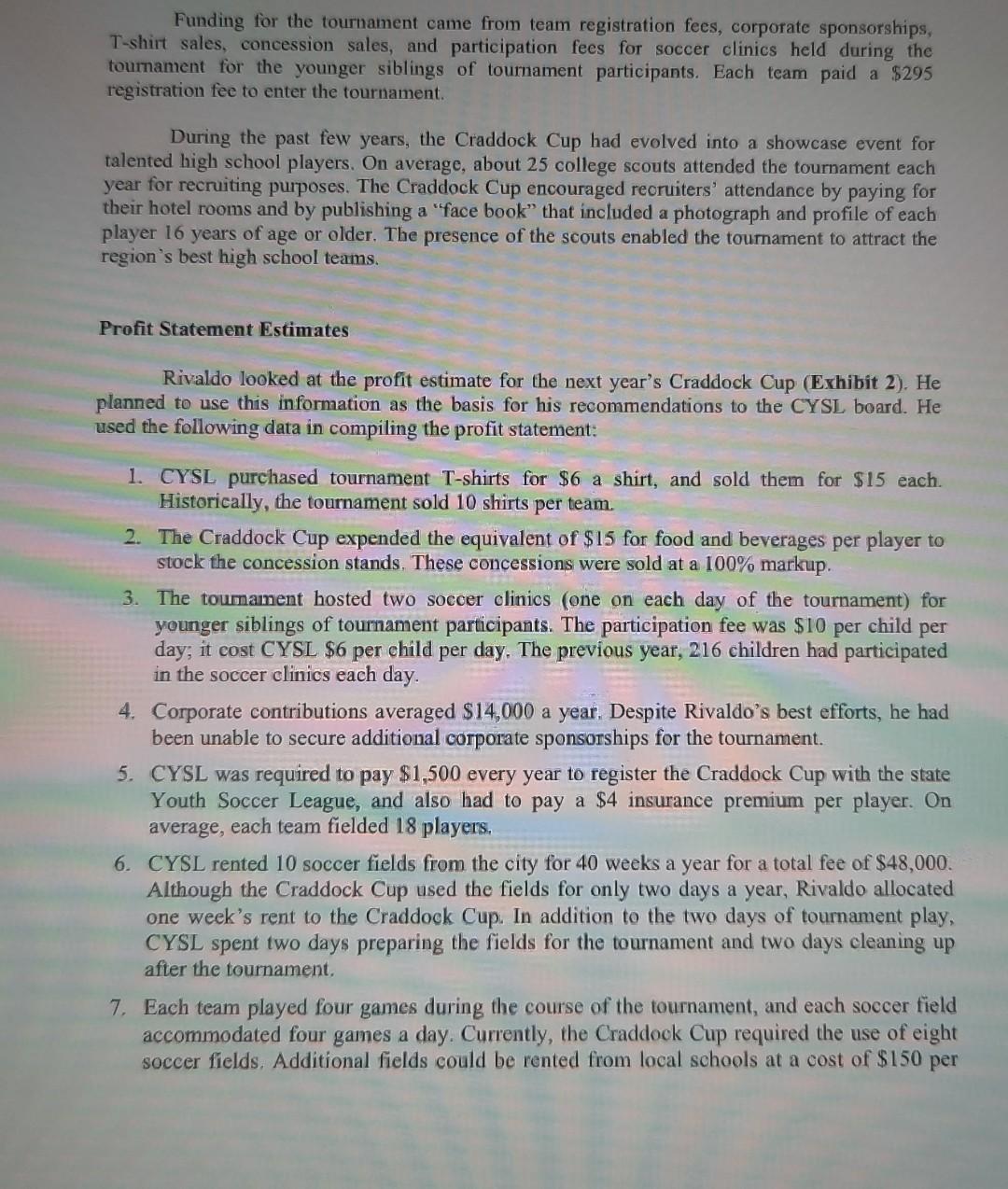
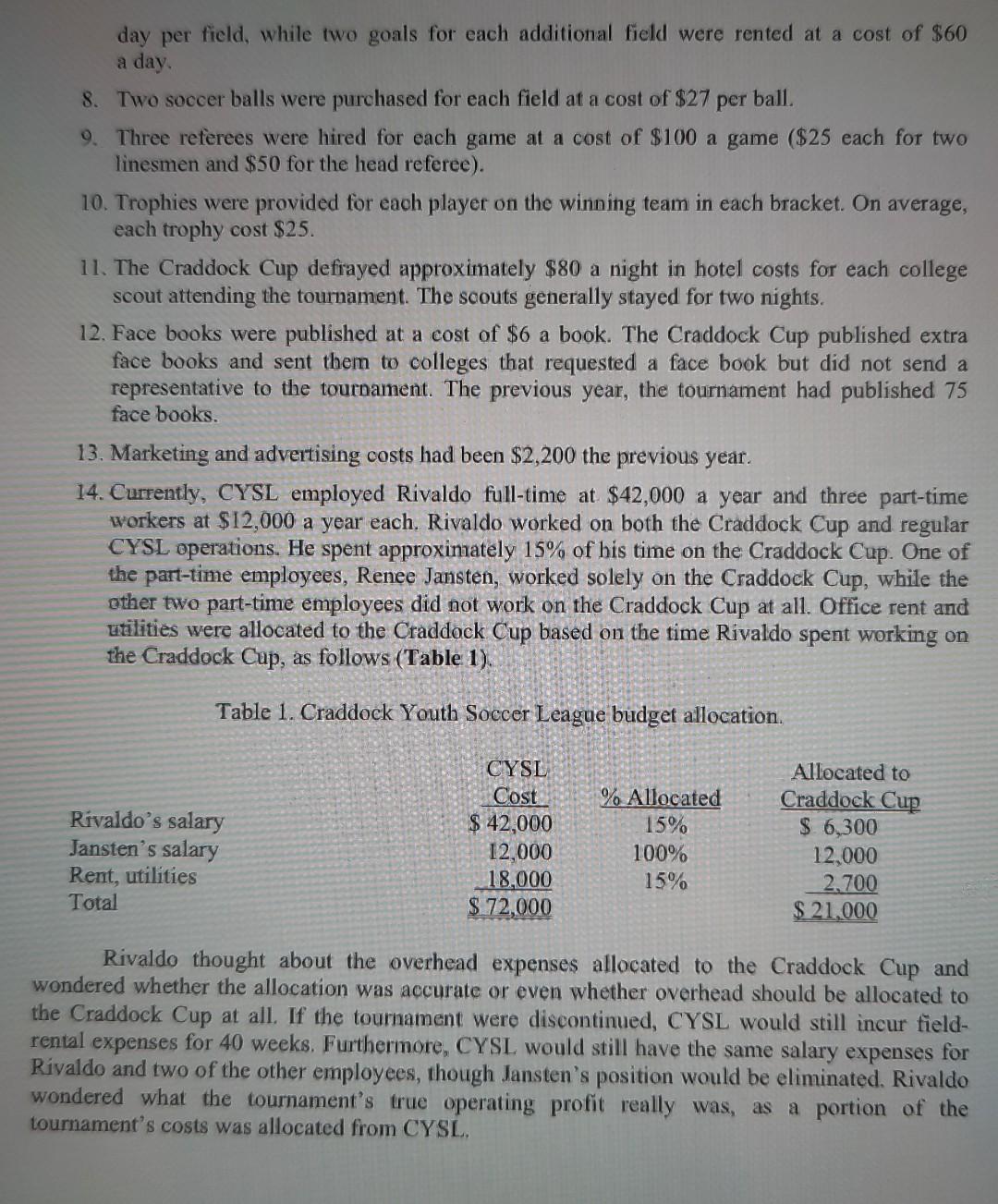
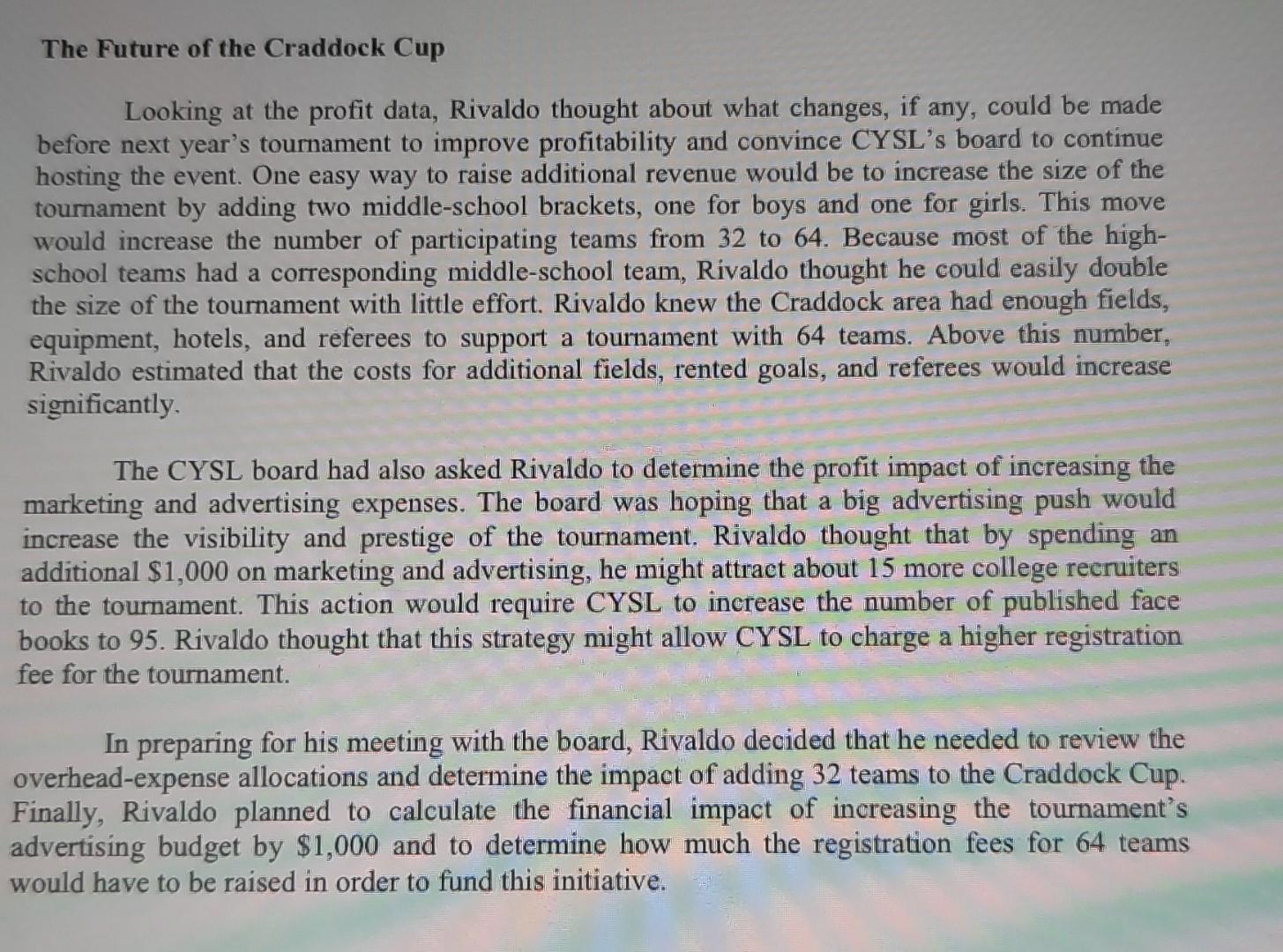
Funding for the tournament came from team registration fees, corporate sponsorships, T-shirt sales, concession sales, and participation fees for soccer clinics held during the tournament for the younger siblings of tournament participants. Each team paid a $295 registration fee to enter the tournament. During the past few years, the Craddock Cup had evolved into a showcase event for talented high school players. On average, about 25 college scouts attended the tournament each year for recruiting purposes. The Craddock Cup encouraged recruiters' attendance by paying for their hotel rooms and by publishing a "face book that included a photograph and profile of each player 16 years of age or older. The presence of the scouts enabled the tournament to attract the region's best high school teams. Profit Statement Estimates Rivaldo looked at the profit estimate for the next year's Craddock Cup (Exhibit 2). He planned to use this information as the basis for his recommendations to the CYSL board. He used the following data in compiling the profit statement: 1. CYSL purchased tournament T-shirts for $6 a shirt, and sold them for $15 each. Historically, the tournament sold 10 shirts per team. 2. The Craddock Cup expended the equivalent of $15 for food and beverages per player to stock the concession stands. These concessions were sold at a 100% markup. 3. The toumament hosted two soccer clinics (one on each day of the tournament) for younger siblings of tournament participants. The participation fee was $10 per child per day, it cost CYSL $6 per child per day. The previous year, 216 children had participated in the soccer clinics each day. 4. Corporate contributions averaged $14,000 a year. Despite Rivaldo's best efforts, he had been unable to secure additional corporate sponsorships for the tournament. 5. CYSL was required to pay $1,500 every year to register the Craddock Cup with the state Youth Soccer League, and also had to pay a $4 insurance premium per player. On average, each team fielded 18 players. 6. CYSL rented 10 soccer fields from the city for 40 weeks a year for a total fee of $48,000. Although the Craddock Cup used the fields for only two days a year, Rivaldo allocated one week's rent to the Craddock Cup. In addition to the two days of tournament play, CYSL spent two days preparing the fields for the tournament and two days cleaning up after the tournament, 7. Each team played four games during the course of the tournament, and each soccer field accommodated four games a day. Currently, the Craddock Cup required the use of eight soccer fields. Additional fields could be rented from local schools at a cost of $150 per day per field, while two goals for each additional field were rented at a cost of $60 a day. 8. Two soccer balls were purchased for each field at a cost of $27 per ball. 9. Three referees were hired for each game at a cost of $100 a game ($25 each for two linesmen and $50 for the head referee). 10. Trophies were provided for each player on the winning team in each bracket. On average, each trophy cost $25. 11. The Craddock Cup defrayed approximately $80 a night in hotel costs for each college scout attending the tournament. The scouts generally stayed for two nights. 12. Face books were published at a cost of $6 a book. The Craddock Cup published extra face books and sent them to colleges that requested a face book but did not send a representative to the tournament. The previous year, the tournament had published 75 face books. 13. Marketing and advertising costs had been $2,200 the previous year. 14. Currently, CYSL employed Rivaldo full-time at $42,000 a year and three part-time workers at $12,000 a year each. Rivaldo worked on both the Craddock Cup and regular CYSL operations. He spent approximately 15% of his time on the Craddock Cup. One of the part-time employees, Renee Jansten, worked solely on the Craddock Cup, while the other two part-time employees did not work on the Craddock Cup at all. Office rent and utilities were allocated to the Craddock Cup based on the time Rivaldo spent working on the Craddock Cup, as follows (Table 1). Table 1. Craddock Youth Soccer League budget allocation. Rivaldo's salary Jansten's salary Rent, utilities Total CYSL Cost $ 42,000 12,000 18,000 $ 72,000 % Allocated 15% 100% 15% Allocated to Craddock Cup $ 6,300 12.000 2.700 $ 21,000 Rivaldo thought about the overhead expenses allocated to the Craddock Cup and wondered whether the allocation was accurate or even whether overhead should be allocated to the Craddock Cup at all. If the tournament were discontinued, CYSL would still incur field- rental expenses for 40 weeks. Furthermore, CYSL would still have the same salary expenses for Rivaldo and two of the other employees, though Jansten's position would be eliminated, Rivaldo wondered what the tournament's true operating profit really was, as a portion of the tournament's costs was allocated from CYSL. The Future of the Craddock Cup Looking at the profit data, Rivaldo thought about what changes, if any, could be made before next year's tournament to improve profitability and convince CYSL's board to continue hosting the event. One easy way to raise additional revenue would be to increase the size of the tournament by adding two middle-school brackets, one for boys and one for girls. This move would increase the number of participating teams from 32 to 64. Because most of the high- school teams had a corresponding middle-school team, Rivaldo thought he could easily double the size of the tournament with little effort. Rivaldo knew the Craddock area had enough fields, equipment, hotels, and referees to support a tournament with 64 teams. Above this number, Rivaldo estimated that the costs for additional fields, rented goals, and referees would increase significantly The CYSL board had also asked Rivaldo to determine the profit impact of increasing the marketing and advertising expenses. The board was hoping that a big advertising push would increase the visibility and prestige of the tournament. Rivaldo thought that by spending an additional $1,000 on marketing and advertising, he might attract about 15 more college recruiters to the tournament. This action would require CYSL to increase the number of published face books to 95. Rivaldo thought that this strategy might allow CYSL to charge a higher registration fee for the tournament. In preparing for his meeting with the board, Rivaldo decided that he needed to review the overhead-expense allocations and determine the impact of adding 32 teams to the Craddock Cup. Finally, Rivaldo planned to calculate the financial impact of increasing the tournament's advertising budget by $1,000 and to determine how much the registration fees for 64 teams would have to be raised in order to fund this initiative
Step by Step Solution
There are 3 Steps involved in it

Get step-by-step solutions from verified subject matter experts
 Study Help