



Question: In Example 7, if we replace the power of the denominator from 3 to 4, our answer becomes? The question of Sometimes we simply proceed
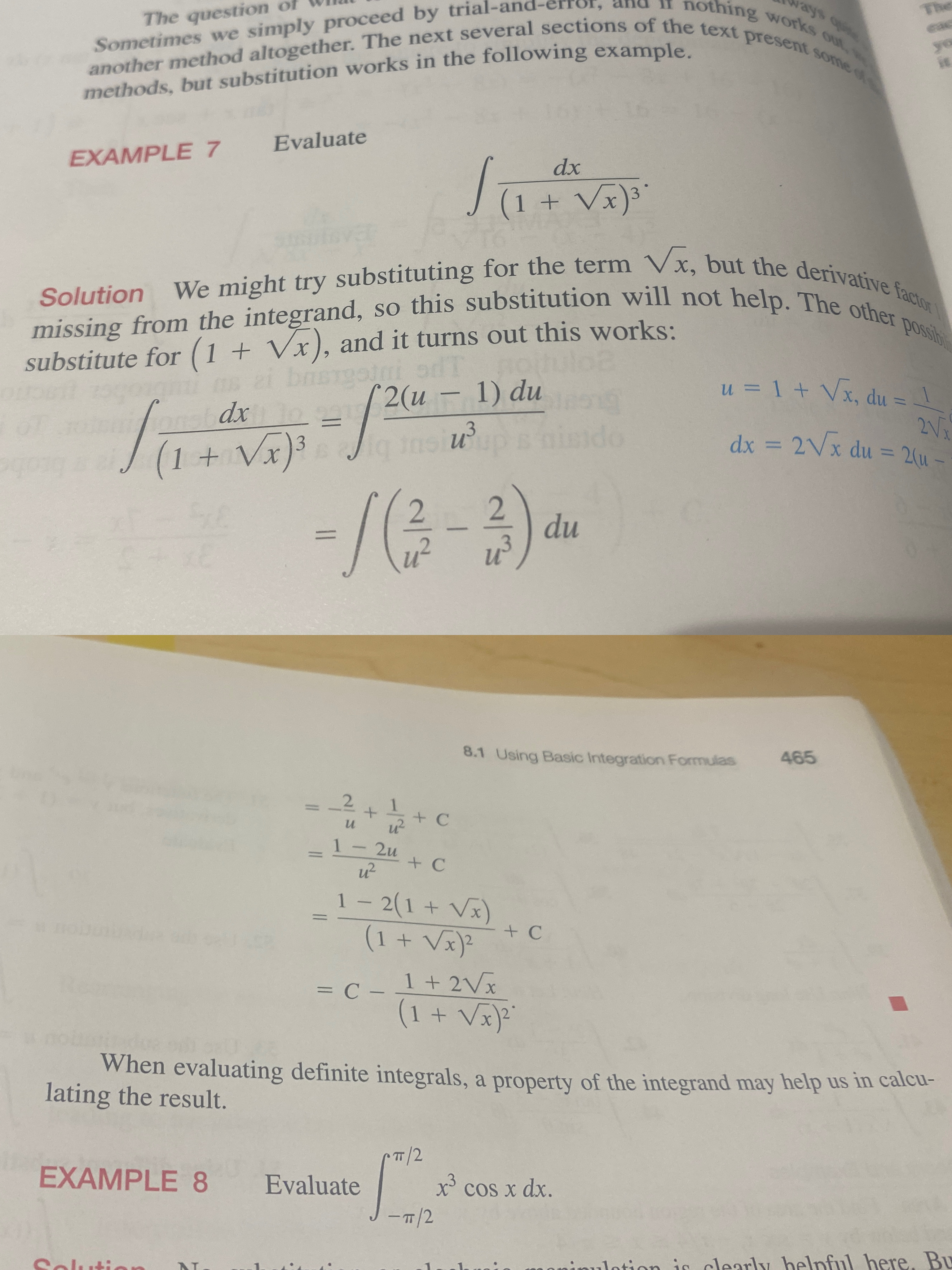
In Example 7, if we replace the power of the denominator from 3 to 4, our answer becomes?
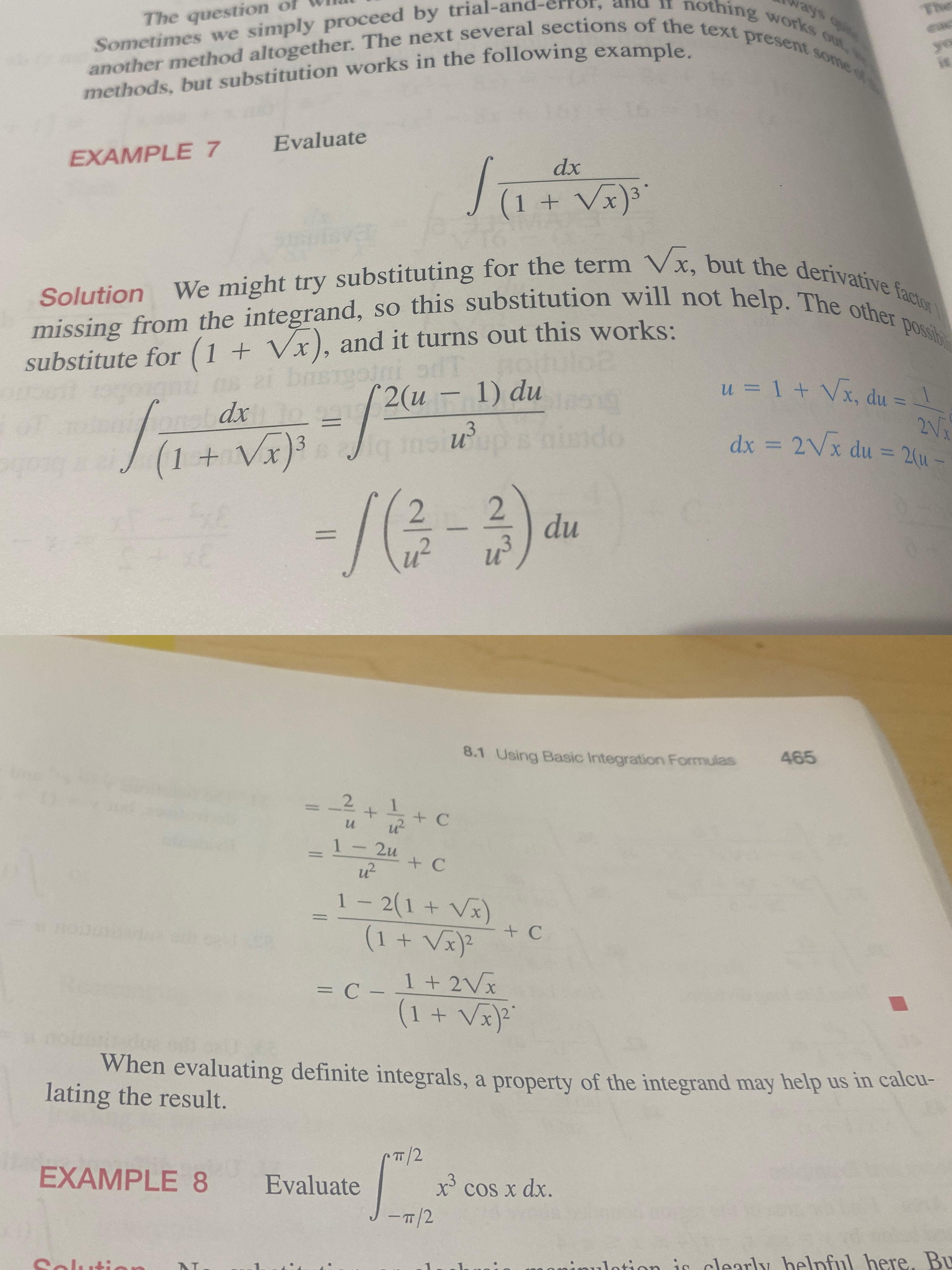
The question of Sometimes we simply proceed by trial-and-e nothing works out, another method altogether. The next several sections of the tent present som methods, but substitution works in the following example. EXAMPLE 7 Evaluate dx ( 1 + V x) 3. Solution We might try substituting for the term V x, but the derivative fact missing from the integrand, so this substitution will not help. The other possi substitute for ( 1 + Vx ), and it turns out this works: dx "2(u - 1) du u = 1 + V x, du = 1 ( 1 + V x ) 3 lig ins wup s'ninido 2Vx dx = 2V x du = 2(u - -J( - 3) du 8.1 Using Basic Integration Formulas 465 u 4 2 + C = 1 - 2u + C 1- 2( 1 + Vx) (1 + Vx ) 2 + C = C _ 1+2Vx ( 1 + V x) 2 lating the result. When evaluating definite integrals, a property of the integrand may help us in calcu- . TT / 2 EXAMPLE 8 Evaluate x' cos x dx. TT / 2 BI
Step by Step Solution
There are 3 Steps involved in it

Get step-by-step solutions from verified subject matter experts