







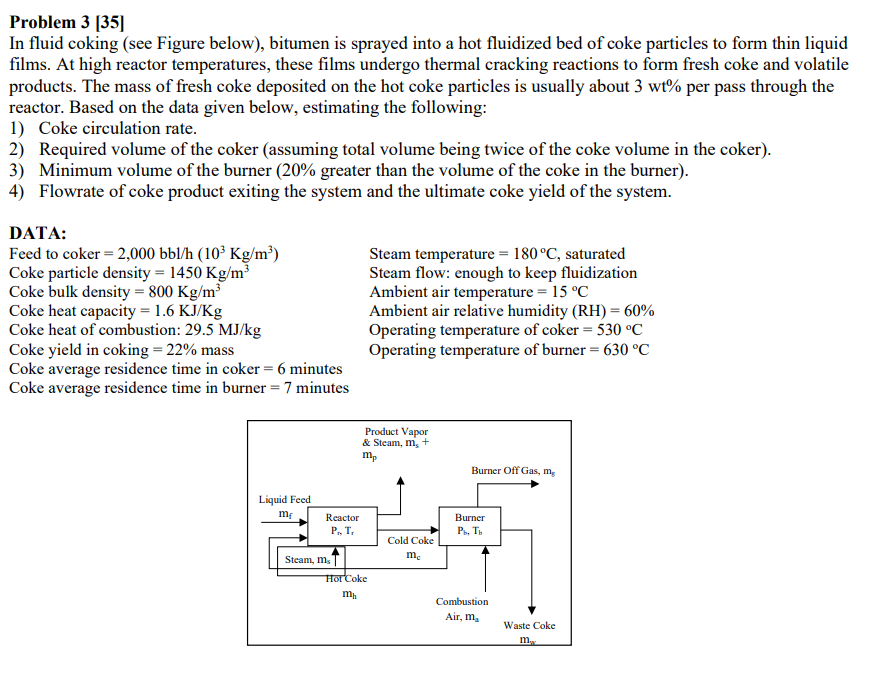
Question: In fluid coking ( see Figure below ) , bitumen is sprayed into a hot fluidized bed of coke particles to form thin liquid films.
In fluid coking see Figure below bitumen is sprayed into a hot fluidized bed of coke particles to form thin liquid
films. At high reactor temperatures, these films undergo thermal cracking reactions to form fresh coke and volatile
products. The mass of fresh coke deposited on the hot coke particles is usually about wt per pass through the
reactor. Based on the data given below, estimating the following:
Coke circulation rate.
Required volume of the coker assuming total volume being twice of the coke volume in the coker
Minimum volume of the burner greater than the volume of the coke in the burner
Flowrate of coke product exiting the system and the ultimate coke yield of the system.
DATA:
Feed to coker bblh
Kgm
Steam temperature oC saturated
Coke particle density Kgm
Steam flow: enough to keep fluidization
Coke bulk density Kgm
Ambient air temperature oC
Coke heat capacity KJKg Ambient air relative humidity RH
Coke heat of combustion: MJkg Operating temperature of coker oC
Coke yield in coking mass Operating temperature of burner oC
Coke average residence time in coker minutes
Coke average residence time in burner minutes
Step by Step Solution
There are 3 Steps involved in it
1 Expert Approved Answer
Step: 1 Unlock

Question Has Been Solved by an Expert!
Get step-by-step solutions from verified subject matter experts
Step: 2 Unlock
Step: 3 Unlock
 Study Help