







Question: In general for a binary gas, we know that at an elevated temperature T and a reduced pressure P, its diffusion coefficient DAB roughly
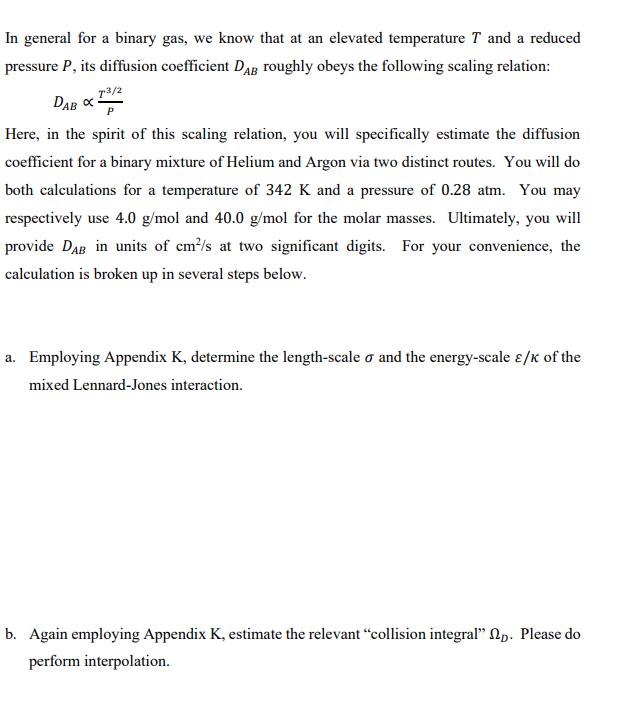
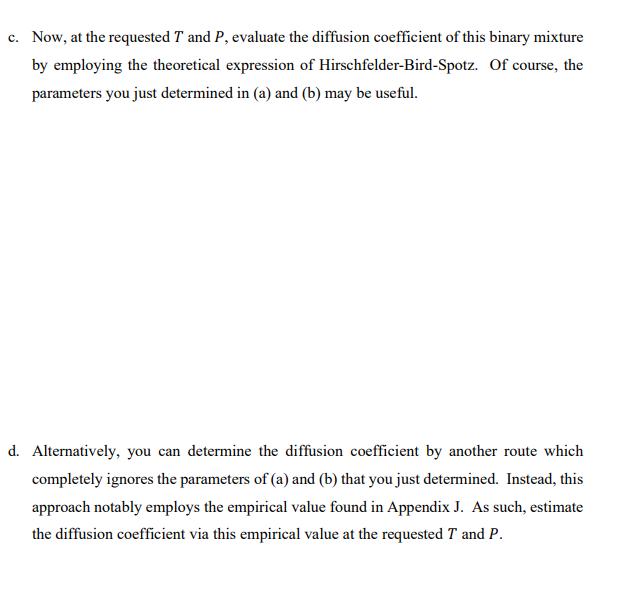
In general for a binary gas, we know that at an elevated temperature T and a reduced pressure P, its diffusion coefficient DAB roughly obeys the following scaling relation: DAB & T 73/2 Here, in the spirit of this scaling relation, you will specifically estimate the diffusion coefficient for a binary mixture of Helium and Argon via two distinct routes. You will do both calculations for a temperature of 342 K and a pressure of 0.28 atm. You may respectively use 4.0 g/mol and 40.0 g/mol for the molar masses. Ultimately, you will provide DAB in units of cm/s at two significant digits. For your convenience, the calculation is broken up in several steps below. a. Employing Appendix K, determine the length-scale o and the energy-scale e/k of the mixed Lennard-Jones interaction. b. Again employing Appendix K, estimate the relevant "collision integral" p. Please do perform interpolation. c. Now, at the requested T and P, evaluate the diffusion coefficient of this binary mixture by employing the theoretical expression of Hirschfelder-Bird-Spotz. Of course, the parameters you just determined in (a) and (b) may be useful. d. Alternatively, you can determine the diffusion coefficient by another route which completely ignores the parameters of (a) and (b) that you just determined. Instead, this approach notably employs the empirical value found in Appendix J. As such, estimate the diffusion coefficient via this empirical value at the requested T and P.
Step by Step Solution
There are 3 Steps involved in it

Get step-by-step solutions from verified subject matter experts
 Study Help