







Question: In image processing, the Prewitt operator is used for edge detection. You can skip all the math below if you don't care; you don't need
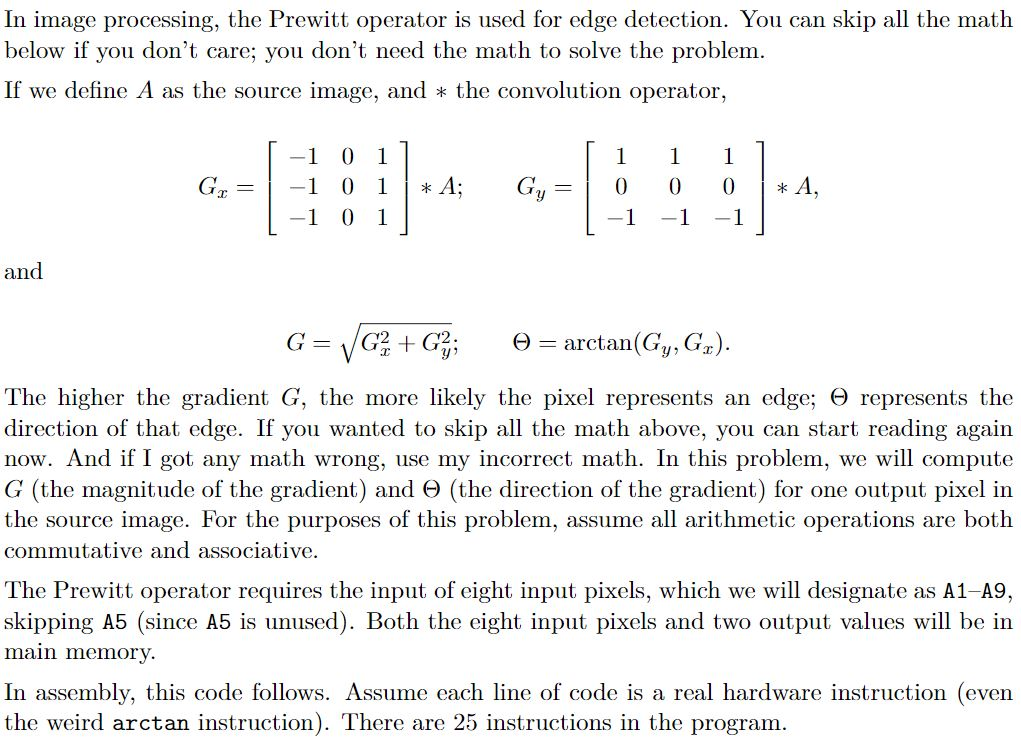
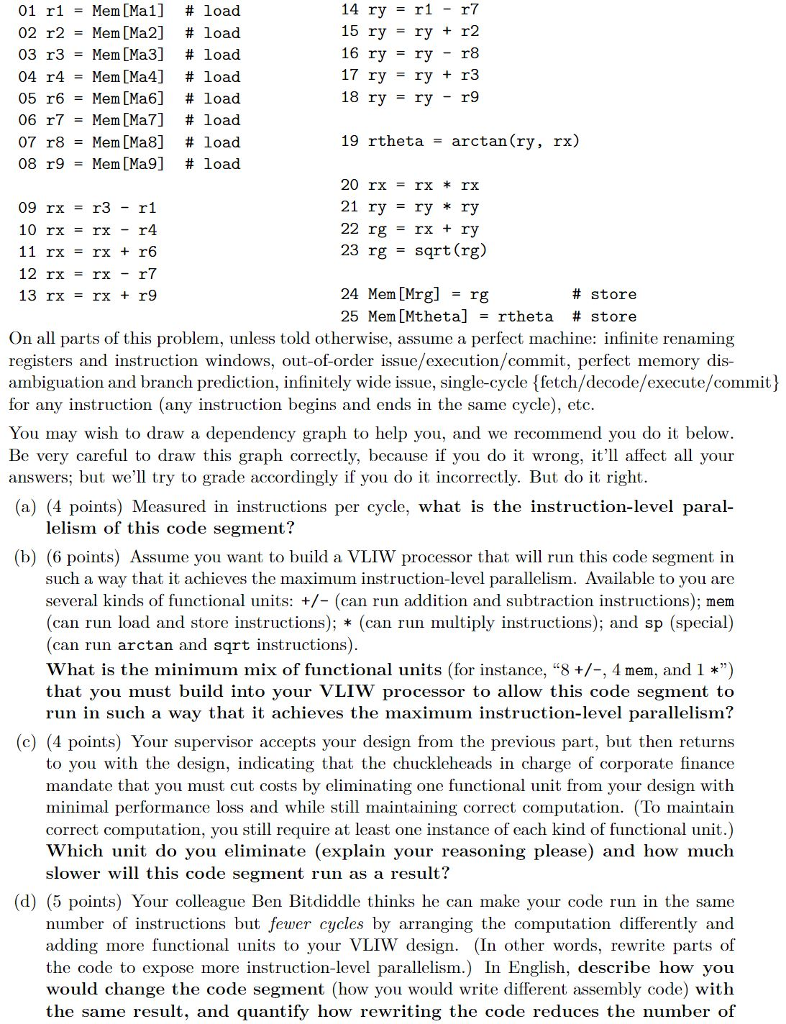

In image processing, the Prewitt operator is used for edge detection. You can skip all the math below if you don't care; you don't need the math to solve the problem. If we define A as the source image, and the convolution operator, 1 0 1 G-1 01A; 1 0 1 an - arctan The higher the gradient G, the more likely the pixel represents an edge: ? represents the direction of that edge. If you wanted to skip all the math above, you can start reading again now. And if I got any math wrong, use my incorrect math. In this problem, we will compute G (the magnitude of the gradient) and ? (the direction of the gradient) for one output pixel in the source image. For the purposes of this problem, assume all arithmetic operations are both commutative and associative. The Prewitt operator requires the input of eight input pixels, which we will designate as A1-A9, skipping A5 (since A5 is unused). Both the eight input pixels and two output values will be in main memory. In assembly, this code follows. Assume each line of code is a real hardware instruction (even the weird arctan instruction). There are 25 instructions in the program In image processing, the Prewitt operator is used for edge detection. You can skip all the math below if you don't care; you don't need the math to solve the problem. If we define A as the source image, and the convolution operator, 1 0 1 G-1 01A; 1 0 1 an - arctan The higher the gradient G, the more likely the pixel represents an edge: ? represents the direction of that edge. If you wanted to skip all the math above, you can start reading again now. And if I got any math wrong, use my incorrect math. In this problem, we will compute G (the magnitude of the gradient) and ? (the direction of the gradient) for one output pixel in the source image. For the purposes of this problem, assume all arithmetic operations are both commutative and associative. The Prewitt operator requires the input of eight input pixels, which we will designate as A1-A9, skipping A5 (since A5 is unused). Both the eight input pixels and two output values will be in main memory. In assembly, this code follows. Assume each line of code is a real hardware instruction (even the weird arctan instruction). There are 25 instructions in the program
Step by Step Solution
There are 3 Steps involved in it

Get step-by-step solutions from verified subject matter experts
 Study Help