







Question: IN JAVA A bucket sort begins with a one-dimensional array of positive integers to be sorted and a two- dimensional array of integers with rows
IN JAVA
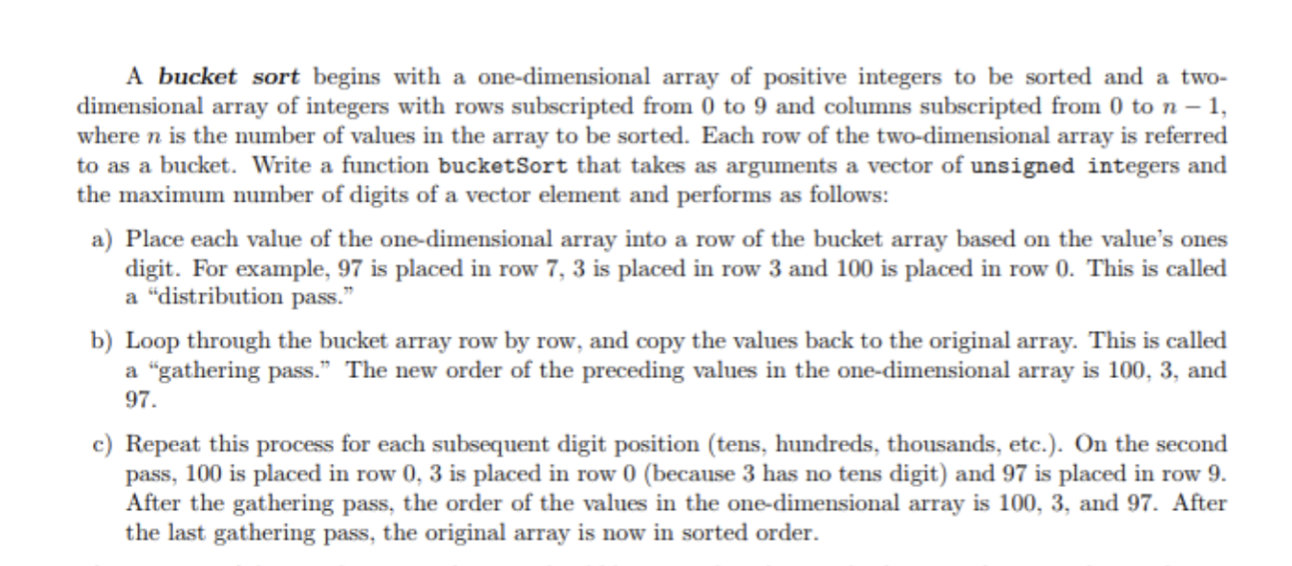
A bucket sort begins with a one-dimensional array of positive integers to be sorted and a two- dimensional array of integers with rows subscripted from 0 to 9 and columns subscripted from 0 to n-1, where n is the number of values in the array to be sorted. Each row of the two-dimensional array is referred to as a bucket. Write a function bucketSort that takes as arguments a vector of unsigned integers and the maximum number of digits of a vector element and performs as follows: a) Place each value of the one-dimensional array into a row of the bucket array based on the value's ones digit. For example, 97 is placed in row 7, 3 is placed in row 3 and 100 is placed in row 0. This is called a "distribution pass." b) Loop through the bucket array row by row, and copy the values back to the original array. This is called a "gathering pass." The new order of the preceding values in the one-dimensional array is 100, 3, and 97. c) Repeat this process for each subsequent digit position (tens, hundreds, thousands, etc.). On the second pass, 100 is placed in row 0, 3 is placed in row 0 (because 3 has no tens digit) and 97 is placed in row 9. After the gathering pass, the order of the values in the one-dimensional array is 100, 3, and 97. After the last gathering pass, the original array is now in sorted order. A bucket sort begins with a one-dimensional array of positive integers to be sorted and a two- dimensional array of integers with rows subscripted from 0 to 9 and columns subscripted from 0 to n-1, where n is the number of values in the array to be sorted. Each row of the two-dimensional array is referred to as a bucket. Write a function bucketSort that takes as arguments a vector of unsigned integers and the maximum number of digits of a vector element and performs as follows: a) Place each value of the one-dimensional array into a row of the bucket array based on the value's ones digit. For example, 97 is placed in row 7, 3 is placed in row 3 and 100 is placed in row 0. This is called a "distribution pass." b) Loop through the bucket array row by row, and copy the values back to the original array. This is called a "gathering pass." The new order of the preceding values in the one-dimensional array is 100, 3, and 97. c) Repeat this process for each subsequent digit position (tens, hundreds, thousands, etc.). On the second pass, 100 is placed in row 0, 3 is placed in row 0 (because 3 has no tens digit) and 97 is placed in row 9. After the gathering pass, the order of the values in the one-dimensional array is 100, 3, and 97. After the last gathering pass, the original array is now in sorted order
Step by Step Solution
There are 3 Steps involved in it

Get step-by-step solutions from verified subject matter experts
 Study Help