







Question: In Java ... Only question 6B The affine is a type of monoalphabetic substitution cipher, where each letter in an alphabet is mapped to its
In Java ... Only question 6B
 The affine is a type of monoalphabetic substitution cipher, where each letter in an alphabet is mapped to its numeric equivalent, encrypted using a simple mathematical function, and converted back to a letter.
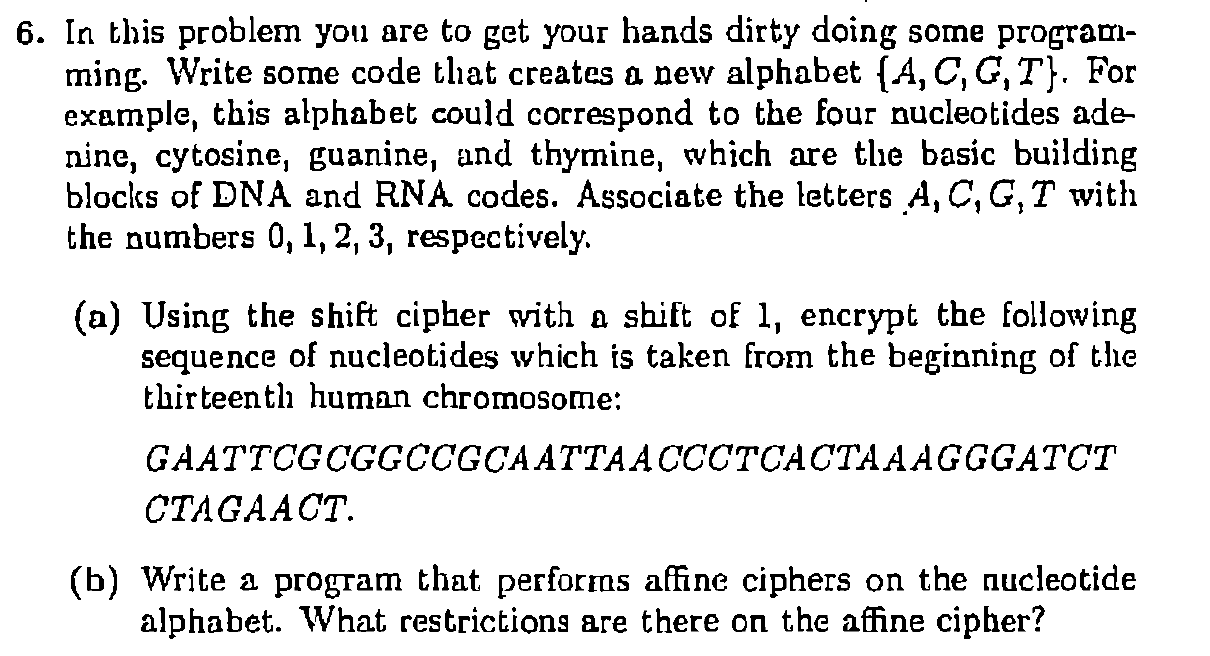
6. In this problem you are to get your hands dirty doing some program- ming. Write some code that creates a new alphabet (A,C, G,T). For example, this alphabet could correspond to the four nucleotides ade nine, cytosine, guanine, and thymine, which are the basic building blocks of DNA and RNA codes. Associate the letters A, C,G,T with the numbers 0, 1, 2, 3, respectively. (a) Using the shift cipher with a shift of 1, encrypt the following sequence of nucleotides which is taken from the beginning of the thirteenth human chromosome: GAATTCGCGGCCGCAATTAACCCTCACTAAAGGGATCT CTAGAACT. (b) Write a program that performs affine ciphers on the nucleotide alphabet. What restrictions are there on the affine cipher? 6. In this problem you are to get your hands dirty doing some program- ming. Write some code that creates a new alphabet (A,C, G,T). For example, this alphabet could correspond to the four nucleotides ade nine, cytosine, guanine, and thymine, which are the basic building blocks of DNA and RNA codes. Associate the letters A, C,G,T with the numbers 0, 1, 2, 3, respectively. (a) Using the shift cipher with a shift of 1, encrypt the following sequence of nucleotides which is taken from the beginning of the thirteenth human chromosome: GAATTCGCGGCCGCAATTAACCCTCACTAAAGGGATCT CTAGAACT. (b) Write a program that performs affine ciphers on the nucleotide alphabet. What restrictions are there on the affine cipher
Step by Step Solution
There are 3 Steps involved in it

Get step-by-step solutions from verified subject matter experts
 Study Help