







Question: In many practical applications, we use variable electric current I(t), that is, the current that changes with time t. A couple of examples that
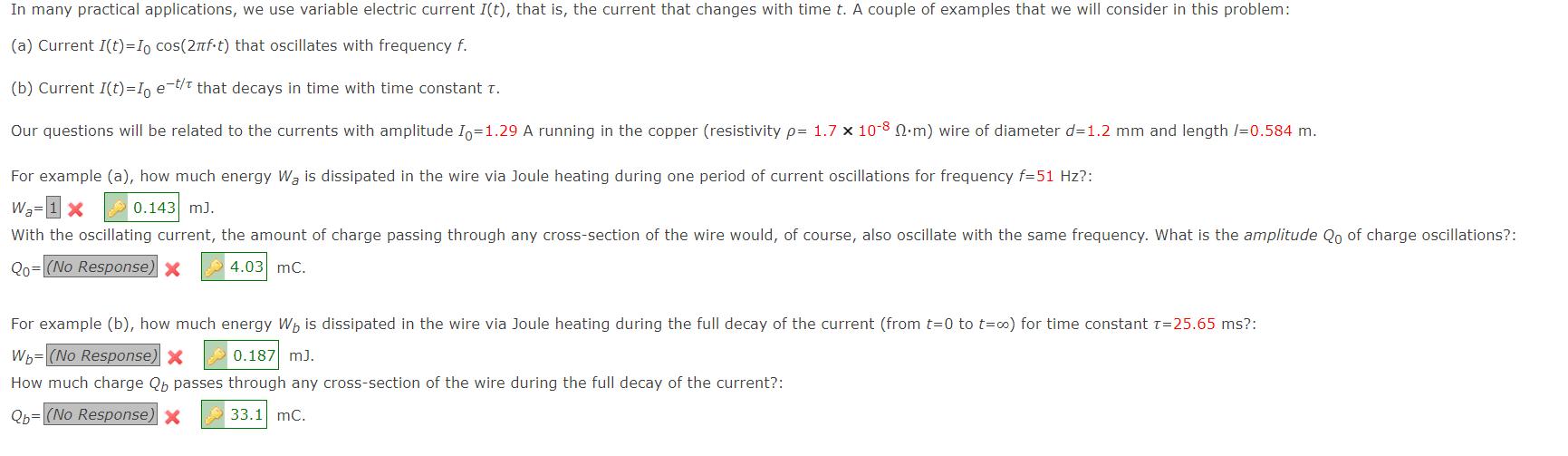
In many practical applications, we use variable electric current I(t), that is, the current that changes with time t. A couple of examples that we will consider in this problem: (a) Current I(t)3Io cos(2nf-t) that oscillates with frequency f. (b) Current I(t)=I, e-t/t that decays in time with time constant t. Our questions will be related to the currents with amplitude In=1.29 A running in the copper (resistivity p= 1.7 x 10⁻⁸ n.m) wire of diameter d=1.2 mm and length I=0.584 m. For example (a), how much energy Wa is dissipated in the wire via Joule heating during one period of current oscillations for frequency f=51 Hz?: Wa3= A 0.143 mJ. With the oscillating current, the amount of charge passing through any cross-section of the wire would, of course, also oscillate with the same frequency. What is the amplitude Qo of charge oscillations?: Qo= (No Response) X 4.03 mC. For example (b), how much energy Wb is dissipated in the wire via Joule heating during the full decay of the current (from t=0 to t=co) for time constant t=25.65 ms?: Wb= (No Response) X 0.187 m). How much charge Qb passes through any cross-section of the wire during the full decay of the current?: Qb= (No Response)X 33.1 mC.
Step by Step Solution
3.41 Rating (151 Votes )
There are 3 Steps involved in it

Get step-by-step solutions from verified subject matter experts
Document Format (2 attachments)

635fca11b2394_233183.pdf
180 KBs PDF File

635fca11b2394_233183.docx
120 KBs Word File
 Study Help