







Question: In mathematics, there's a series called Arithmetic Series. Basically, you add a number of the previous term to obtain the next term. But if you
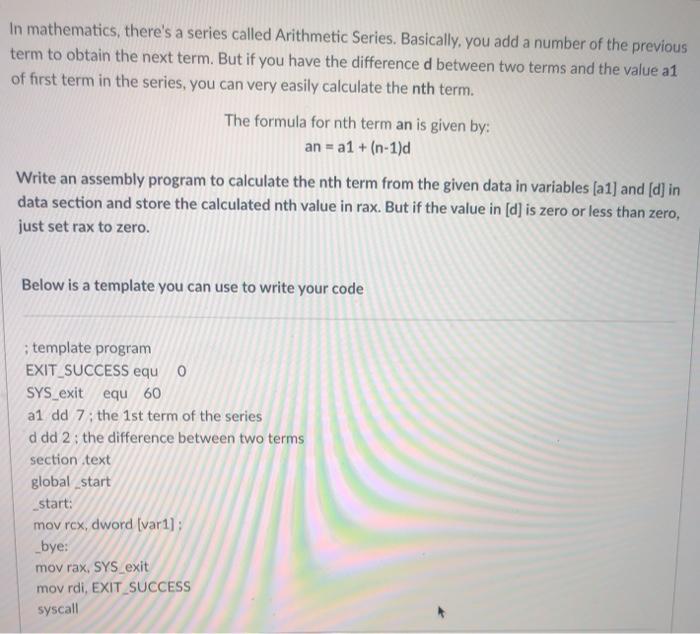
In mathematics, there's a series called Arithmetic Series. Basically, you add a number of the previous term to obtain the next term. But if you have the difference d between two terms and the value a1 of first term in the series, you can very easily calculate the nth term. The formula for nth term an is given by: an = a1 + (n-1)d Write an assembly program to calculate the nth term from the given data in variables (al) and (d) in data section and store the calculated nth value in rax. But if the value in (d) is zero or less than zero, just set rax to zero. Below is a template you can use to write your code ; template program EXIT_SUCCESS equo SYS_exit equ 60 al dd 7: the 1st term of the series d dd 2: the difference between two terms section text global start _start: mov rcx, dword (var1]; bye: mov rax, SYS_exit mov rdi, EXIT_SUCCESS syscall
Step by Step Solution
There are 3 Steps involved in it

Get step-by-step solutions from verified subject matter experts
 Study Help