







Question: In MATLAB, compute the bit error probability for a communication link. Assume that the transmission characteristics are. BPSK modulation, Gaussian Noise, PrN,-43776,-0-1, and varying data
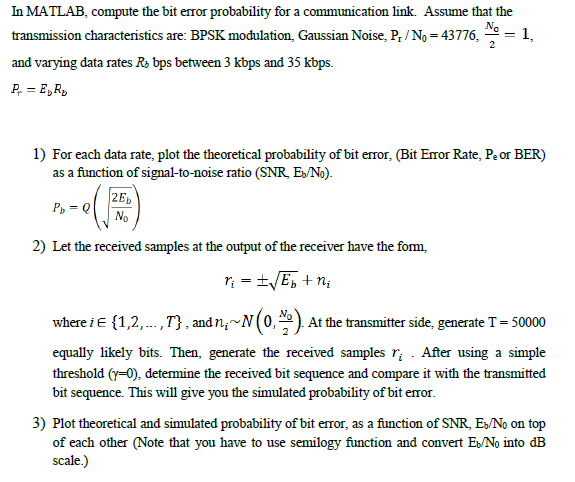
In MATLAB, compute the bit error probability for a communication link. Assume that the transmission characteristics are. BPSK modulation, Gaussian Noise, PrN,-43776,-0-1, and varying data rates R bps between 3 kbps and 35 kbps. 1) For each data rate, plot the theoretical probability of bit enor, (Bit Error Rate, Pe or BER) as a function of signal-to-noise ratio (SNR ENo). 2Eb No 2) Let the received samples at the output of the receiver have the form, where iE (1,2,. , T]. andnN(o) Arthe transmitrate T-5000 equally likely bits. Then, generate the received samples r After using a simple threshold (r-0), determine the received bit sequence and compare it with the transmitted bit sequence. This will give you the simulated probability of bit eror. 3) Plot theoretical and simulated probability of bit error, as a function of SNR, ENo on top of each other (Note that you have to use semilogy function and convert Eb/No into dB scale.) In MATLAB, compute the bit error probability for a communication link. Assume that the transmission characteristics are. BPSK modulation, Gaussian Noise, PrN,-43776,-0-1, and varying data rates R bps between 3 kbps and 35 kbps. 1) For each data rate, plot the theoretical probability of bit enor, (Bit Error Rate, Pe or BER) as a function of signal-to-noise ratio (SNR ENo). 2Eb No 2) Let the received samples at the output of the receiver have the form, where iE (1,2,. , T]. andnN(o) Arthe transmitrate T-5000 equally likely bits. Then, generate the received samples r After using a simple threshold (r-0), determine the received bit sequence and compare it with the transmitted bit sequence. This will give you the simulated probability of bit eror. 3) Plot theoretical and simulated probability of bit error, as a function of SNR, ENo on top of each other (Note that you have to use semilogy function and convert Eb/No into dB scale.)
Step by Step Solution
There are 3 Steps involved in it

Get step-by-step solutions from verified subject matter experts
 Study Help