







Question: In Matlab Given a random coin, i.e., one whose probability of heads p in a tossing is a random variable. In cases A, the probability
In Matlab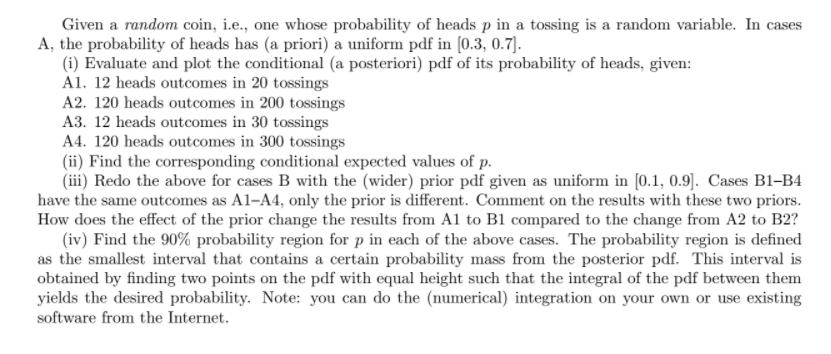
Given a random coin, i.e., one whose probability of heads p in a tossing is a random variable. In cases A, the probability of heads has (a priori) a uniform pdf in [0.3, 0.7 (i) Evaluate and plot the conditional (a posteriori) pdf of its probability of heads, given: Al. 12 heads outcomes in 20 tossings A2. 120 heads outcomes in 200 tossings A3. 12 heads outcomes in 30 tossings A4. 120 heads outcomes in 300 tossings (ii) Find the corresponding conditional expected values of p. (ii) Redo the above for cases B with the (wider) prior pdf given as uniform in [0.1, 0.9]. Cases B1-B4 have the same outcomes as Al-A4, only the prior is different. Comment on the results with these two priors How does the effect of the prior change the results from Al to B1 compared to the change from A2 to B2? (iv) Find the 90% probability region for p in each of the above cases. The probability region is defined as the smallest interval that contains a certain probability mass from the posterior pdf. This interval is obtained by finding two points on the pdf with equal height such that the integral of the pdf between them yields the desired probability. Note: you can do the (numerical) integration on your own or use existing software from the Internet. Given a random coin, i.e., one whose probability of heads p in a tossing is a random variable. In cases A, the probability of heads has (a priori) a uniform pdf in [0.3, 0.7 (i) Evaluate and plot the conditional (a posteriori) pdf of its probability of heads, given: Al. 12 heads outcomes in 20 tossings A2. 120 heads outcomes in 200 tossings A3. 12 heads outcomes in 30 tossings A4. 120 heads outcomes in 300 tossings (ii) Find the corresponding conditional expected values of p. (ii) Redo the above for cases B with the (wider) prior pdf given as uniform in [0.1, 0.9]. Cases B1-B4 have the same outcomes as Al-A4, only the prior is different. Comment on the results with these two priors How does the effect of the prior change the results from Al to B1 compared to the change from A2 to B2? (iv) Find the 90% probability region for p in each of the above cases. The probability region is defined as the smallest interval that contains a certain probability mass from the posterior pdf. This interval is obtained by finding two points on the pdf with equal height such that the integral of the pdf between them yields the desired probability. Note: you can do the (numerical) integration on your own or use existing software from the Internet
Step by Step Solution
There are 3 Steps involved in it

Get step-by-step solutions from verified subject matter experts
 Study Help