







Question: **In Matlab. Write a program in Matlab to solve the partial derivative of Q wrt to (n) and (S). Compare those results 4.16 Manning's formula
**In Matlab. Write a program in Matlab to solve the partial derivative of Q wrt to (n) and (S). Compare those results
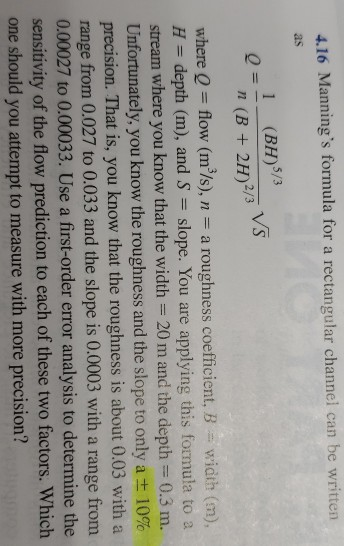
4.16 Manning's formula for a rectangular channel can be written as (BH)$/3 Vs n (B + 2H)2/3 where Q = flow (m'/s), n = a roughness coefficient, B depth (m), and S where width (m), slope. You are applying this formula to a know that the width = 20 m and the depth = 0.3 m. Unfortunately, you know the roughness and the slope to only a 10% precision. That is, you know that the roughness is about 0.03 with a range from 0.027 to 0.033 and the slope is 0.0003 with a range from 0.00027 to 0.00033. Use a first-order error analysis to determine the %3D stream you sensitivity of the flow prediction to each of these two factors. Which one should you attempt to measure with more precision? 4.16 Manning's formula for a rectangular channel can be written as (BH)$/3 Vs n (B + 2H)2/3 where Q = flow (m'/s), n = a roughness coefficient, B depth (m), and S where width (m), slope. You are applying this formula to a know that the width = 20 m and the depth = 0.3 m. Unfortunately, you know the roughness and the slope to only a 10% precision. That is, you know that the roughness is about 0.03 with a range from 0.027 to 0.033 and the slope is 0.0003 with a range from 0.00027 to 0.00033. Use a first-order error analysis to determine the %3D stream you sensitivity of the flow prediction to each of these two factors. Which one should you attempt to measure with more precision
Step by Step Solution
There are 3 Steps involved in it

Get step-by-step solutions from verified subject matter experts
 Study Help