





Question: | In Out Process 1 Process 2 Process 3 Consider the assembly line of a producer of Smart TVs. An image of the line is
| In Out Process 1 Process 2 Process 3 Consider| In Out Process 1 Process 2 Process 3 Consider

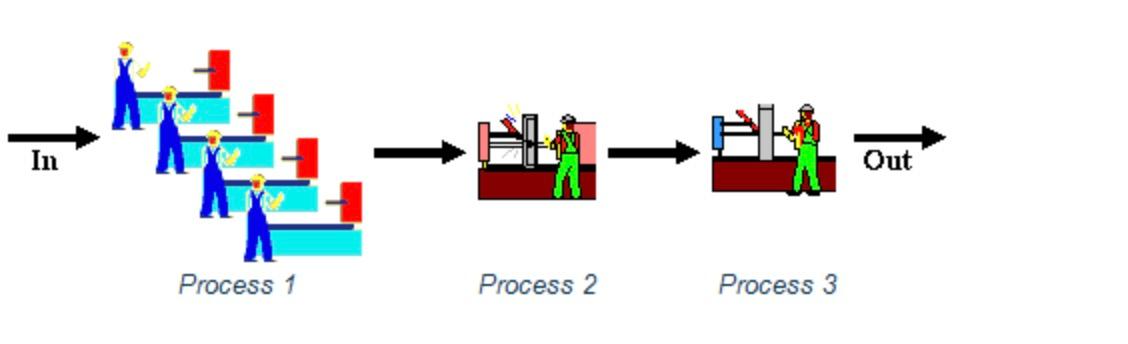
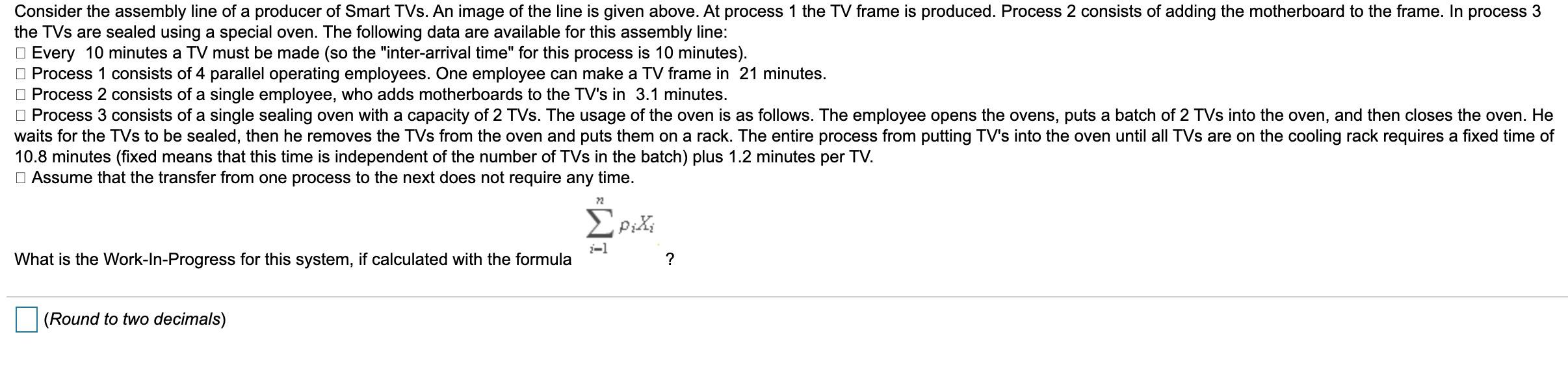
| In Out Process 1 Process 2 Process 3 Consider the assembly line of a producer of Smart TVs. An image of the line is given above. At process 1 the TV frame is produced. Process 2 consists of adding the motherboard to the frame. In process 3 the TVs are sealed using a special oven. The following data are available for this assembly line: Every 10 minutes a TV must be made (so the "inter-arrival time" for this process is 10 minutes). Process 1 consists of 4 parallel operating employees. One employee can make a TV frame in 21 minutes. Process 2 consists of a single employee, who adds motherboards to the TV's in 3.1 minutes. Process 3 consists of a single sealing oven with a capacity of 2 TVs. The usage of the oven is as follows. The employee opens the ovens, puts a batch of 2 TVs into the oven, and then closes the oven. He waits for the TVs to be sealed, then he removes the TVs from the oven and puts them on a rack. The entire process from putting TV's into the oven until all TVs are on the cooling rack requires a fixed time of 10.8 minutes (fixed means that this time is independent of the number of TVs in the batch) plus 1.2 minutes per TV. Assume that the transfer from one process to the next does not require any time. 22 X: 2-1 What is the Work-In-Progress for this system, if calculated with the formula ? (Round to two decimals) | In Out Process 1 Process 2 Process 3 Consider the assembly line of a producer of Smart TVs. An image of the line is given above. At process 1 the TV frame is produced. Process 2 consists of adding the motherboard to the frame. In process 3 the TVs are sealed using a special oven. The following data are available for this assembly line: Every 10 minutes a TV must be made (so the "inter-arrival time" for this process is 10 minutes). Process 1 consists of 4 parallel operating employees. One employee can make a TV frame in 21 minutes. Process 2 consists of a single employee, who adds motherboards to the TV's in 3.1 minutes. Process 3 consists of a single sealing oven with a capacity of 2 TVs. The usage of the oven is as follows. The employee opens the ovens, puts a batch of 2 TVs into the oven, and then closes the oven. He waits for the TVs to be sealed, then he removes the TVs from the oven and puts them on a rack. The entire process from putting TV's into the oven until all TVs are on the cooling rack requires a fixed time of 10.8 minutes (fixed means that this time is independent of the number of TVs in the batch) plus 1.2 minutes per TV. Assume that the transfer from one process to the next does not require any time. 22 X: 2-1 What is the Work-In-Progress for this system, if calculated with the formula ? (Round to two decimals)

Step by Step Solution

There are 3 Steps involved in it

1 Expert Approved Answer
Step: 1 Unlock blur-text-image

Question Has Been Solved by an Expert!

Get step-by-step solutions from verified subject matter experts

Step: 2 Unlock
Step: 3 Unlock

Students Have Also Explored These Related General Management Questions!