







Question: in phyton # -*- coding: utf-8 -*- simple = 'Can you can a can as a canner can can a can?' multiline = Peter Piper
in phyton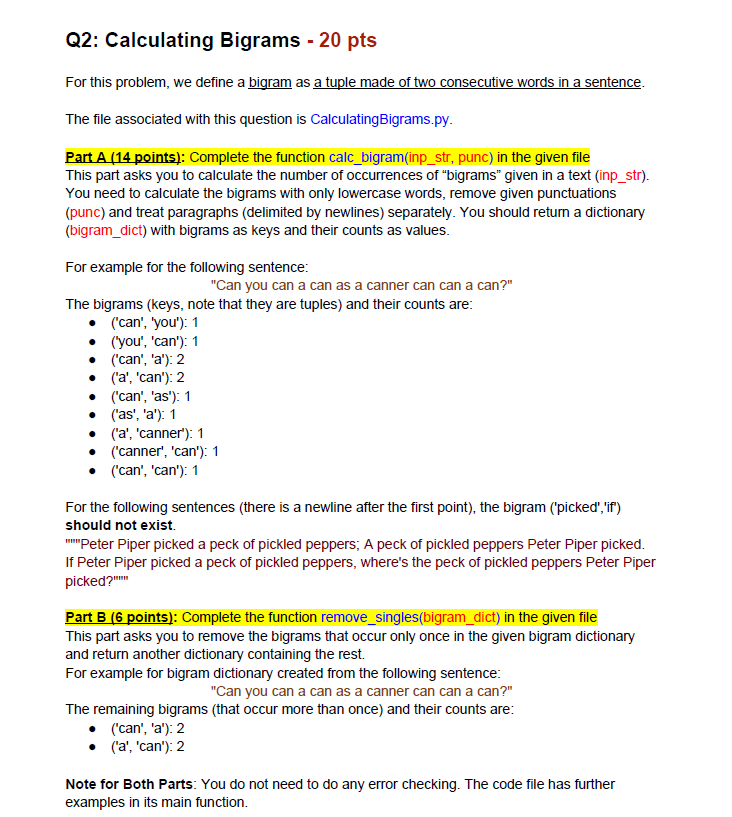
# -*- coding: utf-8 -*-
simple = 'Can you can a can as a canner can can a can?'
multiline = "Peter Piper picked a peck of pickled peppers; A peck of pickled peppers Peter Piper picked. If Peter Piper picked a peck of pickled peppers, where's the peck of pickled peppers Peter Piper picked?"
alice = '''Alice was beginning to get very tired of sitting by her sister on the bank, and of having nothing to do: once or twice she had peeped into the book her sister was reading, but it had no pictures or conversations in it, "and what is the use of a book," thought Alice "without pictures or conversation?" So she was considering in her own mind (as well as she could, for the hot day made her feel very sleepy and stupid), whether the pleasure of making a daisy-chain would be worth the trouble of getting up and picking the daisies, when suddenly a White Rabbit with pink eyes ran close by her. There was nothing so VERY remarkable in that; nor did Alice think it so VERY much out of the way to hear the Rabbit say to itself, "Oh dear! Oh dear! I shall be late!" (when she thought it over afterwards, it occurred to her that she ought to have wondered at this, but at the time it all seemed quite natural); but when the Rabbit actually TOOK A WATCH OUT OF ITS WAISTCOAT-POCKET, and looked at it, and then hurried on, Alice started to her feet, for it flashed across her mind that she had never before seen a rabbit with either a waistcoat-pocket, or a watch to take out of it, and burning with curiosity, she ran across the field after it, and fortunately was just in time to see it pop down a large rabbit-hole under the hedge. In another moment down went Alice after it, never once considering how in the world she was to get out again. The rabbit-hole went straight on like a tunnel for some way, and then dipped suddenly down, so suddenly that Alice had not a moment to think about stopping herself before she found herself falling down a very deep well. Either the well was very deep, or she fell very slowly, for she had plenty of time as she went down to look about her and to wonder what was going to happen next. First, she tried to look down and make out what she was coming to, but it was too dark to see anything; then she looked at the sides of the well, and noticed that they were filled with cupboards and book-shelves; here and there she saw maps and pictures hung upon pegs. She took down a jar from one of the shelves as she passed; it was labelled "ORANGE MARMALADE", but to her great disappointment it was empty: she did not like to drop the jar for fear of killing somebody, so managed to put it into one of the cupboards as she fell past it. "Well!" thought Alice to herself, "after such a fall as this, I shall think nothing of tumbling down stairs! How brave they'll all think me at home! Why, I wouldn't say anything about it, even if I fell off the top of the house!" (Which was very likely true.) Down, down, down. Would the fall NEVER come to an end! "I wonder how many miles I've fallen by this time?" she said aloud. "I must be getting somewhere near the centre of the earth. Let me see: that would be four thousand miles down, I think--" (for, you see, Alice had learnt several things of this sort in her lessons in the schoolroom, and though this was not a VERY good opportunity for showing off her knowledge, as there was no one to listen to her, still it was good practice to say it over) "--yes, that's about the right distance--but then I wonder what Latitude or Longitude I've got to?" (Alice had no idea what Latitude was, or Longitude either, but thought they were nice grand words to say.) Presently she began again. "I wonder if I shall fall right THROUGH the earth! How funny it'll seem to come out among the people that walk with their heads downward! The Antipathies, I think--" (she was rather glad there WAS no one listening, this time, as it didn't sound at all the right word) "--but I shall have to ask them what the name of the country is, you know. Please, Ma'am, is this New Zealand or Australia?" (and she tried to curtsey as she spoke--fancy CURTSEYING as you're falling through the air! Do you think you could manage it?) "And what an ignorant little girl she'll think me for asking! No, it'll never do to ask: perhaps I shall see it written up somewhere." Down, down, down. There was nothing else to do, so Alice soon began talking again. "Dinah'll miss me very much to-night, I should think!" (Dinah was the cat.) "I hope they'll remember her saucer of milk at tea-time. Dinah my dear! I wish you were down here with me! There are no mice in the air, I'm afraid, but you might catch a bat, and that's very like a mouse, you know. But do cats eat bats, I wonder?" And here Alice began to get rather sleepy, and went on saying to herself, in a dreamy sort of way, "Do cats eat bats? Do cats eat bats?" and sometimes, "Do bats eat cats?" for, you see, as she couldn't answer either question, it didn't much matter which way she put it. She felt that she was dozing off, and had just begun to dream that shewas walking hand in hand with Dinah, and saying to her very earnestly, "Now, Dinah, tell me the truth: did you ever eat a bat?" when suddenly, thump! thump! down she came upon a heap of sticks and dry leaves, and the fall was over. Alice was not a bit hurt, and she jumped up on to her feet in a moment: she looked up, but it was all dark overhead; before her was another long passage, and the White Rabbit was still in sight, hurrying down it. There was not a moment to be lost: away went Alice like the wind, and was just in time to hear it say, as it turned a corner, "Oh my ears and whiskers, how late it's getting!" She was close behind it when she turned the corner, but the Rabbit was no longer to be seen: she found herself in a long, low hall, which was lit up by a row of lamps hanging from the roof.'''
# Use the one after a punctuation. # Do not take the one after a newline # For the last word of a paragraph do not count anything
def calc_bigram(instr, punctuations = '!"#$%&\'()*+,-./:;?@[\\]^_`{|}~'): # Fill and return this bigram dictionary bigram_dict = {} # Make sure to convert each letter to its lowercase and remove the given punctuations # Then calculate bigrams # - Do not forget to treat each paragraph separately # They are delimited by newlines ' ' # - Pay attention not to "loop around" with the first/last words # - Should be relatively easy, take a look at the word counting example
# Your code starts below this line # Do not edit below this line return bigram_dict
def remove_singles(bigram_dict): # Given a bigram dictionary, remove the bigrams (word pairs) that occur # only once i.e. fill the below dictionary with the bigrams that occur # more than once subset_dict = {} # Your code starts below this line # Do not edit below this line return subset_dict
def main(): # Testing simple simple_bigrams = calc_bigram(simple) print("Simple case all bigrams:") print(simple_bigrams) ''' Expected (order maybe different): ('can', 'you'): 1, ('you', 'can'): 1, ('can', 'a'): 2, ('a', 'can'): 2, ('can', 'as'): 1, ('as', 'a'): 1, ('a', 'canner'): 1, ('canner', 'can'): 1, ('can', 'can'): 1 ''' print("Simple case, bigrams that occur more than once:") simple_subset_bigrams = remove_singles(simple_bigrams) print(simple_subset_bigrams) ''' Expected (order maybe different): ('can', 'a'): 2, ('a', 'can'): 2 ''' print() print("Multiline case all bigrams:") multiline_bigrams = calc_bigram(multiline) print(multiline_bigrams) ''' Expected (order maybe different): ('peter', 'piper'): 4, ('piper', 'picked'): 4, ('picked', 'a'): 2, ('a', 'peck'): 3, ('peck', 'of'): 4, ('of', 'pickled'): 4, ('pickled', 'peppers'): 4, ('peppers', 'a'): 1, ('peppers', 'peter'): 2, ('if', 'peter'): 1, ('peppers', 'where'): 1, ('where', 's'): 1, ('s', 'the'): 1, ('the', 'peck'): 1 ''' print("Multiline case, bigrams that occur more than once:") multiline_subset_bigrams = remove_singles(multiline_bigrams) print(multiline_subset_bigrams) ''' Expected (order maybe different): ('peter', 'piper'): 4, ('piper', 'picked'): 4, ('picked', 'a'): 2, ('a', 'peck'): 3, ('peck', 'of'): 4, ('of', 'pickled'): 4, ('pickled', 'peppers'): 4, ('peppers', 'peter'): 2 ''' print() print('Long case (excerpt from Alice in Wonderland). Bigram dictionaries are too long to print:') all_bigrams = calc_bigram(alice) subset_bigrams = remove_singles(all_bigrams) print(len(all_bigrams.keys())) ''' Expected: 918 ''' print(len(subset_bigrams.keys())) ''' Expected: 115 ''' # Note that we will actually look at the dictionaries to grade you, the lengths are given to you as a short check
if __name__ == '__main__': main()
Q2: Calculating Bigrams - 20 pts For this problem, we define a bigram as a tuple made of two consecutive words in a sentence. The file associated with this question is Calculating Bigrams.py. Part A (14 points): Complete the function calc_bigram(inp_str, punc) in the given file This part asks you to calculate the number of occurrences of "bigrams" given in a text (inp_str). You need to calculate the bigrams with only lowercase words, remove given punctuations (punc) and treat paragraphs (delimited by newlines) separately. You should return a dictionary (bigram_dict) with bigrams as keys and their counts as values. For example for the following sentence: "Can you can a can as a canner can can a can?" The bigrams (keys, note that they are tuples) and their counts are: ('can', 'you'): 1 ('you', 'can'): 1 ('can', 'a'): 2 ('a', 'can'): 2 ('can', 'as'): 1 ('as', 'a'): 1 ('a', 'canner): 1 ('canner', 'can'): 1 ('can', 'can'): 1 For the following sentences (there is a newline after the first point), the bigram ('picked', 'if) should not exist Peter Piper picked a peck of pickled peppers; A peck of pickled peppers Peter Piper picked. If Peter Piper picked a peck of pickled peppers, where's the peck of pickled peppers Peter Piper picked? Part B (6 points): Complete the function remove_singles(bigram_dict) in the given file This part asks you to remove the bigrams that occur only once in the given bigram dictionary and return another dictionary containing the rest. For example for bigram dictionary created from the following sentence: "Can you can a can as a canner can can a can?" The remaining bigrams (that occur more than once) and their counts are: ('can', 'a'): 2 ('a', 'can'): 2 Note for Both Parts: You do not need to do any error checking. The code file has further examples in its main function
Step by Step Solution
There are 3 Steps involved in it

Get step-by-step solutions from verified subject matter experts
 Study Help