







Question: In problems 2 10, we consider a simple electrical circuit with voltage V (measured in volts), resistance R (measured in ohms), and current I (measured



![the limit lim (R.V)-(0,0) [/] does not exist by evaluating limits along](https://s3.amazonaws.com/si.experts.images/answers/2024/06/667bbdf0edb8c_584667bbdf0bf8a1.jpg)



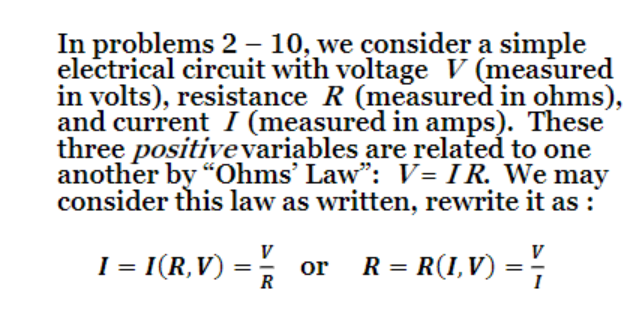
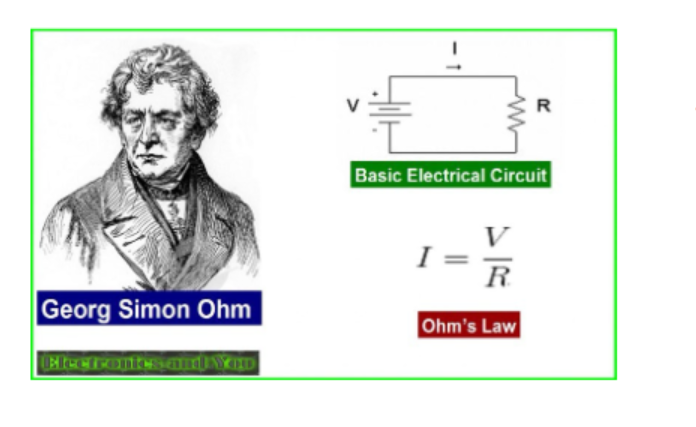
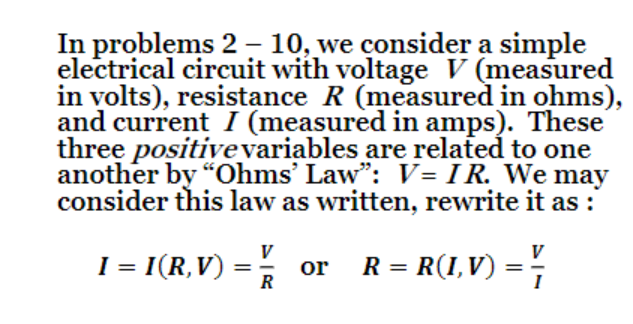
In problems 2 10, we consider a simple electrical circuit with voltage V (measured in volts), resistance R (measured in ohms), and current I (measured in amps). These three positive variables are related to one another by "Ohms' Law\": V: I R. We may consider this law as written, rewrite it as : I=I(R,V) =% or R=R(I,V) =1; V R Basic Electrical Circuit R Georg Simon Ohm Ohm's Law3. Show that the limit lim (R.V)-(0,0) [/] does not exist by evaluating limits along the positive R-axis and along the line R = V in the RV-plane.4. Describe and sketch the contour map for the function : I = 1(R, V) = 4 level curves. ; include at least halt: 5. Compute the partial derivatives 3! and g ; explain the meaning of the signs of each of these partial derivatives in a comp ete sentence
Step by Step Solution
There are 3 Steps involved in it

Get step-by-step solutions from verified subject matter experts
 Study Help