







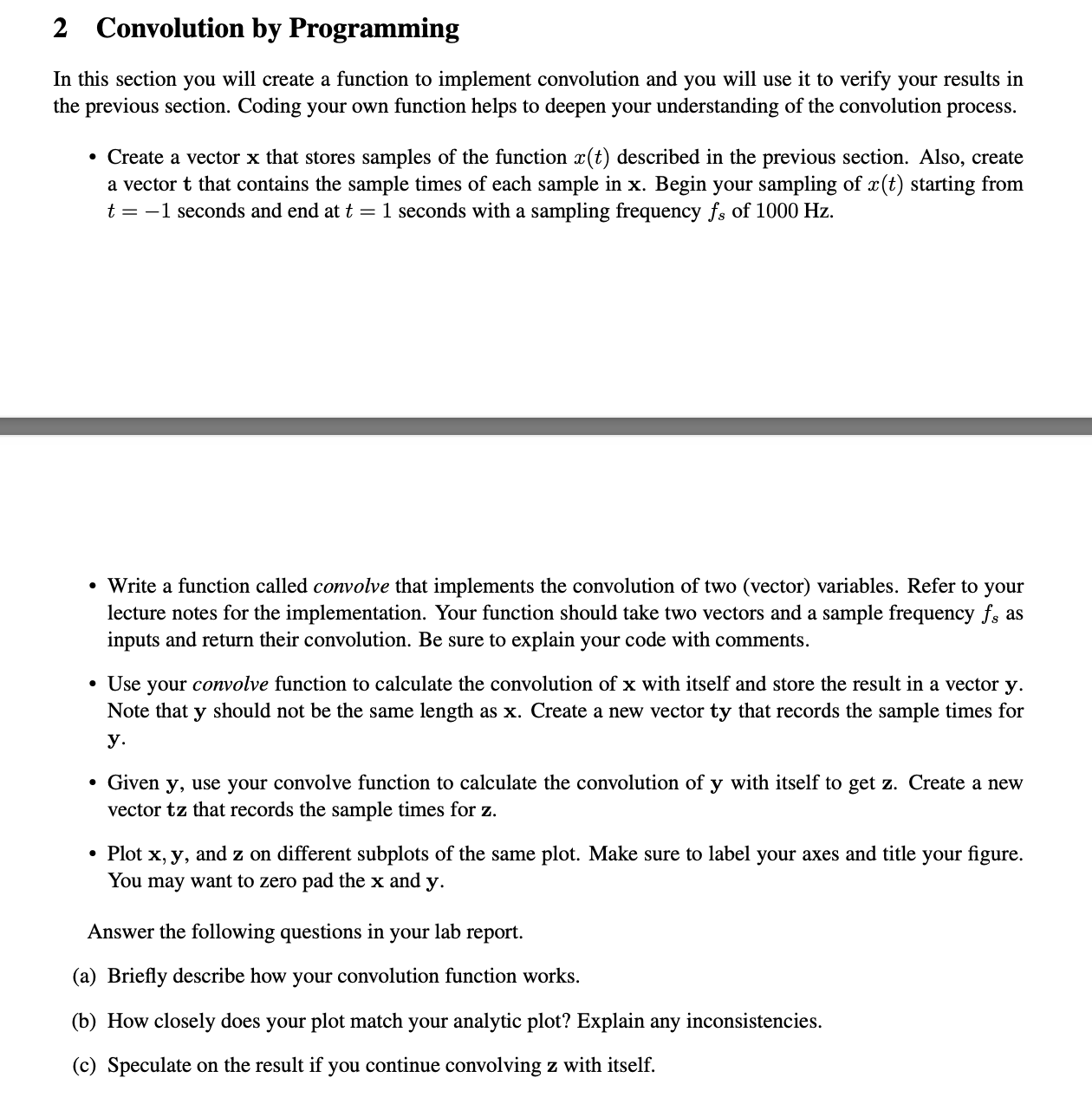
Question: IN python / juptyer notebook 2 Convolution by Programming In this section you will create a function to implement convolution and you will use it
IN python juptyer notebook
Convolution by Programming
In this section you will create a function to implement convolution and you will use it to verify your results in
the previous section. Coding your own function helps to deepen your understanding of the convolution process.
Create a vector that stores samples of the function described in the previous section. Also, create
a vector that contains the sample times of each sample in Begin your sampling of starting from
seconds and end at seconds with a sampling frequency of
Write a function called convolve that implements the convolution of two vector variables. Refer to your
lecture notes for the implementation. Your function should take two vectors and a sample frequency as
inputs and return their convolution. Be sure to explain your code with comments.
Use your convolve function to calculate the convolution of with itself and store the result in a vector
Note that should not be the same length as Create a new vector ty that records the sample times for
y
Given use your convolve function to calculate the convolution of with itself to get Create a new
vector that records the sample times for
Plot and on different subplots of the same plot. Make sure to label your axes and title your figure.
You may want to zero pad the and
Answer the following questions in your lab report.
a Briefly describe how your convolution function works.
b How closely does your plot match your analytic plot? Explain any inconsistencies.
c Speculate on the result if you continue convolving with itself.
PLEASE HELP ME DO THIS IN PYTHON
Step by Step Solution
There are 3 Steps involved in it
1 Expert Approved Answer
Step: 1 Unlock

Question Has Been Solved by an Expert!
Get step-by-step solutions from verified subject matter experts
Step: 2 Unlock
Step: 3 Unlock
 Study Help