







Question: In Python ! Please don't repost the previous answer as it was not correct.thanks I am looking to modify the code given below that gives
In Python !
Please don't repost the previous answer as it was not correct.thanks
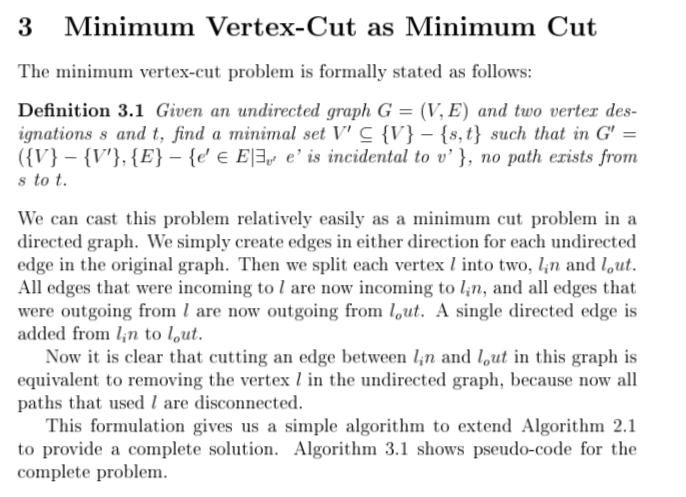
I am looking to modify the code given below that gives traditional min-cut of a graph to min vertex cut of a graph based on the following idea:
Code to modify ( taken from geeks for geeks "Find minimum s-t cut in a flow network"):
from collections import defaultdict
# This class represents a directed graph using adjacency matrix representation
class Graph:
def __init__(self,graph):
self.graph = graph # residual graph
self.org_graph = [i[:] for i in graph]
self. ROW = len(graph)
self.COL = len(graph[0])
'''Returns true if there is a path from source 's' to sink 't' in
residual graph. Also fills parent[] to store the path '''
def BFS(self,s, t, parent):
# Mark all the vertices as not visited
visited =[False]*(self.ROW)
# Create a queue for BFS
queue=[]
# Mark the source node as visited and enqueue it
queue.append(s)
visited[s] = True
# Standard BFS Loop
while queue:
#Dequeue a vertex from queue and print it
u = queue.pop(0)
# Get all adjacent vertices of the dequeued vertex u
# If a adjacent has not been visited, then mark it
# visited and enqueue it
for ind, val in enumerate(self.graph[u]):
if visited[ind] == False and val > 0 :
queue.append(ind)
visited[ind] = True
parent[ind] = u
# If we reached sink in BFS starting from source, then return
# true, else false
return True if visited[t] else False
# Returns the min-cut of the given graph
def minCut(self, source, sink):
# This array is filled by BFS and to store path
parent = [-1]*(self.ROW)
max_flow = 0 # There is no flow initially
# Augment the flow while there is path from source to sink
while self.BFS(source, sink, parent) :
# Find minimum residual capacity of the edges along the
# path filled by BFS. Or we can say find the maximum flow
# through the path found.
path_flow = float("Inf")
s = sink
while(s != source):
path_flow = min (path_flow, self.graph[parent[s]][s])
s = parent[s]
# Add path flow to overall flow
max_flow += path_flow
# update residual capacities of the edges and reverse edges
# along the path
v = sink
while(v != source):
u = parent[v]
self.graph[u][v] -= path_flow
self.graph[v][u] += path_flow
v = parent[v]
# print the edges which initially had weights
# but now have 0 weight
for i in range(self.ROW):
for j in range(self.COL):
if self.graph[i][j] == 0 and self.org_graph[i][j] > 0:
print str(i) + " - " + str(j)
# Create a graph given in the above diagram
graph = [[0, 1, 1, 0, 0, 0],
[0, 0, 1, 1, 0, 0],
[0, 1, 0, 0, 1, 0],
[0, 0, 1, 0, 0, 1],
[0, 0, 0, 7, 0, 4],
[0, 0, 0, 0, 0, 0]]
g = Graph(graph)
source = 0; sink = 5
g.minCut(source, sink)
Minimum Vertex-Cut as Minimum Cut 3 The minimum vertex-cut problem is formally stated as follows: Definition 3.1 Given an undirected graph G = (V, E) and two verter des- ignations s and t, find a minimal set V' C {V} {s,t} such that in G' = ({V} {V'}, {E} {e' e E[3, e' is incidental to v' }, no path erists from s to t. We can cast this problem relatively easily as a minimum cut problem in a directed graph. We simply create edges in either direction for each undirected edge in the original graph. Then we split each vertex l into two, l;n and lut. All edges that were incoming to l are now incoming to l;n, and all edges that were outgoing from 1 are now outgoing from l,ut. A single directed edge is added from l;n to lut. Now it is clear that cutting an edge between ln and lout in this graph is equivalent to removing the vertex l in the undirected graph, because now all paths that usedI are disconnected. This formulation gives us a simple algorithm to extend Algorithm 2.1 to provide a complete solution. Algorithm 3.1 shows pseudo-code for the complete problem. Minimum Vertex-Cut as Minimum Cut 3 The minimum vertex-cut problem is formally stated as follows: Definition 3.1 Given an undirected graph G = (V, E) and two verter des- ignations s and t, find a minimal set V' C {V} {s,t} such that in G' = ({V} {V'}, {E} {e' e E[3, e' is incidental to v' }, no path erists from s to t. We can cast this problem relatively easily as a minimum cut problem in a directed graph. We simply create edges in either direction for each undirected edge in the original graph. Then we split each vertex l into two, l;n and lut. All edges that were incoming to l are now incoming to l;n, and all edges that were outgoing from 1 are now outgoing from l,ut. A single directed edge is added from l;n to lut. Now it is clear that cutting an edge between ln and lout in this graph is equivalent to removing the vertex l in the undirected graph, because now all paths that usedI are disconnected. This formulation gives us a simple algorithm to extend Algorithm 2.1 to provide a complete solution. Algorithm 3.1 shows pseudo-code for the complete
Step by Step Solution
There are 3 Steps involved in it

Get step-by-step solutions from verified subject matter experts
 Study Help