







Question: in python We set out to answer the questions: 1. When asked to be random, are the numbers humans chose actually random? 2. What is/are
in python
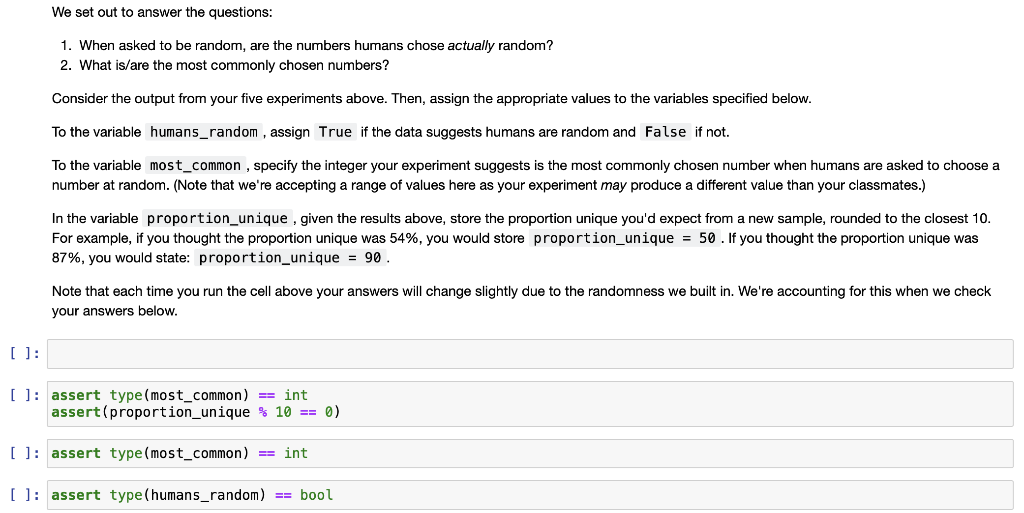
We set out to answer the questions: 1. When asked to be random, are the numbers humans chose actually random? 2. What is/are the most commonly chosen numbers? Consider the output from your five experiments above. Then, assign the appropriate values to the variables specified below. To the variable humans_random, assign True if the data suggests humans are random and False if not. To the variable most_common, specify the integer your experiment suggests is the most commonly chosen number when humans are asked to choose a number at random. (Note that we're accepting a range of values here as your experiment may produce a different value than your classmates.) In the variable proportion_unique, given the results above, store the proportion unique you'd expect from a new sample, rounded to the closest 10. For example, if you thought the proportion unique was 54%, you would store proportion_unique =50. If you thought the proportion unique was 87%, you would state: proportion_unique =90. Note that each time you run the cell above your answers will change slightly due to the randomness we built in. We're accounting for this when we check your answers below. assert type(most_common) = int assert(proportion_unique %10==0 ) We set out to answer the questions: 1. When asked to be random, are the numbers humans chose actually random? 2. What is/are the most commonly chosen numbers? Consider the output from your five experiments above. Then, assign the appropriate values to the variables specified below. To the variable humans_random, assign True if the data suggests humans are random and False if not. To the variable most_common, specify the integer your experiment suggests is the most commonly chosen number when humans are asked to choose a number at random. (Note that we're accepting a range of values here as your experiment may produce a different value than your classmates.) In the variable proportion_unique, given the results above, store the proportion unique you'd expect from a new sample, rounded to the closest 10. For example, if you thought the proportion unique was 54%, you would store proportion_unique =50. If you thought the proportion unique was 87%, you would state: proportion_unique =90. Note that each time you run the cell above your answers will change slightly due to the randomness we built in. We're accounting for this when we check your answers below. assert type(most_common) = int assert(proportion_unique %10==0 )
Step by Step Solution
There are 3 Steps involved in it

Get step-by-step solutions from verified subject matter experts
 Study Help