







Question: in question 1, what does each variable in the given question stand for in terms of greek letters? like which one is which and how
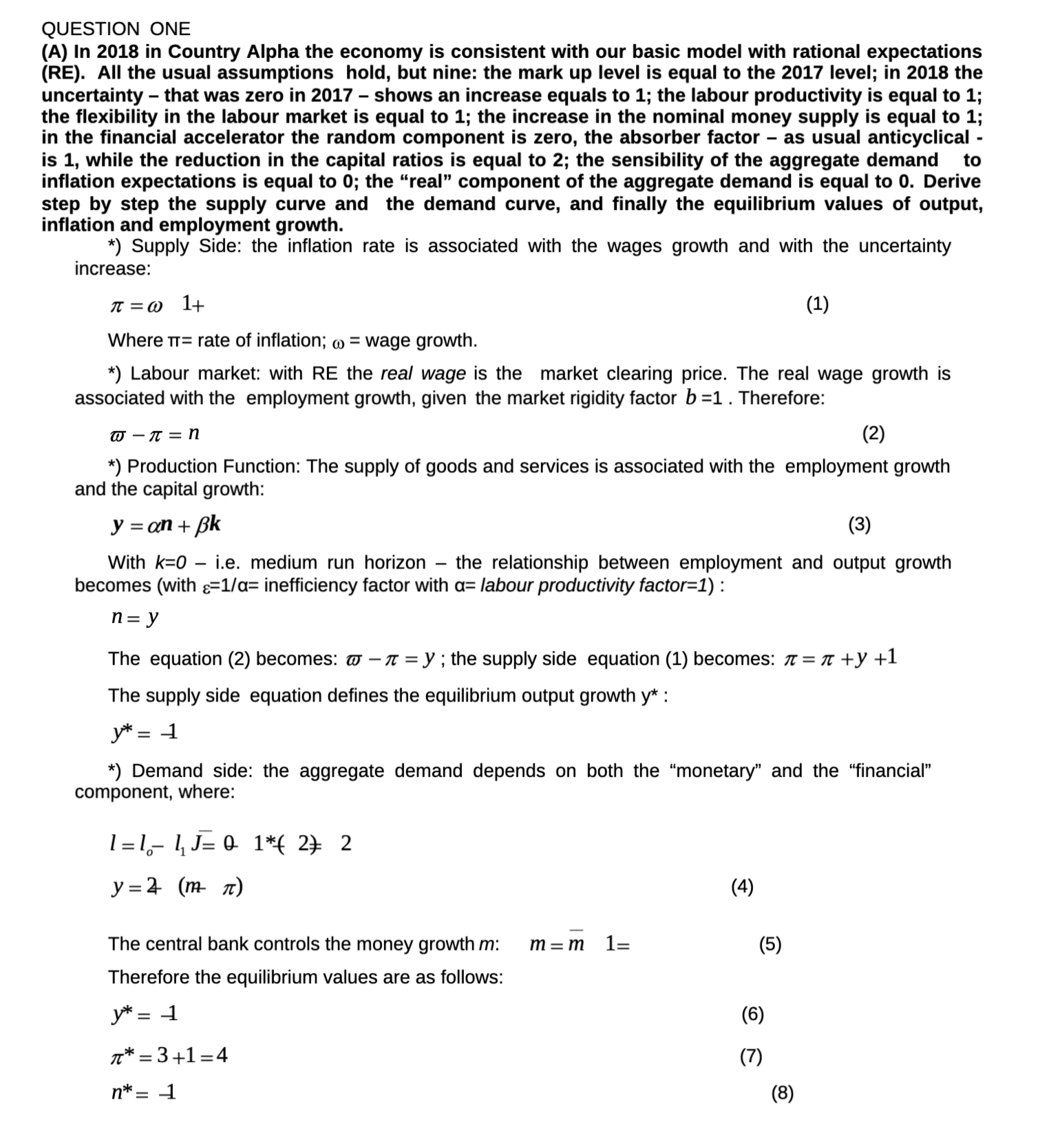
in question 1, what does each variable in the given question stand for in terms of greek letters? like which one is which and how do they fit into each equation in the solutions.
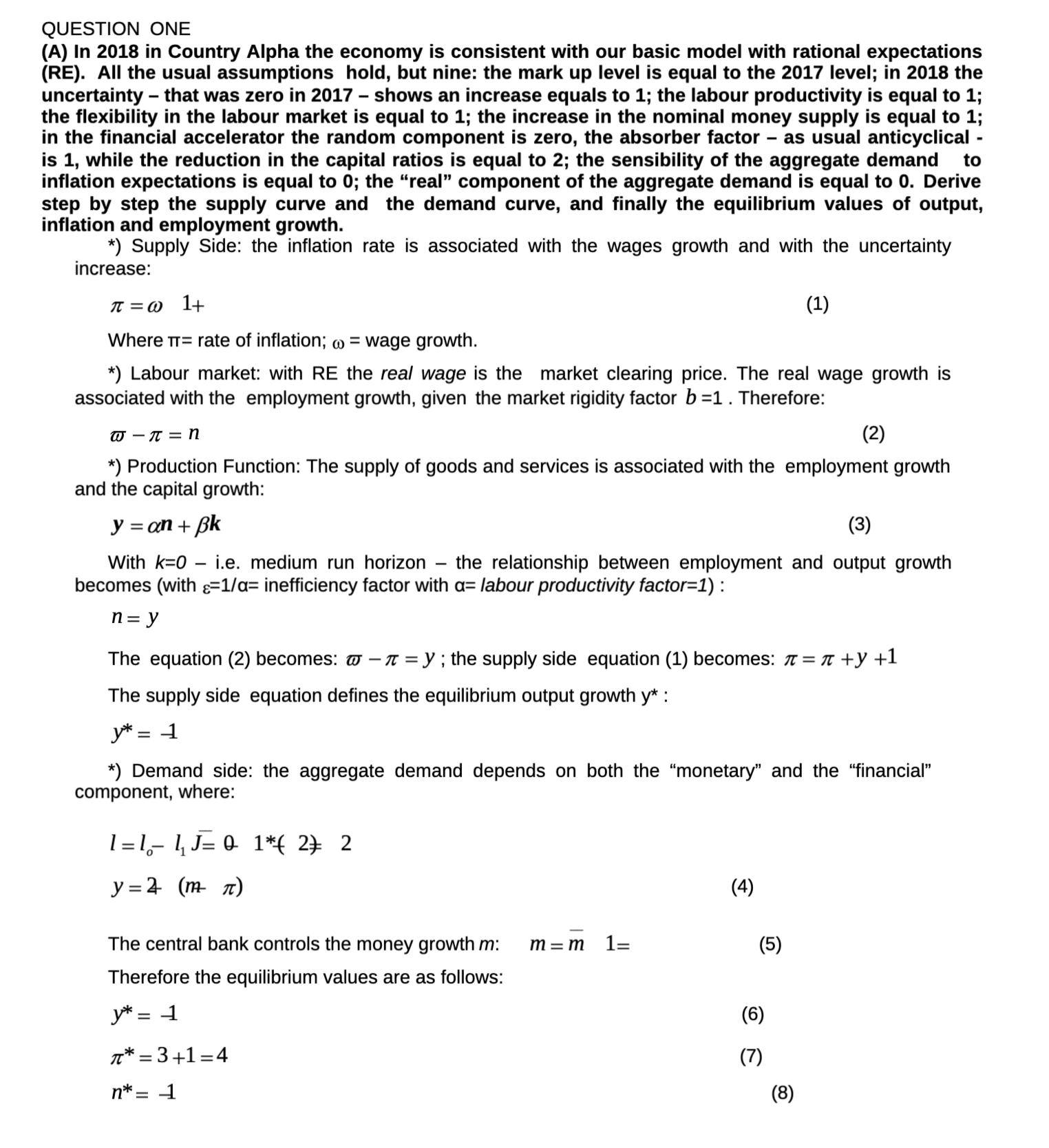
QUESTION ONE (A) In 2018 in Country Alpha the economy is consistent with our basic model with rational expectations (RE). All the usual assumptions hold, but nine: the mark up level is equal to the 2017 level; in 2018 the uncertainty - that was zero in 2017 - shows an increase equals to 1; the labour productivity is equal to 1; the flexibility in the labour market is equal to 1; the increase in the nominal money supply is equal to 1; in the financial accelerator the random component is zero, the absorber factor as usual anticyclical - is 1, while the reduction in the capital ratios is equal to 2; the sensibility of the aggregate demand to inflation expectations is equal to 0; the \"real\" component of the aggregate demand is equal to 0. Derive step by step the supply curve and the demand curve, and finally the equilibrium values of output, inflation and employment growth. *) Supply Side: the inflation rate is associated with the wages growth and with the uncertainty increase: T = 1+ (1) Where 1= rate of inflation; = wage growth. *) Labour market: with RE the real wage is the market clearing price. The real wage growth is associated with the employment growth, given the market rigidity factor b =1 . Therefore: @wm=n (2) *) Production Function: The supply of goods and services is associated with the employment growth and the capital growth: y =an + gk 3) With k=0 i.e. medium run horizon the relationship between employment and output growth becomes (with =1/a= inefficiency factor with a= labour productivity factor=1) : n=y The equation (2) becomes: @ 7 = Y ; the supply side equation (1) becomes: 7 =7 +y +1 The supply side equation defines the equilibrium output growth y* : ye=4 *) Demand side: the aggregate demand depends on both the \"monetary\" and the \"financial\" component, where: =1~ LJ=0 1% 2} 2 y=% (m n) 4 The central bank controls the money growthm: m=m 1= (5) Therefore the equilibrium values are as follows: yr= 1 (6) 7*=3+1=4 (7) =4 (8)
Step by Step Solution
There are 3 Steps involved in it

Get step-by-step solutions from verified subject matter experts
 Study Help