







Question: In Roe v . Wade ( 1 9 7 3 ) , the U . S . Supreme Court held that the right to privacy
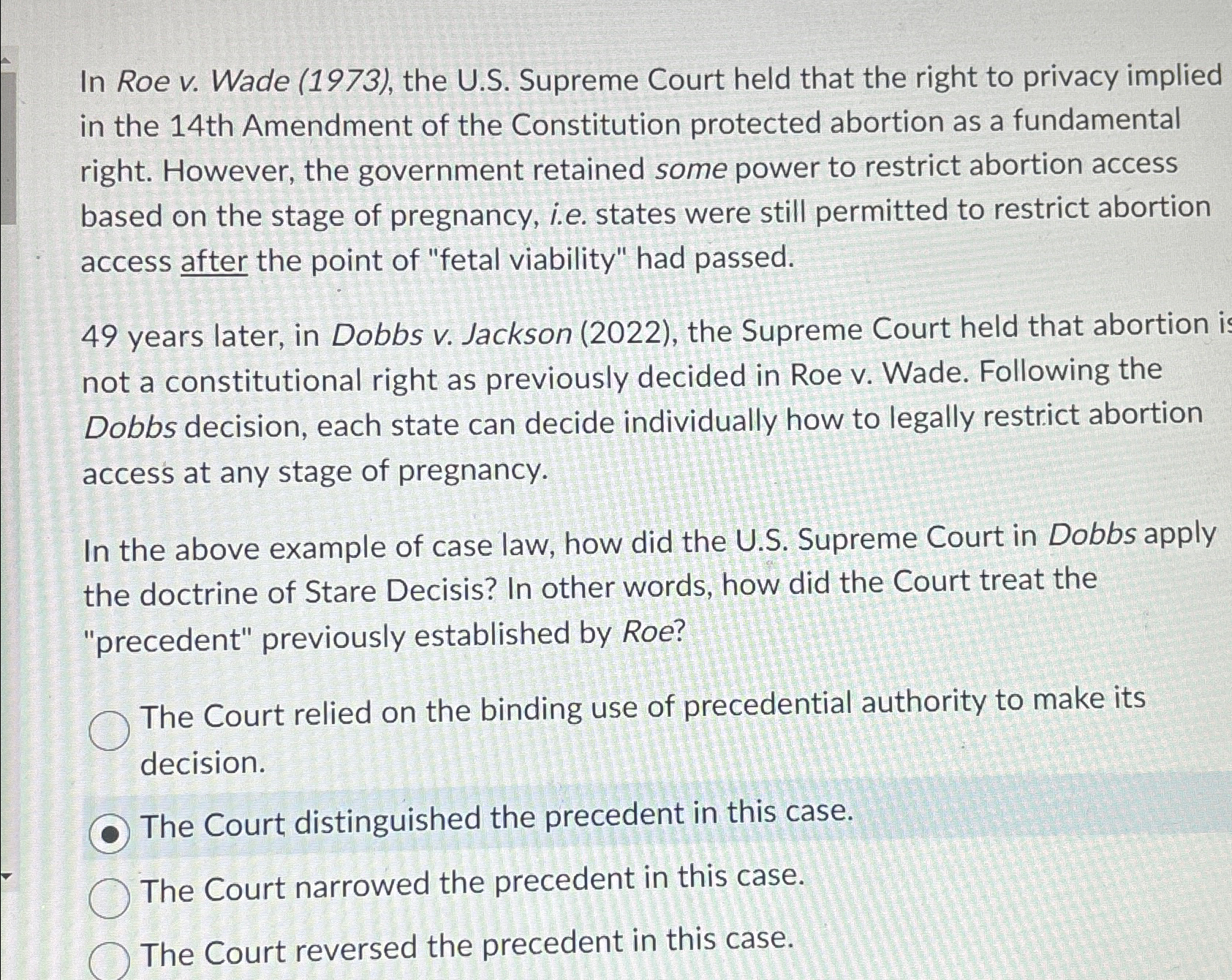
In Roe v Wade the US Supreme Court held that the right to privacy implied in the th Amendment of the Constitution protected abortion as a fundamental right. However, the government retained some power to restrict abortion access based on the stage of pregnancy, ie states were still permitted to restrict abortion access after the point of "fetal viability" had passed.
years later, in Dobbs v Jackson the Supreme Court held that abortion i not a constitutional right as previously decided in Roe v Wade. Following the Dobbs decision, each state can decide individually how to legally restrict abortion access at any stage of pregnancy.
In the above example of case law, how did the US Supreme Court in Dobbs apply the doctrine of Stare Decisis? In other words, how did the Court treat the "precedent" previously established by Roe?
The Court relied on the binding use of precedential authority to make its decision.
The Court distinguished the precedent in this case.
The Court narrowed the precedent in this case.
The Court reversed the precedent in this case.
Step by Step Solution
There are 3 Steps involved in it
1 Expert Approved Answer
Step: 1 Unlock

Question Has Been Solved by an Expert!
Get step-by-step solutions from verified subject matter experts
Step: 2 Unlock
Step: 3 Unlock
 Study Help