







Question: In special relativity, an object that has length L centimeters when at rest with respect to the observer has a relativistic length, LR centimeters, given
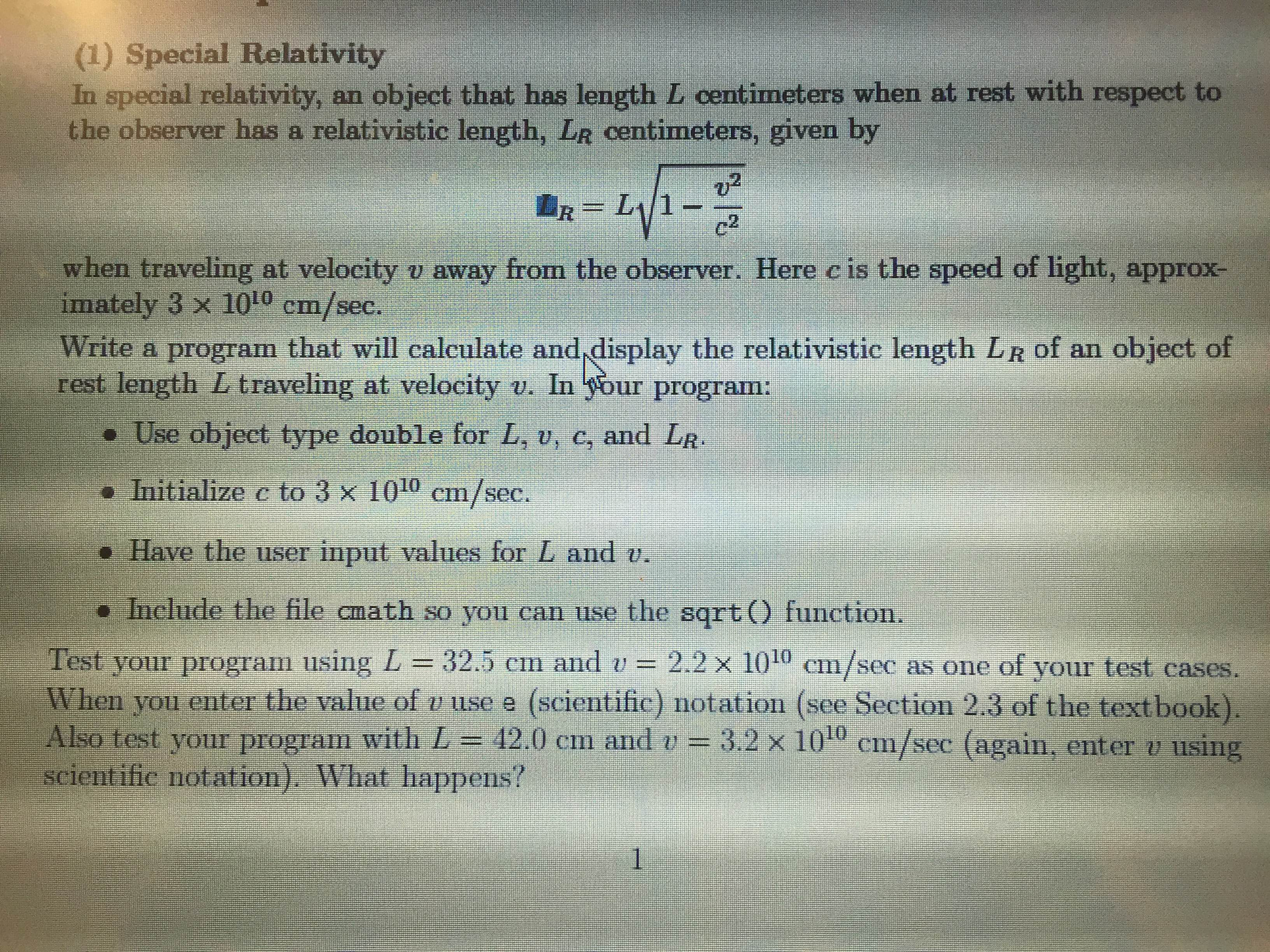
In special relativity, an object that has length L centimeters when at rest with respect to the observer has a relativistic length, LR centimeters, given by
LR = L sqrt( 1 ? (v^2 /c^2) )
when traveling at velocity v away from the observer. Here c is the speed of light, approximately 3 10^10 cm/sec.
Write a program that will calculate and display the relativistic length LR of an object of rest length L traveling at velocity v. In your program:
Use object type double for L, v, c, and LR.
Initialize c to 3 10^10 cm/sec.
Have the user input values for L and v.
Include the file cmath so you can use the sqrt() function.
Test your program using L = 32.5 cm and v = 2.210^10 cm/sec as one of your test cases. When you enter the value of v use e (scientific) notation (see Section 2.3 of the textbook). Also test your program with L = 42.0 cm and v = 3.210^10 cm/sec (again, enter v using scientific notation). What happens?
This is a pic of the problem just in case! and this problem is for my C++ class.
Step by Step Solution
There are 3 Steps involved in it

Get step-by-step solutions from verified subject matter experts
 Study Help