Question: In the case below, the original source material is given along with a sample of student work. Determine the type of plagiarism by clicking the
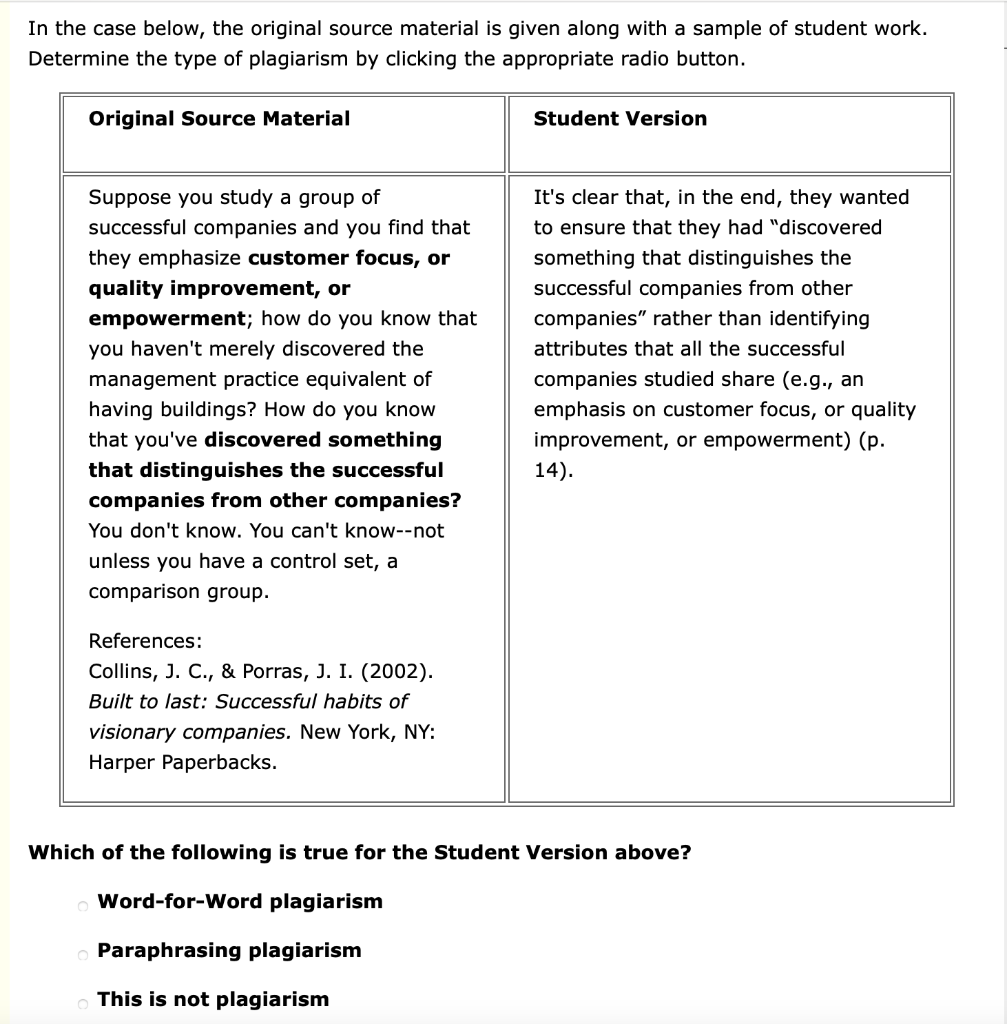
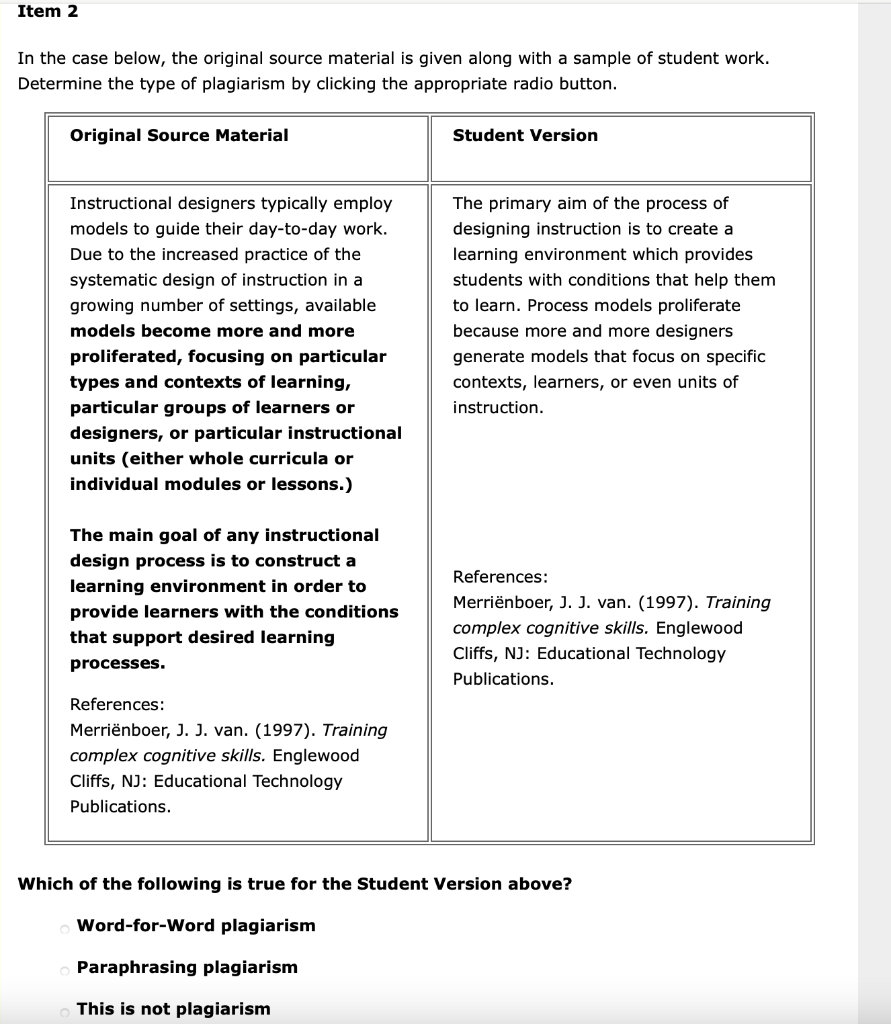
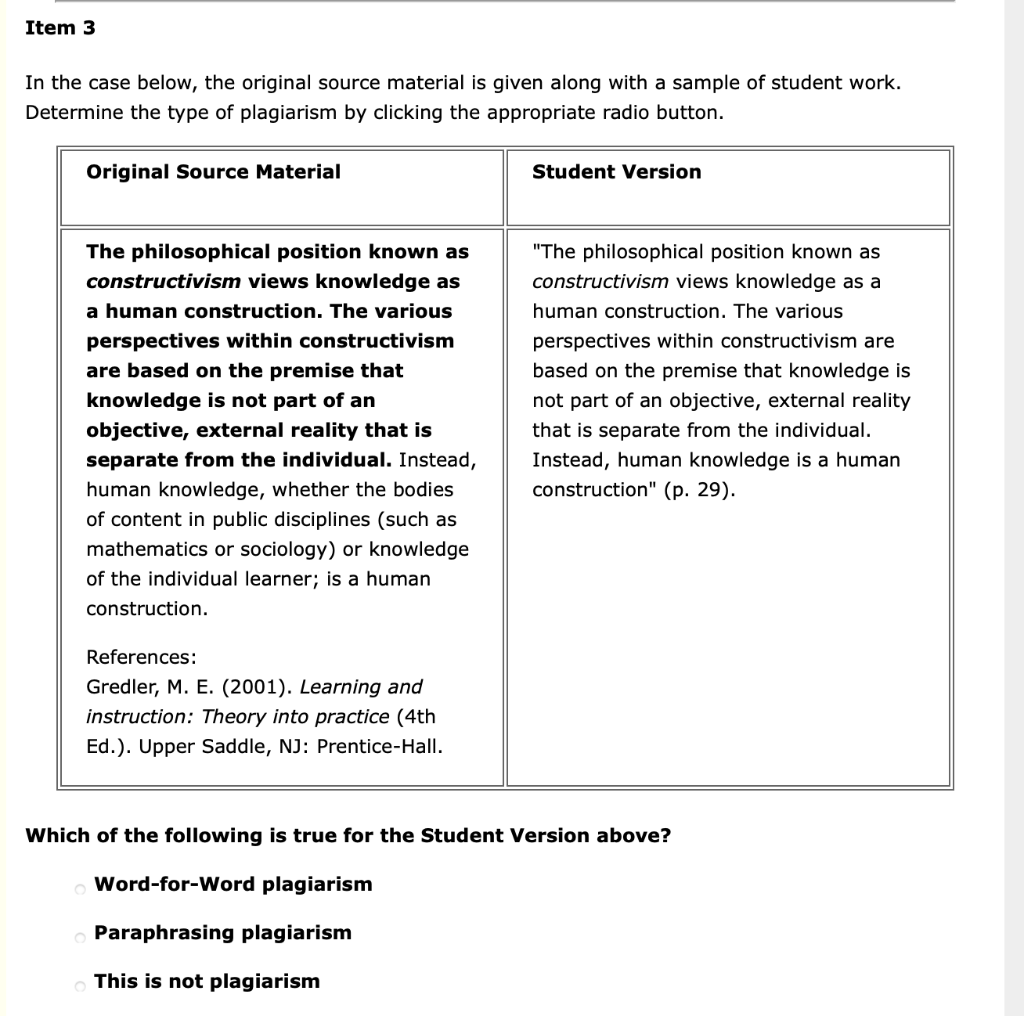
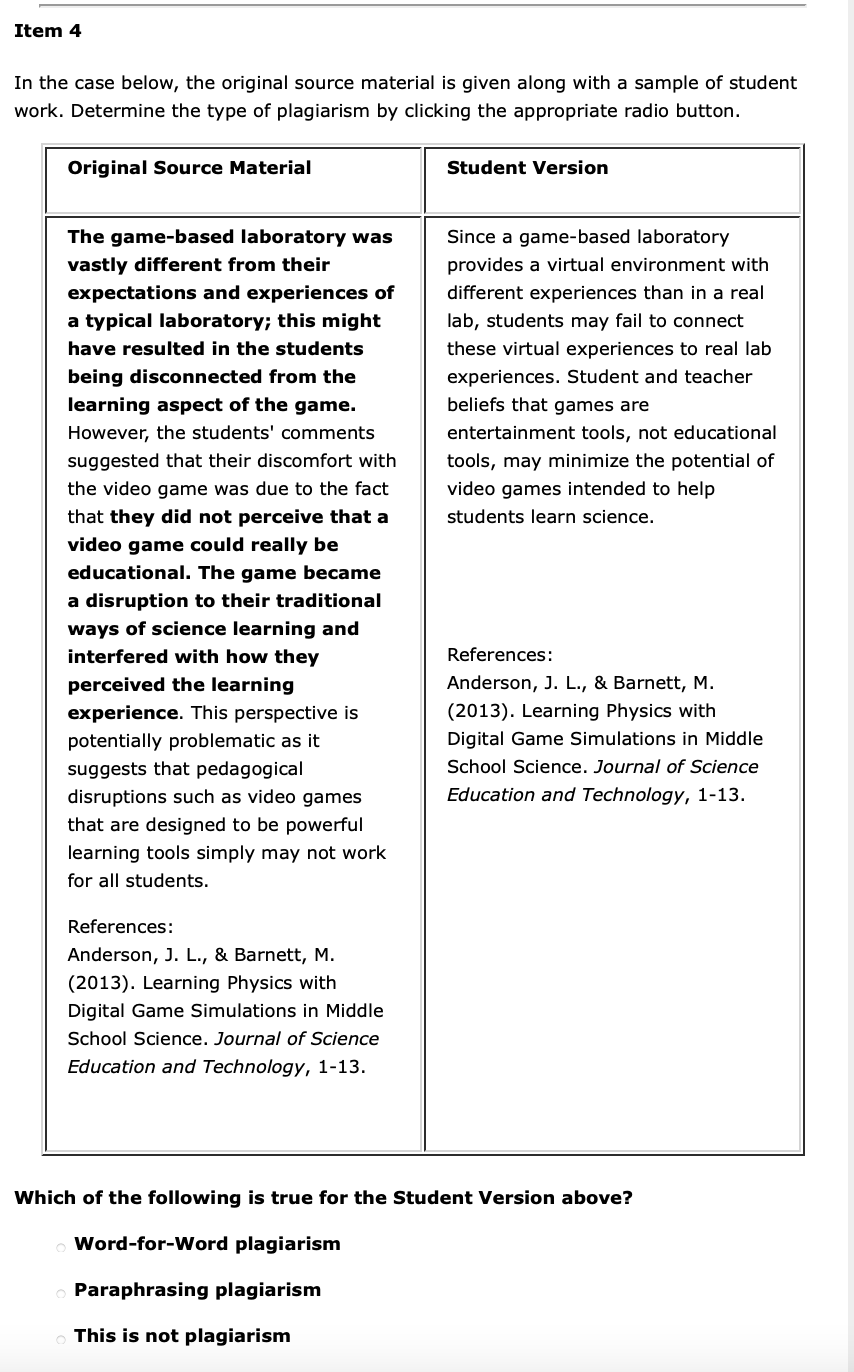
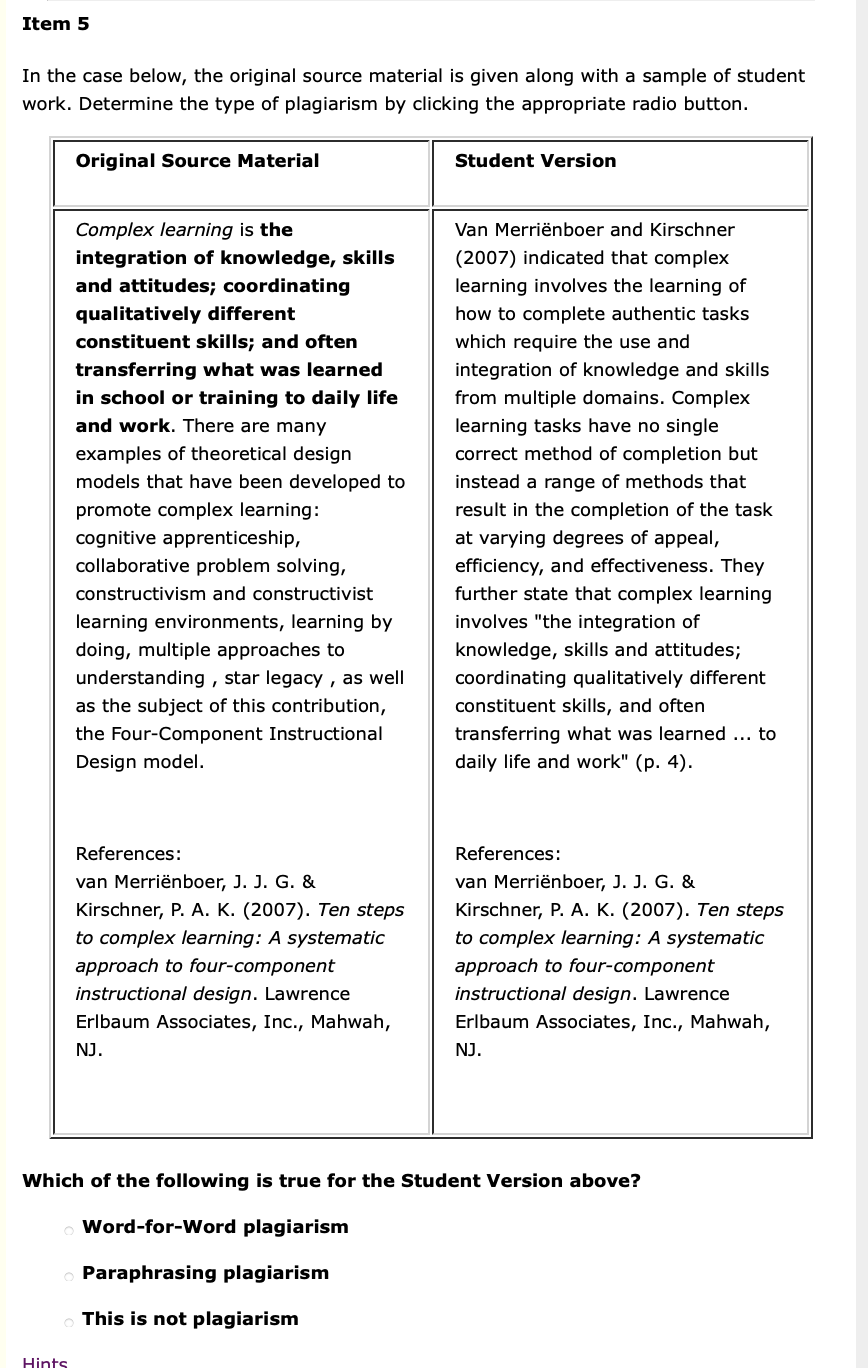
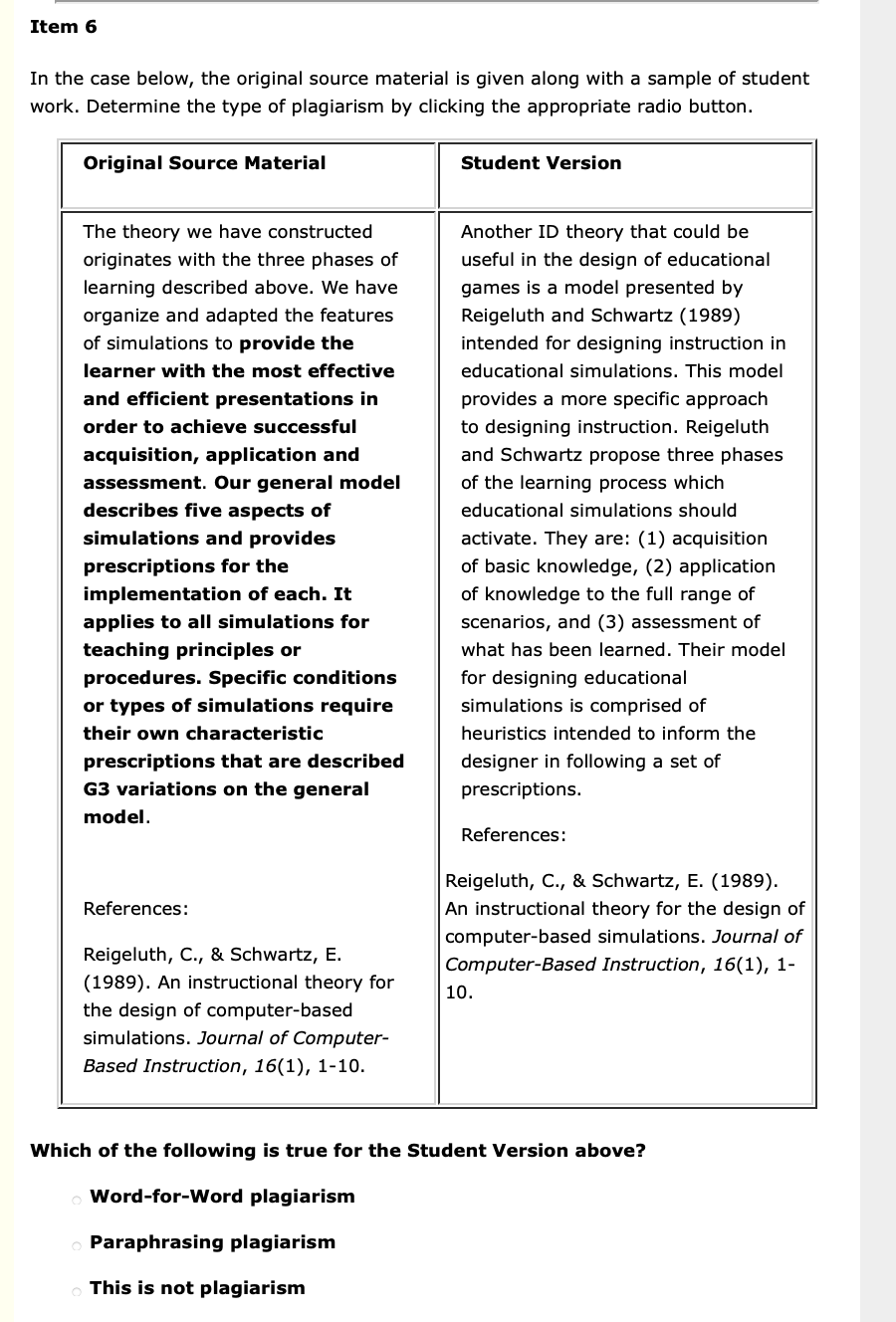
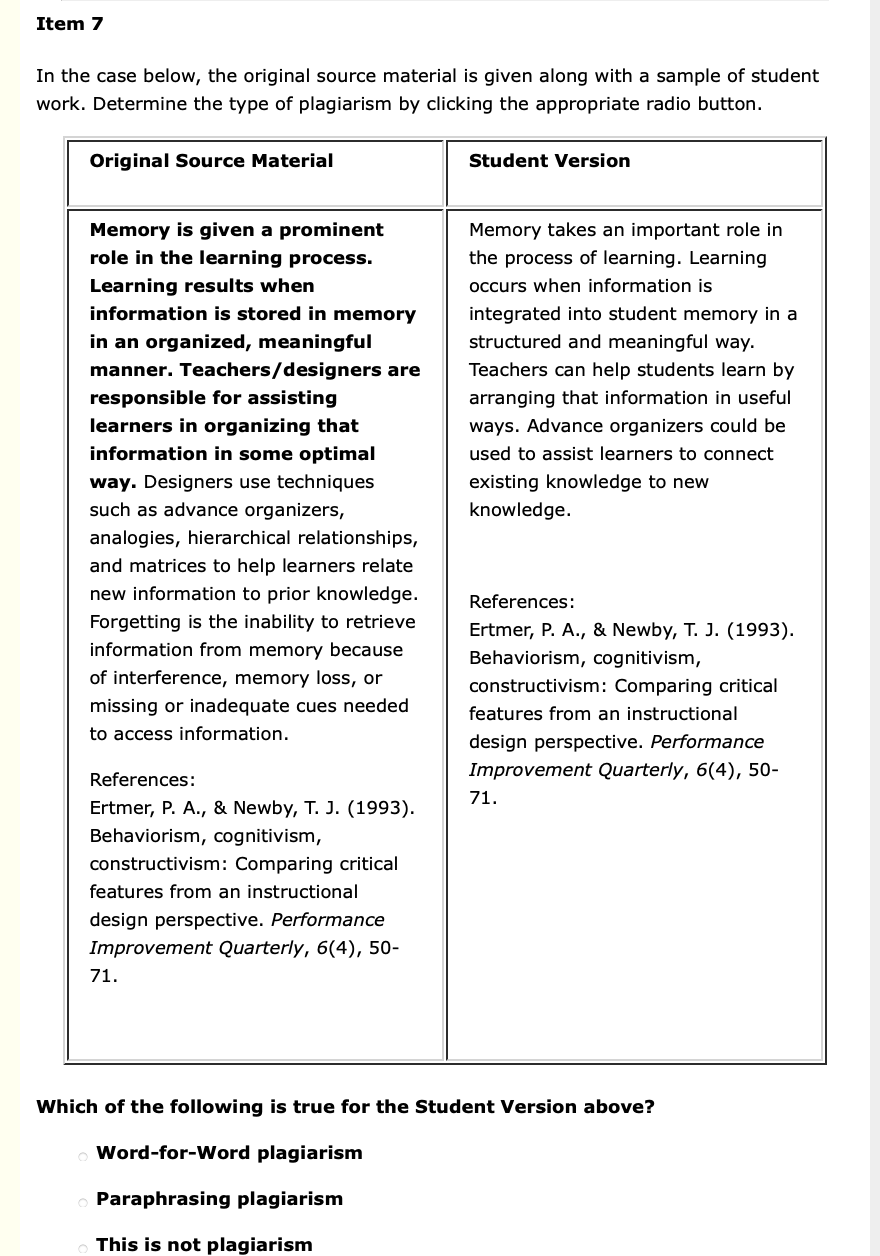
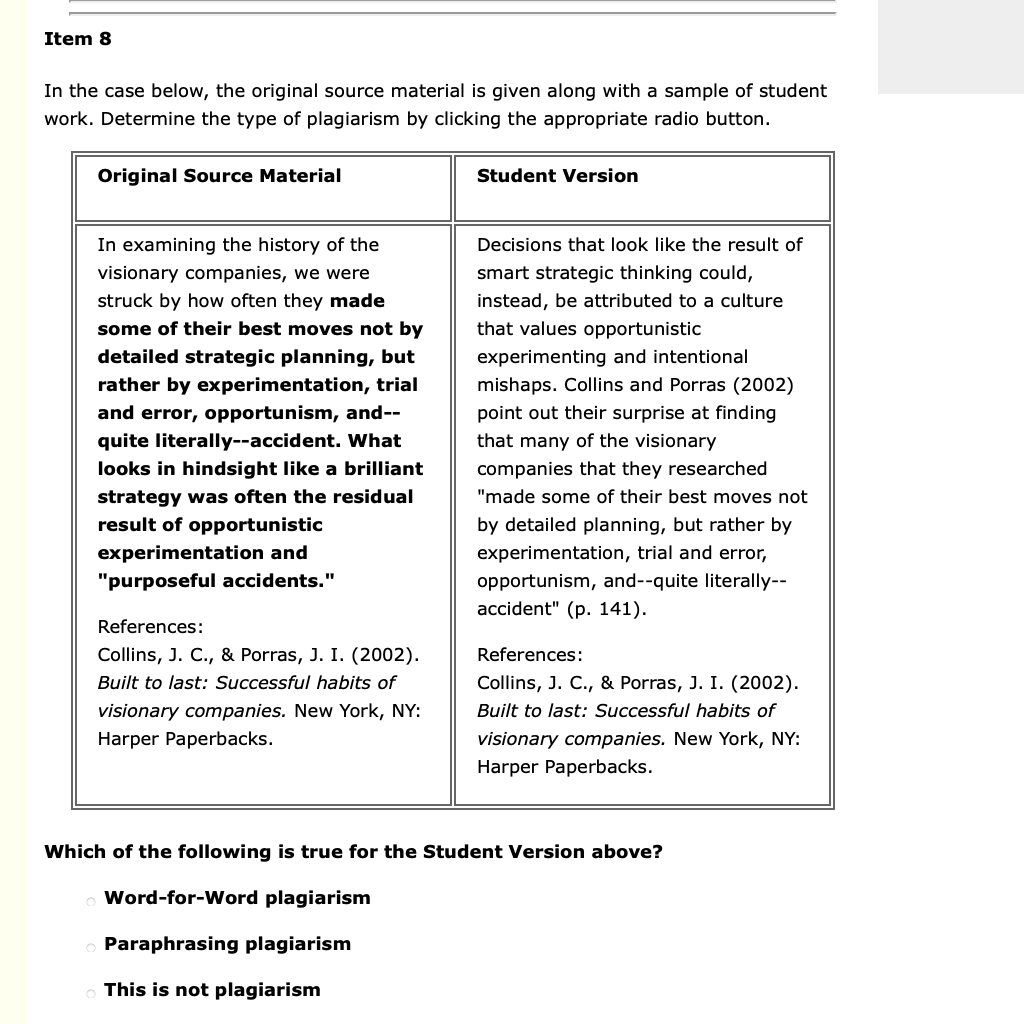
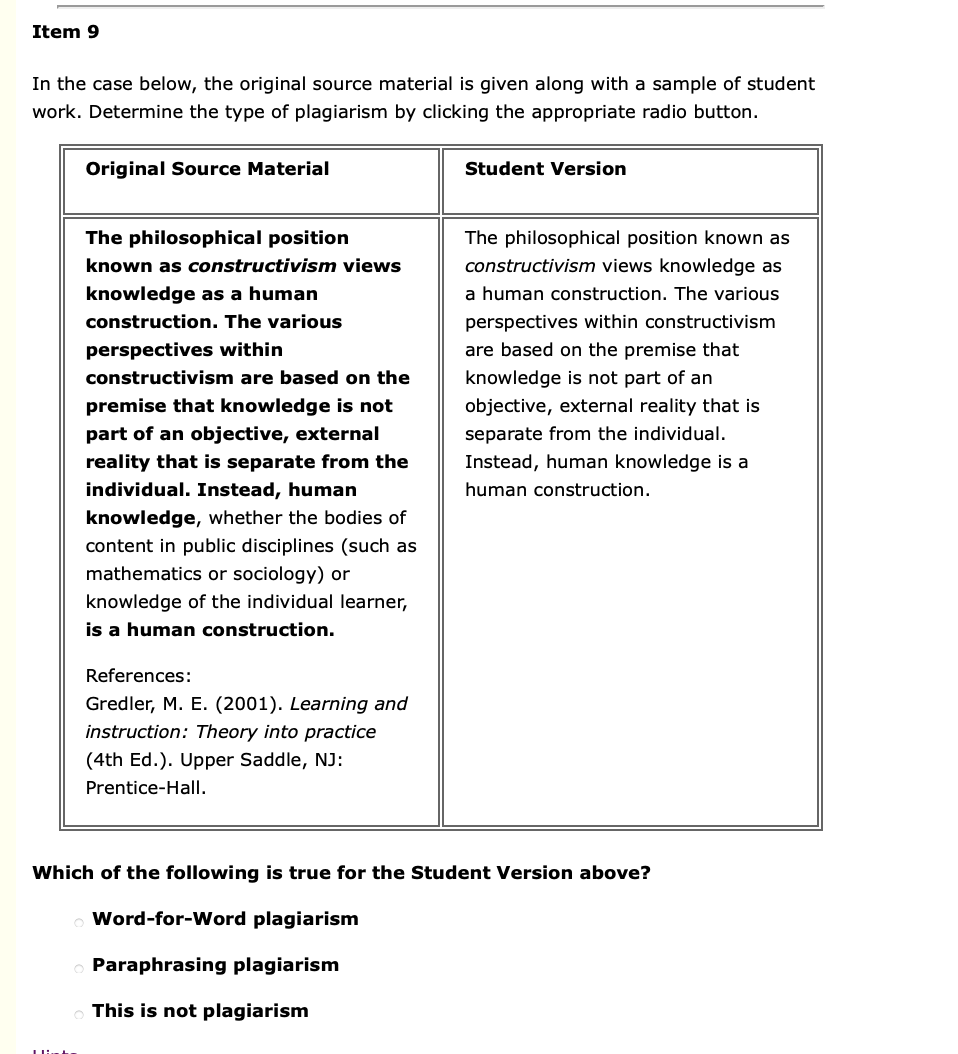
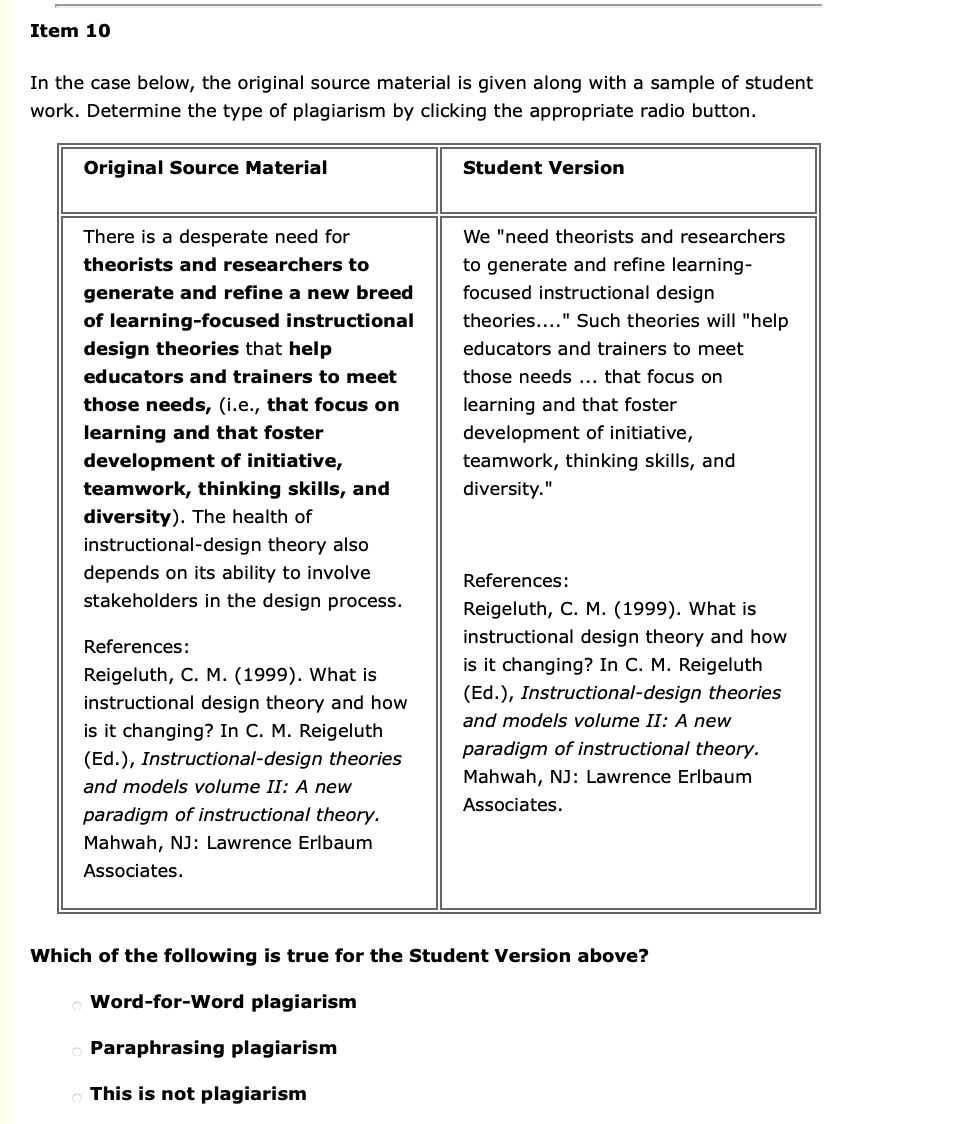
In the case below, the original source material is given along with a sample of student work. Determine the type of plagiarism by clicking the appropriate radio button. Original Source Material Student Version Suppose you study a group of successful companies and you find that they emphasize customer focus, or quality improvement, or empowerment; how do you know that you haven't merely discovered the management practice equivalent of having buildings? How do you know that you've discovered something that distinguishes the successful companies from other companies? You don't know. You can't know--not unless you have a control set, a comparison group. It's clear that, in the end, they wanted to ensure that they had "discovered something that distinguishes the successful companies from other companies" rather than identifying attributes that all the successful companies studied share (e.g., an emphasis on customer focus, or quality improvement, or empowerment) (p. 14). References: Collins, J. C., & Porras, J. I. (2002). Built to last: Successful habits of visionary companies. New York, NY: Harper Paperbacks. Which of the following is true for the Student Version above? Word-for-Word plagiarism Paraphrasing plagiarism This is not plagiarism Item 2 In the case below, the original source material is given along with a sample of student work. Determine the type of plagiarism by clicking the appropriate radio button. Original Source Material Student Version Instructional designers typically employ models to guide their day-to-day work. Due to the increased practice of the systematic design of instruction in a growing number of settings, available models become more and more proliferated, focusing on particular types and contexts of learning, particular groups of learners or designers, or particular instructional units (either whole curricula or individual modules or lessons.) The primary aim of the process of designing instruction is to create a learning environment which provides students with conditions that help them to learn. Process models proliferate because more and more designers generate models that focus on specific contexts, learners, or even units of instruction. The main goal of any instructional design process is to construct a learning environment in order to provide learners with the conditions that support desired learning processes. References: Merrinboer, J. J. van. (1997). Training complex cognitive skills. Englewood Cliffs, NJ: Educational Technology Publications. References: Merrinboer, J. J. van. (1997). Training complex cognitive skills. Englewood Cliffs, NJ: Educational Technology Publications. Which of the following is true for the Student Version above? Word-for-Word plagiarism Paraphrasing plagiarism This is not plagiarism Item 3 In the case below, the original source material is given along with a sample of student work. Determine the type of plagiarism by clicking the appropriate radio button. Original Source Material Student Version The philosophical position known as constructivism views knowledge as a human construction. The various perspectives within constructivism are based on the premise that knowledge is not part of an objective, external reality that is separate from the individual. Instead, human knowledge, whether the bodies of content in public disciplines (such as mathematics or sociology) or knowledge of the individual learner; is a human construction. "The philosophical position known as constructivism views knowledge as a human construction. The various perspectives within constructivism are based on the premise that knowledge is not part of an objective, external reality that is separate from the individual. Instead, human knowledge is a human construction" (p. 29). References: Gredler, M. E. (2001). Learning and instruction: Theory into practice (4th Ed.). Upper Saddle, NJ: Prentice-Hall. Which of the following is true for the Student Version above? Word-for-Word plagiarism Paraphrasing plagiarism This is not plagiarism Item 4 In the case below, the original source material is given along with a sample of student work. Determine the type of plagiarism by clicking the appropriate radio button. Original Source Material Student Version Since a game-based laboratory provides a virtual environment with different experiences than in a real lab, students may fail to connect these virtual experiences to real lab experiences. Student and teacher beliefs that games are entertainment tools, not educational tools, may minimize the potential of video games intended to help students learn science. The game-based laboratory was vastly different from their expectations and experiences of a typical laboratory; this might have resulted in the students being disconnected from the learning aspect of the game. However, the students' comments suggested that their discomfort with the video game was due to the fact that they did not perceive that a video game could really be educational. The game became a disruption to their traditional ways of science learning and interfered with how they perceived the learning experience. This perspective is potentially problematic as it suggests that pedagogical disruptions such as video games that are designed to be powerful learning tools simply may not work for all students. References: Anderson, J. L., & Barnett, M. (2013). Learning Physics with Digital Game Simulations in Middle School Science. Journal of Science Education and Technology, 1-13. References: Anderson, J. L., & Barnett, M. (2013). Learning Physics with Digital Game Simulations in Middle School Science. Journal of Science Education and Technology, 1-13. Which of the following is true for the Student Version above? Word-for-Word plagiarism Paraphrasing plagiarism This is not plagiarism Item 5 In the case below, the original source material is given along with a sample of student work. Determine the type of plagiarism by clicking the appropriate radio button. Original Source Material Student Version Complex learning is the integration of knowledge, skills and attitudes; coordinating qualitatively different constituent skills; and often transferring what was learned in school or training to daily life and work. There are many examples of theoretical design models that have been developed to promote complex learning: cognitive apprenticeship, collaborative problem solving, constructivism and constructivist learning environments, learning by doing, multiple approaches to understanding, star legacy, as well as the subject of this contribution, the Four-Component Instructional Design model. Van Merrinboer and Kirschner (2007) indicated that complex learning involves the learning of how to complete authentic tasks which require the use and integration of knowledge and skills from multiple domains. Complex learning tasks have no single correct method of completion but instead a range of methods that result in the completion of the task at varying degrees of appeal, efficiency, and effectiveness. They further state that complex learning involves "the integration of knowledge, skills and attitudes; coordinating qualitatively different constituent skills, and often transferring what was learned ... to daily life and work" (p. 4). References: van Merrinboer, J. J. G. & Kirschner, P. A. K. (2007). Ten steps to complex learning: A systematic approach to four-component instructional design. Lawrence Erlbaum Associates, Inc., Mahwah, NJ. References: van Merrinboer, J. J. G. & Kirschner, P. A. K. (2007). Ten steps to complex learning: A systematic approach to four-component instructional design. Lawrence Erlbaum Associates, Inc., Mahwah, NJ. Which of the following is true for the Student Version above? Word-for-Word plagiarism Paraphrasing plagiarism This is not plagiarism Hints Item 6 In the case below, the original source material is given along with a sample of student work. Determine the type of plagiarism by clicking the appropriate radio button. Original Source Material Student Version The theory we have constructed originates with the three phases of learning described above. We have organize and adapted the features of simulations to provide the learner with the most effective and efficient presentations in order to achieve successful acquisition, application and assessment. Our general model describes five aspects of simulations and provides prescriptions for the implementation of each. It applies to all simulations for teaching principles or procedures. Specific conditions or types of simulations require their own characteristic prescriptions that are described G3 variations on the general model. Another ID theory that could be useful in the design of educational games is a model presented by Reigeluth and Schwartz (1989) intended for designing instruction in educational simulations. This model provides a more specific approach to designing instruction. Reigeluth and Schwartz propose three phases of the learning process which educational simulations should activate. They are: (1) acquisition of basic knowledge, (2) application of knowledge to the full range of scenarios, and (3) assessment of what has been learned. Their model for designing educational simulations is comprised of heuristics intended to inform the designer in following a set of prescriptions. References: References: Reigeluth, C., & Schwartz, E. (1989). An instructional theory for the design of computer-based simulations. Journal of Computer-Based Instruction, 16(1), 1- 10. Reigeluth, C., & Schwartz, E. (1989). An instructional theory for the design of computer-based simulations. Journal of Computer- Based Instruction, 16(1), 1-10. Which of the following is true for the Student Version above? Word-for-Word plagiarism Paraphrasing plagiarism This is not plagiarism Item 7 In the case below, the original source material is given along with a sample of student work. Determine the type of plagiarism by clicking the appropriate radio button. Original Source Material Student Version Memory is given a prominent role in the learning process. Learning results when information is stored in memory in an organized, meaningful manner. Teachers/designers are responsible for assisting learners in organizing that information in some optimal way. Designers use techniques such as advance organizers, analogies, hierarchical relationships, and matrices to help learners relate new information to prior knowledge. Forgetting is the inability to retrieve information from memory because of interference, memory loss, or missing or inadequate cues needed to access information. Memory takes an important role in the process of learning. Learning occurs when information is integrated into student memory in a structured and meaningful way. Teachers can help students learn by arranging that information in useful ways. Advance organizers could be used to assist learners to connect existing knowledge to new knowledge. References: Ertmer, P. A., & Newby, T. J. (1993). Behaviorism, cognitivism, constructivism: Comparing critical features from an instructional design perspective. Performance Improvement Quarterly, 6(4), 50- 71. References: Ertmer, P. A., & Newby, T. J. (1993). Behaviorism, cognitivism, constructivism: Comparing critical features from an instructional design perspective. Performance Improvement Quarterly, 6(4), 50- 71. Which of the following is true for the Student Version above? Word-for-Word plagiarism Paraphrasing plagiarism This is not plagiarism Item 8 In the case below, the original source material is given along with a sample of student work. Determine the type of plagiarism by clicking the appropriate radio button. Original Source Material Student Version In examining the history of the visionary companies, we were struck by how often they made some of their best moves not by detailed strategic planning, but rather by experimentation, trial and error, opportunism, and-- quite literally--accident. What looks in hindsight like a brilliant strategy was often the residual result of opportunistic experimentation and "purposeful accidents." Decisions that look like the result of smart strategic thinking could, instead, be attributed to a culture that values opportunistic experimenting and intentional mishaps. Collins and Porras (2002) point out their surprise at finding that many of the visionary companies that they researched "made some of their best moves not by detailed planning, but rather by experimentation, trial and error, opportunism, and--quite literally-- accident" (p. 141). References: Collins, J. C., & Porras, J. I. (2002). Built to last: Successful habits of visionary companies. New York, NY: Harper Paperbacks. References: Collins, J. C., & Porras, J. I. (2002). Built to last: Successful habits of visionary companies. New York, NY: Harper Paperbacks. Which of the following is true for the Student Version above? Word-for-Word plagiarism Paraphrasing plagiarism This is not plagiarism Item 9 In the case below, the original source material is given along with a sample of student work. Determine the type of plagiarism by clicking the appropriate radio button. Original Source Material Student Version The philosophical position known as constructivism views knowledge as a human construction. The various perspectives within constructivism are based on the premise that knowledge is not part of an objective, external reality that is separate from the individual. Instead, human knowledge, whether the bodies of content in public disciplines (such as mathematics or sociology) or knowledge of the individual learner, is a human construction. The philosophical position known as constructivism views knowledge as a human construction. The various perspectives within constructivism are based on the premise that knowledge is not part of an objective, external reality that is separate from the individual. Instead, human kno is a human construction. References: Gredler, M. E. (2001). Learning and instruction: Theory into practice (4th Ed.). Upper Saddle, NJ: Prentice-Hall. Which of the following is true for the Student Version above? Word-for-Word plagiarism Paraphrasing plagiarism This is not plagiarism Item 10 In the case below, the original source material is given along with a sample of student work. Determine the type of plagiarism by clicking the appropriate radio button. Original Source Material Student Version There is a desperate need for theorists and researchers to generate and refine a new breed of learning-focused instructional design theories that help educators and trainers to meet those needs, i.e., that focus on learning and that foster development of initiative, teamwork, thinking skills, and diversity). The health of instructional-design theory also depends on its ability to involve stakeholders in the design process. We "need theorists and researchers to generate and refine learning- focused instructional design theories...." Such theories will "help educators and trainers to meet those needs ... that focus on learning and that foster development of initiative, teamwork, thinking skills, and diversity." References: Reigeluth, C. M. (1999). What is instructional design theory and how is it changing? In C. M. Reigeluth (Ed.), Instructional-design theories and models volume II: A new paradigm of instructional theory. Mahwah, NJ: Lawrence Erlbaum Associates. References: Reigeluth, C. M. (1999). What is instructional design theory and how is it changing? In C. M. Reigeluth (Ed.), Instructional-design theories and models volume II: A new paradigm of instructional theory. Mahwah, NJ: Lawrence Erlbaum Associates. Which of the following is true for the Student Version above? Word-for-Word plagiarism Paraphrasing plagiarism This is not plagiarism









 Study Help