







Question: In the case below, the original source material is given along with a sample of student work. Determine the type of plagiarism by clicking the
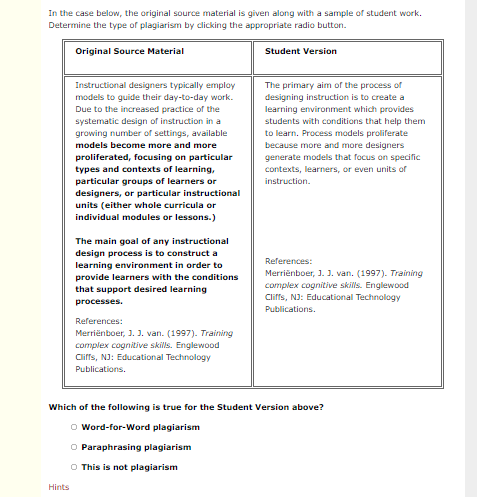
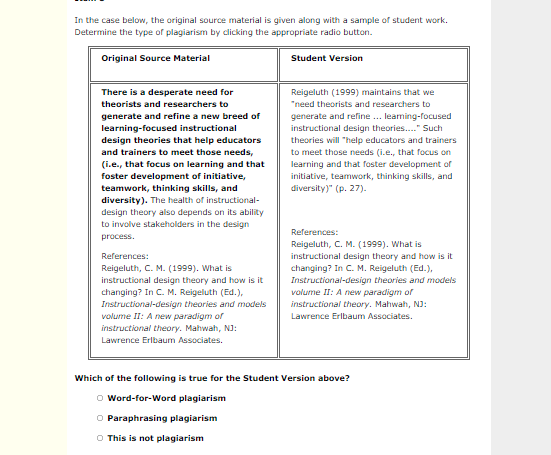
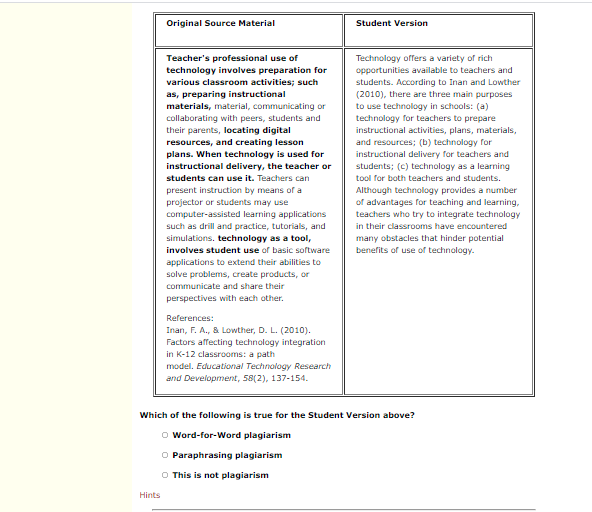
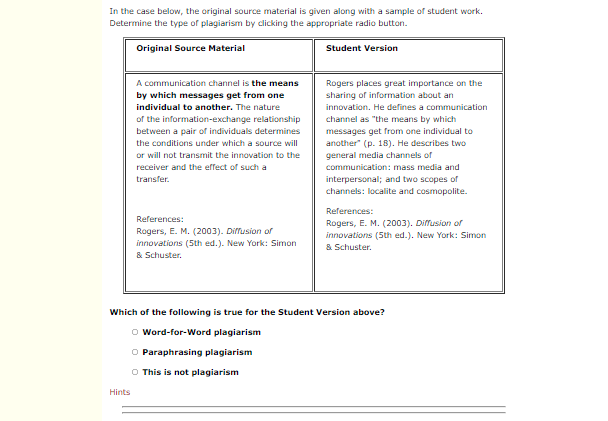
In the case below, the original source material is given along with a sample of student work. Determine the type of plagiarism by clicking the appropriate radio button. Original Source Material Student Version Instructional designers typically employ models to guide their day-to-day work. Due to the increased practice of the systematic design of instruction in a growing number of settings, available models become more and more proliferated, focusing on particular types and contexts of learning, particular groups of learners or designers, or particular instructional units (either whole curricula or individual modules or lessons.) The primary aim of the process of designing instruction is to create a learning environment which provides students with conditions that help them to learn. Process models proliferate because more and more designers generate models that focus on specific contexts, learners, or even units of instruction. The main goal of any instructional design process is to construct a learning environment in order to provide learners with the conditions that support desired learning processes. References: Merrienboer, J. J. van. (1997). Training complex cognitive skills. Englewood Cliffs, NJ: Educational Technology Publications. References: Merrienboer, J. J. van. (1997). Training complex cognitive skills. Englewood Cliffs, NJ: Educational Technology Publications. Which of the following is true for the Student Version above? O Word-for-Word plagiarism O Paraphrasing plagiarism O This is not plagiarism Hints In the case below, the original source material is given along with a sample of student work. Determine the type of plagiarism by clicking the appropriate radio button. Original Source Material Student Version Reigeluth (1999) maintains that we "need theorists and researchers to generate and refine ... leaming-focused instructional design theories...." Such theories will help educators and trainers to meet those needs (i.e., that focus on learning and that foster development of initiative, teamwork, thinking skills, and diversity)" (p. 27). There is a desperate need for theorists and researchers to generate and refine a new breed of learning-focused instructional design theories that help educators and trainers to meet those needs, (i.e., that focus on learning and that foster development of initiative, teamwork, thinking skills, and diversity). The health of instructional- design theory also depends on its ability to involve stakeholders in the design process. References: Reigeluth, C. M. (1999). What is instructional design theory and how is it changing? In C. M. Reigeluth (Ed.), Instructional-design theories and models volume II: A new paradigm of instructional theory. Mahwah, NJ: Lawrence Erlbaum Associates. References: Reigeluth, C. M. (1999). What is instructional design theory and how is it changing? In C. M. Reigeluth (Ed.), Instructional-design theories and models volume II: A new paradigm of instructional theory. Mahwah, NJ: Lawrence Erlbaum Associates. Which of the following is true for the Student Version above? Word-for-Word plagiarism O Paraphrasing plagiarism This is not plagiarism Original Source Material Student Version Teacher's professional use of technology involves preparation for various classroom activities, such as, preparing instructional materials, material, communicating or collaborating with peers, students and their parents, locating digital resources, and creating lesson plans. When technology is used for instructional delivery, the teacher or students can use it. Teachers can present instruction by means of a projector or students may use computer-assisted learning applications such as drill and practice, tutorials, and simulations, technology as a tool, involves student use of basic software applications to extend their abilities to solve problems, create products, or communicate and share their perspectives with each other. References: Inan, F. A., & Lowther, D. L. (2010). Factors affecting technology integration in K-12 classrooms: a path model. Educational Technology Research and Development, 58(2), 137-154. Technology offers a variety of rich opportunities available to teachers and students. According to inan and Lowther (2010), there are three main purposes to use technology in schools: (a) technology for teachers to prepare instructional activities, plans, materials, and resources; (b) technology for instructional delivery for teachers and students; (c) technology as a learning tool for both teachers and students. Although technology provides a number of advantages for teaching and learning, teachers who try to integrate technology in their classrooms have encountered many obstacles that hinder potential benefits of use of technology Which of the following is true for the Student Version above? o Word-for-Word plagiarism O Paraphrasing plagiarism O This is not plagiarism Hints In the case below, the original source material is given along with a sample of student work. Determine the type of plagiarism by clicking the appropriate radio button. Original Source Material Student Version A communication channel is the means by which messages get from one individual to another. The nature of the information-exchange relationship between a pair of individuals determines the conditions under which a source will or will not transmit the innovation to the receiver and the effect of such a transfer. Rogers places great importance on the sharing of information about an innovation. He defines a communication channel as "the means by which messages get from one individual to another" (p. 18). He describes two general media channels of communication: mass media and interpersonal; and two scopes of channels: localite and cosmopolite. References: Rogers, E. M. (2003). Dilusion of innovations (5th ed.). New York: Simon & Schuster References: Rogers, E. M. (2003). Diffusion of innovations (5th ed.). New York: Simon & Schuster. Which of the following is true for the Student Version above? O Word-for-Word plagiarism O Paraphrasing plagiarism O This is not plagiarism Hints
Step by Step Solution
There are 3 Steps involved in it
1 Expert Approved Answer
Step: 1 Unlock

Question Has Been Solved by an Expert!
Get step-by-step solutions from verified subject matter experts
Step: 2 Unlock
Step: 3 Unlock
 Study Help