







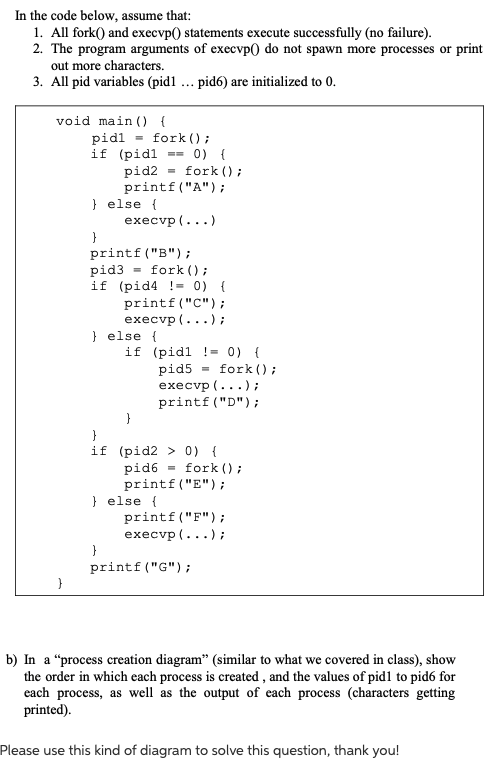
Question: In the code below, assume that: 1. All fork() and execvp0) statements execute successfully (no failure). 2. The program arguments of execvpO do not
 \\
\\
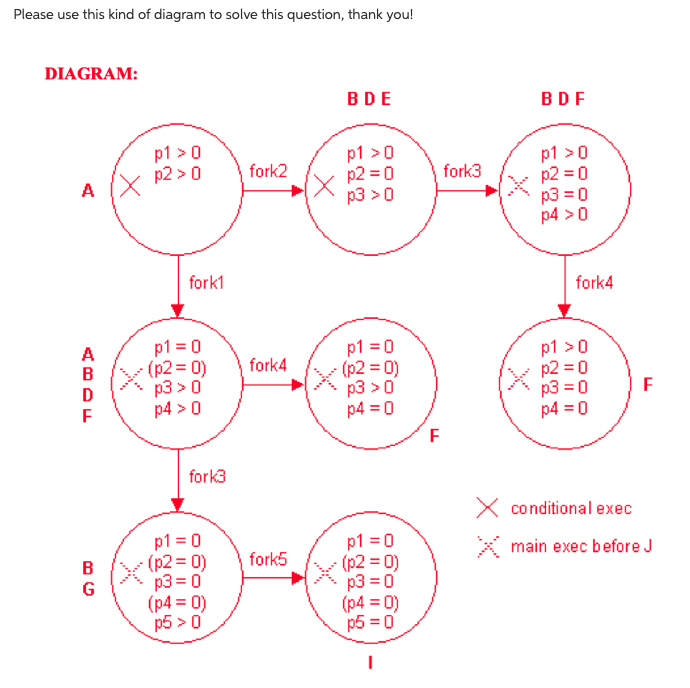
In the code below, assume that: 1. All fork() and execvp0) statements execute successfully (no failure). 2. The program arguments of execvpO do not spawn more processes or print out more characters. 3. All pid variables (pidi ... pid6) are initialized to 0. void main() { pidi fork(); if (pidi 0) { pid2 = fork(); printf ("A"); } else { execvp(...) } printf ("B"); pid3 fork(); if (pid !- 0) { printf("C"); execvp (...); } else { if (pidi != 0) { pid5 fork(); execvp (...); printf ("D"); } if (pid2 > 0) { pid6 - fork(); printf ("E"); } else { printf("F"); execvp (...); } printf ("G"); } b) In a "process creation diagram (similar to what we covered in class), show the order in which each process is created, and the values of pidi to pido for each process, as well as the output of each process (characters getting printed). Please use this kind of diagram to solve this question, thank you! Please use this kind of diagram to solve this question, thank you! DIAGRAM: BDE BDF p1>0 p2 > 0 fork2 p1 > p2 = 0 p3 > 0 fork3 AX p1 > 0 p2 = 0 p3 = 0 p4 > fork1 fork4 fork4 A B D F p1 = 0 (p2 = 0) p3 > 0 p4 > 0 p1 = 0 (p2 = 0) p3 > 0 p4 = 0 p1 > 0 p2 = 0 p3 = 0 p4 = 0 F F fork3 x conditional exec main exec before fork5 p1 = 0 8 X 0 (p2 = 0) G p3 = 0 (p4 = 0) p5>0 p1 = 0 (p2 = 0) p3 = 0 (p4 = 0) p5 = 0 In the code below, assume that: 1. All fork() and execvp0) statements execute successfully (no failure). 2. The program arguments of execvpO do not spawn more processes or print out more characters. 3. All pid variables (pidi ... pid6) are initialized to 0. void main() { pidi fork(); if (pidi 0) { pid2 = fork(); printf ("A"); } else { execvp(...) } printf ("B"); pid3 fork(); if (pid !- 0) { printf("C"); execvp (...); } else { if (pidi != 0) { pid5 fork(); execvp (...); printf ("D"); } if (pid2 > 0) { pid6 - fork(); printf ("E"); } else { printf("F"); execvp (...); } printf ("G"); } b) In a "process creation diagram (similar to what we covered in class), show the order in which each process is created, and the values of pidi to pido for each process, as well as the output of each process (characters getting printed). Please use this kind of diagram to solve this question, thank you! Please use this kind of diagram to solve this question, thank you! DIAGRAM: BDE BDF p1>0 p2 > 0 fork2 p1 > p2 = 0 p3 > 0 fork3 AX p1 > 0 p2 = 0 p3 = 0 p4 > fork1 fork4 fork4 A B D F p1 = 0 (p2 = 0) p3 > 0 p4 > 0 p1 = 0 (p2 = 0) p3 > 0 p4 = 0 p1 > 0 p2 = 0 p3 = 0 p4 = 0 F F fork3 x conditional exec main exec before fork5 p1 = 0 8 X 0 (p2 = 0) G p3 = 0 (p4 = 0) p5>0 p1 = 0 (p2 = 0) p3 = 0 (p4 = 0) p5 = 0
Step by Step Solution
There are 3 Steps involved in it

Get step-by-step solutions from verified subject matter experts
 Study Help