







Question: In the context of memory management techniques, how does segmentation differ from paging, and what are the advantages and disadvantages of each method? Segmentation and
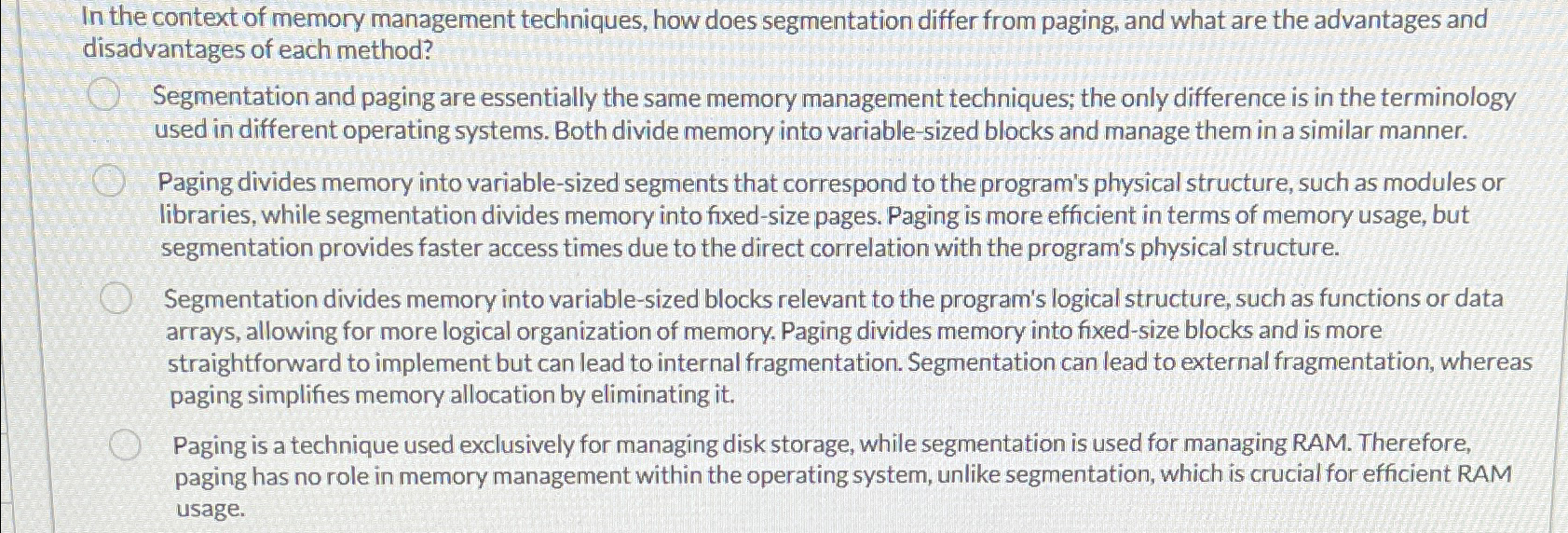
In the context of memory management techniques, how does segmentation differ from paging, and what are the advantages and disadvantages of each method?
Segmentation and paging are essentially the same memory management techniques; the only difference is in the terminology used in different operating systems. Both divide memory into variablesized blocks and manage them in a similar manner.
Paging divides memory into variablesized segments that correspond to the program's physical structure, such as modules or libraries, while segmentation divides memory into fixedsize pages. Paging is more efficient in terms of memory usage, but segmentation provides faster access times due to the direct correlation with the program's physical structure.
Segmentation divides memory into variablesized blocks relevant to the program's logical structure, such as functions or data arrays, allowing for more logical organization of memory. Paging divides memory into fixedsize blocks and is more straightforward to implement but can lead to internal fragmentation. Segmentation can lead to external fragmentation, whereas paging simplifies memory allocation by eliminating it
Paging is a technique used exclusively for managing disk storage, while segmentation is used for managing RAM. Therefore, paging has no role in memory management within the operating system, unlike segmentation, which is crucial for efficient RAM usage.
Step by Step Solution
There are 3 Steps involved in it
1 Expert Approved Answer
Step: 1 Unlock

Question Has Been Solved by an Expert!
Get step-by-step solutions from verified subject matter experts
Step: 2 Unlock
Step: 3 Unlock
 Study Help