Question: In the Eli Lilly Harvard case study, How did Eli Lilly can commit to improve and innovate change in their existing production of pharmaceutical products
In the Eli Lilly Harvard case study, How did Eli Lilly can commit to improve and innovate change in their existing production of pharmaceutical products manufactured that have not introduced in the market?
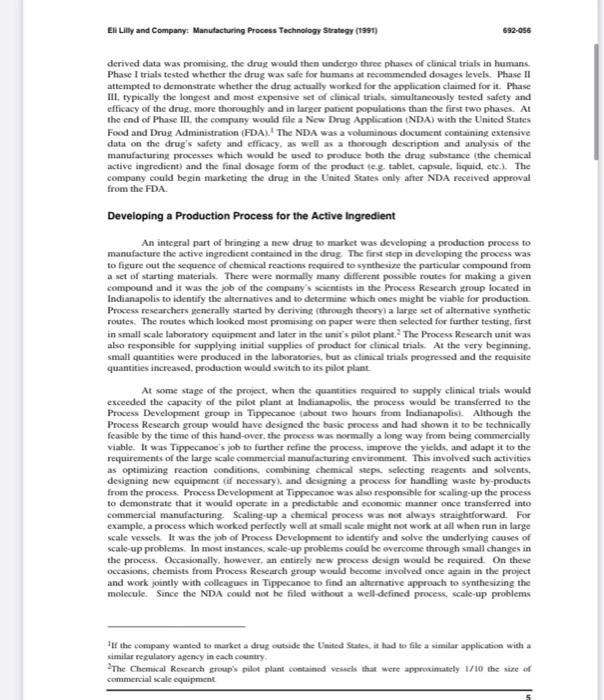
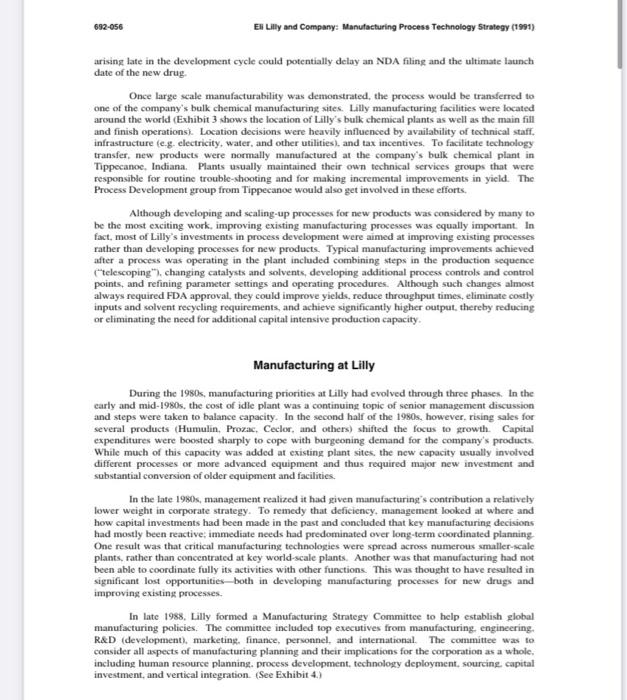
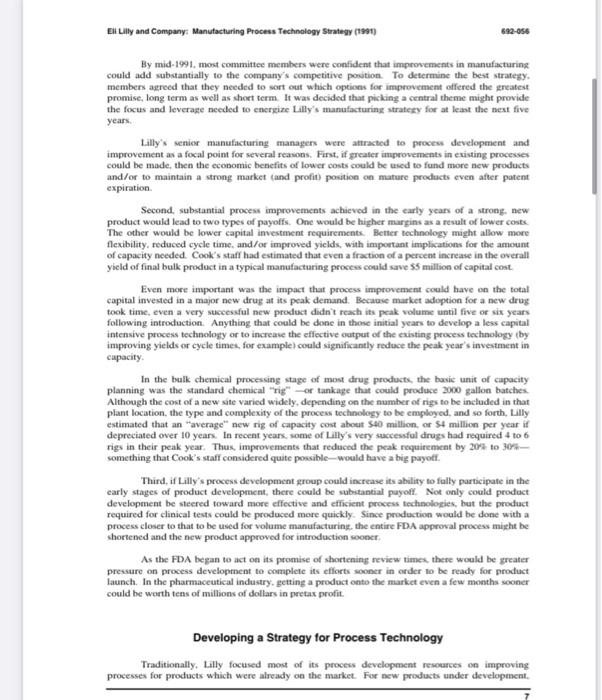
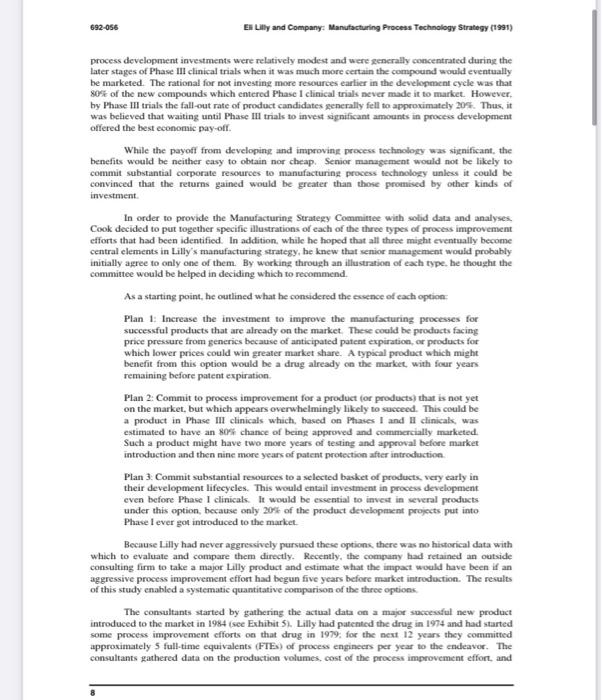
692-056 El Lilly and Company: Manufacturing Process Technology Strategy (1991) and careful management. A scientific division was formed in 1886, and a department of experimental medicine in 1912. In 1991, Lilly, with headquarters in Indianapolis, Indiana, sold a broad line of human health care and agricultural products. It was committed to all essential aspects of the industry: discovery, development, manufacture, and marketing Over one-third of its 1990 sales came from outside the United States the company manufactured and distributed its products in 25 other countries and sold them in more than 110 countries. Pharmaceuticals accounted for 71% of total sales in 1990, while medical devices and diagnostics (195) and animal products contributed the rest Exhibits 1A and B outline recent financial results. Ten Lilly pharmaceuticals sold more than $100 million each in 1990. Lilly's Ceclor. the world's number one selling antibiotic, saw a sales increase in 1990 alone of $100 million. Prozac the world's top-selling antidepressant was introduced in 1988 and rapidly became one of the company's top-selling drugs. In its first year on the market, Prozac's sales topped 100 million, faster growth than any other product in Lilly's history. Humulin. human insulin and the world's first marketed human health care product based on recombinant DNA technology), was the company's third-largest seller The pharmaceutical industry was the most profitable sector of the U.S.cconomy, Returns on equity had long been 50% higher than the median for the Fortune 500 and in the 1980s the gap had widened. Profits for most major drug companies surged in that decade, as world markets expanded and prices rose. In 1990, world pharmaceutical sales totaled $174 billion (U.S. sales were more than $50 billion), an increase of 14% over 1989. continuing a compound annual growth rate of more than 10% throughout the 1980s Pharmaceutical sales in Europe had grown by 28% in 1990 alone. Between them. North America and Europe accounted for 61% of the total: Japan made up a further 25% Market expansion was expected to continue at 79$ per year, adjusted for inflation through the mid-1990s. People around the world were living longer and desired more and better health care, In 1990, 13% of the U.S. population was 65 or older, up by more than 10 million people since 1950, and other developed countries showed similar trends. Typically, people over 65 required three or four times more medical support than younger people. In addition, developments in medical technology, including recombinant DNA and monoclonal antibodies, were yielding entirely new approaches to diagnosis and treatment and were expected to produce a mounting flow of new products. Lilly's major competitors in North America included Merck, Bristol Myers Squibb, American Home Products, Johnson and Johnson, and Pfizer. Worldwide, the largest non-American firms were European, including Ciba-Geigy, Hoechst, Glaxo. Bayer, and SmithKline-Beecham. Most of these had enjoyed growth rates comparable to or better than Lilly's United States-based firms accounted for 42% of world sales in 1990 Companies in the pharmaceutical industry vied to be first to market, especially when another firm was working on a similar product. Competitors had a minimum two years notice of imminent new drugs, because New Drug Applications (NDA) filed with the Food and Drug Authority took at least that long to gain an approval status. In addition, the first years of a drug's life often determined its long-term success. If a company could establish its product firmly in the minds of doctors before another hit the market. the follow-on products would have a more difficult product launch Moreover, maintaining a reputation as industry leader was vital to attracting people, as well as to winning the confidence of doctors and establishing credibility in academia and in government circles The key was to be seen as consistently producing quality products and undertaking leading-edge research Companies also competed vigorously with sales calls to doctors. In the 1980s, the number of pharmaceutical sales representatives employed by U.S. companies increased by 50%. Some companies maintained three or four sales teams in each region, so that each product could be fully Eli Lilly and Company: Manufacturing Process Technology Strategy (1991) 692-056 represented to physicians. Pharmaceutical sales representatives often were highly trained: many were licensed pharmacists. Drug companies, however, rarely competed on price, except occasionally when confronted with generie substitutes. Firms specialized in different kinds of drugs, or in different therapeutic classes, which allowed for some segmentation of the industry and reduced the threat of price competition Lilly, for example, concentrated on insulin and antibiotics. This enabled it to develop strong links with particular universities and other centers of research. Specialization also improved the chance that new drugs in that therapeutic group would be widely accepted. Industry Trends in the 1980s Along with higher sales and profits, the 1980s brought important changes in the competitive environment facing Lilly and other pharmaceutical companies. Many at Lilly felt that the company's response to these shifts could determine its fate in coming years. Globalization Increasingly affluent--and aging-populations in the developed countries meant new customers for health care providers. National differences in health care markets were disappearing as most major medical problems were found worldwide. In addition, government regulators were beginning to communicate and coordinate their evaluation procedures. The European Community. for example, was developing an application procedure that would accelerate approval in European national markets. While this trend could expand the number of buyers, falling trade barriers could reduce prices to the lowest levels in Europe. Rising development costs also spurred many pharmaceutical companies to seek larger markets. Complicated government approval and testing procedures drove up the cost of drug development. At the end of the 1980s, companies needed 8 to 12 years between discovery of a compound and the launch date of a commercial product. The number of patient trials required prior to FDA release for a typical drug had risen from 1.500 in 1980 to 10,000 in 1990, Average development costs per product had risen to an estimated $250 million, which included the considerable research and overhead outlays for the thousands of compounds that did not make it to the market. Slower Rates of Innovation By the mid-1980s, only one-third as many new products were introduced each year as had been during the 1950s. Although stricter regulatory requirements were partly responsible, some people argued that the pace of innovation had slowed as researchers found it increasingly difficult to identify promising new drugs. Industry experts estimated that only one of every 5,000 to 10,000 new chemical compounds discovered by researchers ever became a commercial product Government Involvement In the 1990s, two forces seemed likely to push prices and profits lower. First, governments were becoming more interventionist. By 1991, the United States was one of only a few developed countries that did not significantly intervene in the free market system. Escalating medical costs in many countries sparked new calls for cost containment. Price controls, restrictive reimbursement schemes, managed health care programs, and greater government involvement in medical and El Lilly and Company: Manufacturing Process Technology Strategy (1991) 692-056 derived data was promising the drug would then undergo three phases of clinical trials in humans. Phase I trials tested whether the drug was safe for humans at recommended dosages levels. Phase II attempted to demonstrate whether the drug actually worked for the application claimed for it. Phase III. typically the longest and most expensive set of clinical trials, simultaneously tested safety and efficacy of the drug, more thoroughly and in larger patient populations than the first two phases. At the end of Phase III, the company would file a New Drug Application (NDA) with the United States Food and Drug Administration (FDA). The NDA was a voluminous document containing extensive data on the drug's safety and efficacy, as well as a thorough description and analysis of the manufacturing processes which would be used to produce both the drag substance (the chemical active ingredient) and the final dosage form of the product (eg, tablet. capsule liquid. ctc.). The company could begin marketing the drug in the United States only after NDA received approval from the FDA Developing a Production Process for the Active Ingredient An integral part of bringing a new drug to market was developing a production process to manufacture the active ingredient contained in the drug. The first step in developing the process was to figure out the sequence of chemical reactions required to synthesize the particular compound from a set of starting materials. There were normally many different possible routes for making a given compound and it was the job of the company's scientists in the Process Research group located in Indianapolis to identify the alternatives and to determine which ones might be viable for production Process researchers penerally started by deriving through theory, a large set of alternative synthetic routes. The routes which looked most promising on paper were then selected for further testing, first in small scale laboratory equipment and later in the unit's pilot plant. The Process Research unit was also responsible for supplying initial supplies of product for clinical trials. At the very beginning. small quantities were produced in the laboratories, but as clinical trials progressed and the requisite quantities increased. production would switch to its pilot plant At some stage of the project, when the quantities required to supply clinical trials would exceeded the capacity of the pilot plant at Indianapolis, the process would be transferred to the Process Development group in Tippecanoe about two hours from Indianapolis). Although the Process Research group would have designed the basic process and had shown it to be technically feasible by the time of this hand-over, the process was normally a long way from being commercially viable. It was Tippecanoe's job to further refine the process, improve the yields, and adapt it to the requirements of the large scale commercial manufacturing environment. This involved such activities as optimizing reaction conditions, combining chemical steps selecting reagents and solvents. designing new equipment of necessary), and designing a process for handling waste by-products from the process. Process Development at Tippecanoe was also responsible for scaling-up the process to demonstrate that it would operate in a predictable and economic manner once transferred into commercial manufacturing Scaling-up a chemical process was not always straightforward. For example, a process which worked perfectly well at small scale might not work at all when run in large scale vessels. It was the job of Process Development to identify and solve the underlying causes of scale-up problems. In most instances, scale-up problems could be overcome through small changes in the process. Occasionally, however, an entirely new process design would be required. On these occasions, chemists from Process Research group would become involved once again in the project and work jointly with colleagues in Tippecanoe to find an alternative approach to synthesizing the molecule. Since the NDA could not be filed without a well-defined process, scale-up problems the company wanted to market a drug outsade the United States, it had to file a similar application with a similar regulatory agency in each country The Chemical Research group's pilet plant contained vessels that were approximately 1/10 the size of commercial scale equipment 692-656 El Lily and Company: Manufacturing Process Technology Strategy (1991) arising late in the development cycle could potentially delay an NDA filing and the ultimate latnch date of the new drug. Once large scale manufacturability was demonstrated, the process would be transferred to one of the company's bulk chemical manufacturing sites. Lilly manufacturing facilities were located around the world (Exhibit 3 shows the location of Lilly's bulk chemical plants as well as the main fill and finish operations). Location decisions were heavily influenced by availability of technical staff. infrastructure (eng. electricity, water, and other utilities, and tax incentives. To facilitate technology transfer, new products were normally manufactured at the company's bulk chemical plant in Tippecanoe, Indiana Plants usually maintained their own technical services groups that were responsible for routine trouble shooting and for making incremental improvements in yicld. The Process Development group from Tippecanoe would also get involved in these efforts. Although developing and scaling-up processes for new products was considered by many to be the most exciting work, improving existing manufacturing processes was equally important. In fact, most of Lilly's investments in process development were aimed at improving existing processes rather than developing processes for new products. Typical manufacturing improvements achieved after a process was operating in the plant included combining steps in the production sequence (telescoping").changing catalysts and solvents, developing additional process controls and control points, and refining parameter settings and operating procedures. Although such changes almost always required FDA approval, they could improve yields, reduce throughput times, eliminate costly inputs and solvent recycling requirements, and achieve significantly higher output, thereby reducing or eliminating the need for additional capital intensive production capacity Manufacturing at Lilly During the 1980s, manufacturing priorities at Lilly had evolved through three phases. In the carly and mid-1980s, the cost of idle plant was a continuing topic of senior management discussion and steps were taken to balance capacity. In the second half of the 1980s, however, rising sales for several products (Humulin. Prozac, Ceclor, and others) shifted the focus to growth. Capital expenditures were boosted sharply to cope with burgeoning demand for the company's products While much of this capacity was added at existing plant sites, the new capacity usually involved different processes or more advanced equipment and thus required major new investment and substantial conversion of older equipment and facilities. In the late 1980s, management realized it had given manufacturing's contribution a relatively lower weight in corporate strategy. To remedy that deficiency, management looked at where and how capital investments had been made in the past and concluded that key manufacturing decisions had mostly been reactive: immediate needs had predominated over long-term coordinated planning One result was that critical manufacturing technologies were spread across numerous smaller-scale plants, rather than concentrated at key world-scale plants. Another was that manufacturing had not been able to coordinate fully its activities with other functions. This was thought to have resulted in significant lost opportunities both in developing manufacturing processes for new drugs and improving existing processes In late 1988, Lilly formed a Manufacturing Strategy Committee to help establish global manufacturing policies. The committee included top executives from manufacturing, engineering, R&D development), marketing, finance, personnel, and international. The committee was to consider all aspects of manufacturing planning and their implications for the corporation as a whole. including human resource planning process development, technology deployment, sourcing, capital investment, and vertical integration. (See Exhibit 4.) Eli Lilly and Company: Manutacturing Process Technology Strategy (1991) 692-656 By mid-1991, most committee members were confident that improvements in manufacturing could add substantially to the company's competitive position. To determine the best strategy. members agreed that they needed to sort out which options for improvement offered the greatest promise, long term as well as short term. It was decided that picking a central theme might provide the focus and leverage needed to energize Lilly's manufacturing strategy for at least the next five years. Lilly's senior manufacturing managers were attracted to process development and improvement as a focal point for several reasons. First, if greater improvements in existing processes could be made then the economic benefits of lower costs could be used to fund more new products and/or to maintain a strong market and profit) position on mature products even after patent expiration Second, substantial process improvements achieved in the early years of a strong new product would lead to two types of payoffs. One would be higher margins as a result of lower costs The other would be lower capital investment requirements. Better technology might allow more flexibility, reduced cycle time, and/or improved yields, with important implications for the amount of capacity needed. Cook's staff had estimated that even a fraction of a percent increase in the overall yield of final bulk product in a typical manufacturing process could save $5 million of capital cost. Even more important was the impact that process improvement could have on the total capital invested in a major new drug at its peak demand. Because market adoption for a new drug took time even a very successful new product didn't reach its peak volume until five or six years following introduction. Anything that could be done in those initial years to develop a less capital intensive process technology or to increase the effective output of the existing process technology by improving yields or cycle times, for example) could significantly reduce the peak year's investment in capacity In the bulk chemical processing stage of most drug products, the basic unit of capacity planning was the standard chemical rig" or tankage that could produce 2000 gallon batches Although the cost of a new site varied widely, depending on the number of rigs to be included in that plant location, the type and complexity of the process technology to be employed, and so forth. Lilly estimated that an average new rig of capacity cost about 540 million, or S4 million per year if depreciated over 10 years. In recent years, some of Lilly's very successful drugs had required 4 to 6 rigs in their peak year. Thus, improvements that reduced the peak requirement by 20% to 30- something that Cook's stall considered quite possible would have a big payoff Third, if Lilly's process development group could increase its ability to fully participate in the carly stages of product development, there could be substantial payoff. Not only could product development besteered toward more effective and efficient process technologies, but the product required for clinical tests could be produced more quickly. Since production would be done with a process closer to that to be used for volume manufacturing the entire FDA approval process might be shortened and the new product approved for introduction sooner As the FDA began to act on its promise of shortening review times, there would be greater pressure on process development to complete its efforts sooner in order to be ready for product launch. In the pharmaceutical industry. getting a product onto the market even a few months sooner could be worth tens of millions of dollars in pretax profit. Developing a Strategy for Process Technology Traditionally. Lilly focused most of its process development resources on improving processes for products which were already on the market. For new products under development, 692-056 Ex Lilly and Company: Manufacturing Process Technology Strategy (1991) process development investments were relatively modest and were generally concentrated during the later stages of Phase III clinical trials when it was much more certain the compound would eventually he marketed. The rational for not investing more resources earlier in the development cycle was that 80% of the new compounds which entered Phase I clinical trials never made it to market. However, by Phase III trials the fall-out rate of product candidates generally fell to approximately 20%. Thus, it was believed that waiting until Phase III trials to invest significant amounts in process development offered the best economic pay-off. While the payoff from developing and improving process technology was significant, the benefits would be neither easy to obtain nor cheap. Senior management would not be likely to commit substantial corporate resources to manufacturing process technology unless it could be convinced that the returns gained would be greater than those promised by other kinds of investment In order to provide the Manufacturing Strategy Committee with solid data and analyses. Cook decided to put together specific illustrations of each of the three types of process improvement efforts that had been identified. In addition, while he hoped that all three might eventually become central elements in Lilly's manufacturing strategy, he knew that senior management would probably initially agree to only one of them. By working through an illustration of each type. he thought the committee would be helped in deciding which to recommend. As a starting point, he outlined what he considered the essence of cach option: Plan 1: Increase the investment to improve the manufacturing processes for successful products that are already on the market. These could be products facing price pressure from generics because of anticipated patent expiration, or products for which lower prices could win greater market share. A typical product which might benefit from this option would be a drug already on the market, with four years remaining before patent expiration Plan 2. Commit to process improvement for a product for products) that is not yet on the market, but which appears overwhelmingly likely to succeed. This could be a product in Phase III clinicals which hased on Phases I and I clinicals, was estimated to have an 80% chance of being approved and commercially marketed Such a product might have two more years of testing and approval before market introduction and then nine more years of patent protection after introduction Plan 3. Commit substantial resources to a selected basket of products, very early in their development lifecycles. This would entail investment in process development even before Phase I clinicals. It would be essential to invest in several products under this option, because only 20% of the product development projects put into Phase I ever got introduced to the market Because Lilly had never aggressively pursued these options, there was no historical data with which to evaluate and compare them directly. Recently, the company had retained an outside consulting firm to take a major Lilly product and estimate what the impact would have been if an aggressive process improvement effort had begun five years before market introduction. The results of this study enabled a systematic quantitative comparison of the three options The consultants started by gathering the actual data on a major successful new product introduced to the market in 1984 (see Exhibit 5. Lilly had patented the drug in 1974 and had started some process improvement efforts on that drug in 1979, for the next 12 years they committed approximately 5 full-time equivalents (FIE) of process engineers per year to the endeavor. The consultants gathered data on the production volumes. cost of the process improvement effort, and









 Study Help