







Question: In the figure below the stations are communicating using different flow control protocols. Station A uses sliding windows and station B uses stop and wait.
In the figure below the stations are communicating using different flow control protocols.
Station A uses sliding windows and station B uses stop and wait. There are no errors. There are no internal processing delays in stations.
i)
Determine the delay per kilometer between A and B assuming the propagation delay is a multiple of 2 milliseconds as indicated in the figure. Use the same propagation delay between B and C.
ii)
For maximum sliding window efficiency in the absence of errors what would you expect the minimum size of Station A's sliding window to be?Why?
iii)
Station B uses Stop and Wait for traffic from A which has a sliding window size of 3 and B must keep up with A transmitting 2000 bit frames by clearing out its receiving window buffer before a new set of sequence numbered frames is received.. How long does B have to send the 3 frames and what bit rate must be used from B to C?
Support your answer with an approximate sketch on the figure.
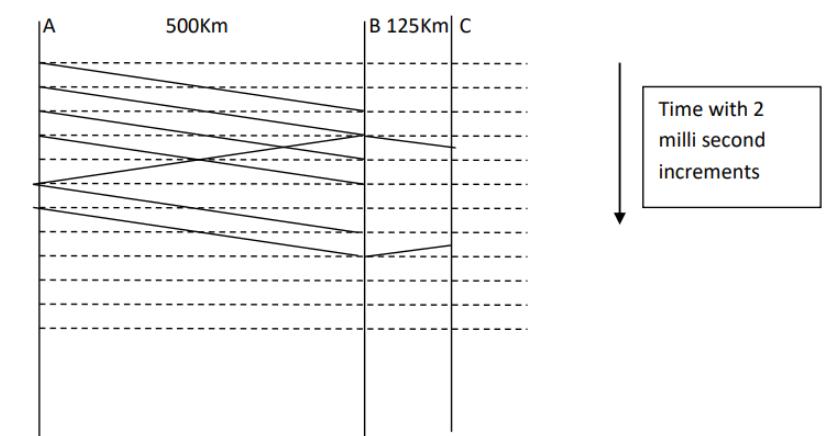
IA 500Km B 125Km C Time with 2 milli second increments
Step by Step Solution
There are 3 Steps involved in it

Get step-by-step solutions from verified subject matter experts
 Study Help