







Question: In the GNU Debugger (gdb), if I type the command to examine the current instruction pointer address and specify 4 single bytes, I see: (gdb)
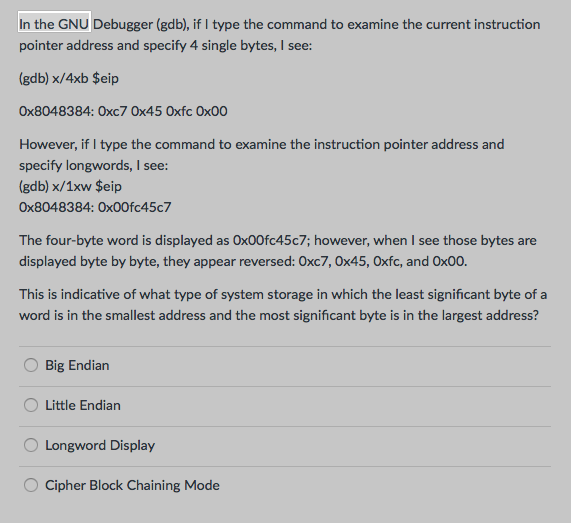
In the GNU Debugger (gdb), if I type the command to examine the current instruction pointer address and specify 4 single bytes, I see: (gdb) x/4xb $eip 0x8048384: 0xc7 0x45 0xfc 0x00 However, if I type the command to examine the instruction pointer address and specify longwords, I see: (gdb) x/lxw $eip 0x8048384: 0x00fc45c7 The four-byte word is displayed as 0x00fc45c7; however, when I see those bytes are displayed byte by byte, they appear reversed: 0xc7, 0x45, Oxfc, and 0x00. This is indicative of what type of system storage in which the least significant byte of a word is in the smallest address and the most significant byte is in the largest address? Big Endian Little Endian Longword Display Cipher Block Chaining Mode In the GNU Debugger (gdb), if I type the command to examine the current instruction pointer address and specify 4 single bytes, I see: (gdb) x/4xb $eip 0x8048384: 0xc7 0x45 0xfc 0x00 However, if I type the command to examine the instruction pointer address and specify longwords, I see: (gdb) x/lxw $eip 0x8048384: 0x00fc45c7 The four-byte word is displayed as 0x00fc45c7; however, when I see those bytes are displayed byte by byte, they appear reversed: 0xc7, 0x45, Oxfc, and 0x00. This is indicative of what type of system storage in which the least significant byte of a word is in the smallest address and the most significant byte is in the largest address? Big Endian Little Endian Longword Display Cipher Block Chaining Mode
Step by Step Solution
There are 3 Steps involved in it

Get step-by-step solutions from verified subject matter experts
 Study Help