







Question: . In the graph coloring problem, the input is a graph G = (V, E), and the goal is to t is a graph G
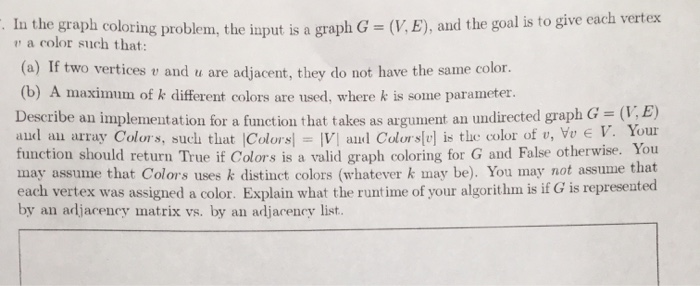
. In the graph coloring problem, the input is a graph G = (V, E), and the goal is to t is a graph G = (V. E), and the goal is to give each vertex I a color such that: (a) If two vertices v and u are adjacent, they do not have the same color. (b) A maximum of k different colors are used, where k is some parameter. Describe an implementation for a function that takes as argument an undirected graph G = (1,1) and all array Colors, such that Colors = V and Colors[uis the color of U, VU EV. Your function should return True if Colors is a valid graph coloring for G and False otherwise. You may assume that Colors uses k distinct colors (whatever k may be). You may not assume that each vertex was assigned a color. Explain what the runtime of your algorithm is if G is represented by an adjacency matrix vs. by an adjacency list
Step by Step Solution
There are 3 Steps involved in it

Get step-by-step solutions from verified subject matter experts
 Study Help