







Question: In the next two problems and throughout the course, you will be asked to design efficient algorithms. The word efficient here usually means that the
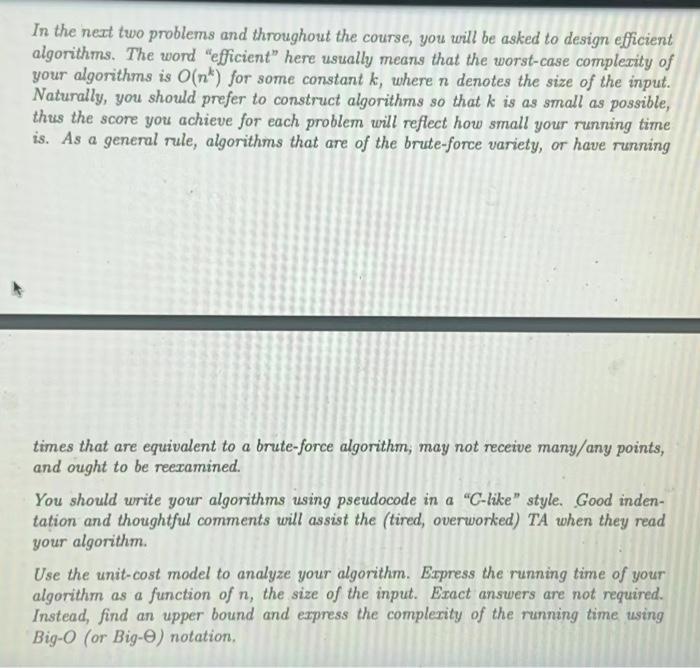
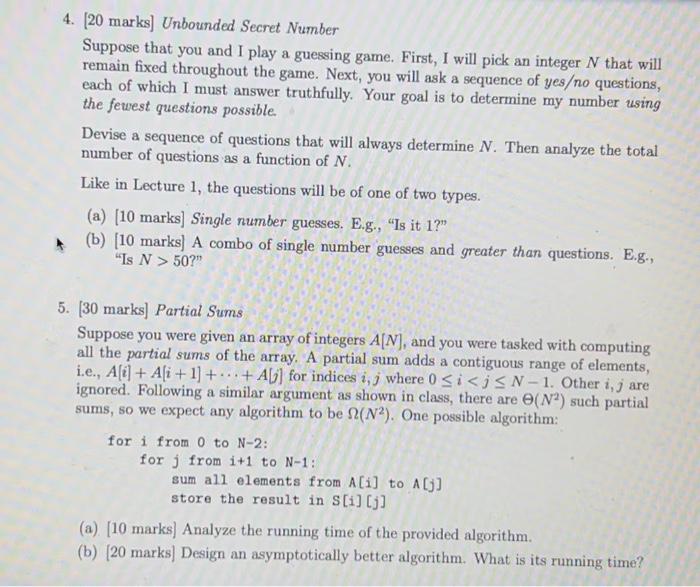
In the next two problems and throughout the course, you will be asked to design efficient algorithms. The word "efficient" here usually means that the worst-case complexity of your algorithms is O(n") for some constant k, where n denotes the size of the input. Naturally, you should prefer to construct algorithms so that k is as small as possible, thus the score you achieve for each problem will reflect how small your running time is. As a general rule, algorithms that are of the brute-force variety, or have running times that are equivalent to a brute-force algorithm, may not receive many/any points, and ought to be reexamined. You should write your algorithms using pseudocode in a "C-like" style. Good inden- tation and thoughtful comments will assist the (tired, overworked) TA when they read your algorithm. Use the unit-cost model to analyze your algorithm. Express the running time of your algorithm as a function of n, the size of the input. Exact answers are not required. Instead, find an upper bound and express the complexity of the running time using Big-O (or Big-e) notation. 4. [20 marks] Unbounded Secret Number Suppose that you and I play a guessing game. First, I will pick an integer N that will remain fixed throughout the game. Next, you will ask a sequence of yeso questions, each of which I must answer truthfully. Your goal is to determine my number using the fewest questions possible. Devise a sequence of questions that will always determine N. Then analyze the total number of questions as a function of N. Like in Lecture 1, the questions will be of one of two types. (a) [10 marks] Single number guesses. E.g., "Is it 1?" (b) (10 marks) A combo of single number guesses and greater than questions. E.g., "Is N > 50?" 5. (30 marks] Partial Sums Suppose you were given an array of integers A[N], and you were tasked with computing all the partial sums of the array. A partial sum adds a contiguous range of elements, i.e., A[i] + A[i+1] + ... + AG) for indices i, j where 0
Step by Step Solution
There are 3 Steps involved in it

Get step-by-step solutions from verified subject matter experts
 Study Help