







Question: In the previous Problem Set question, we started looking at the position function 3 (t). the position of an object at time t . Two
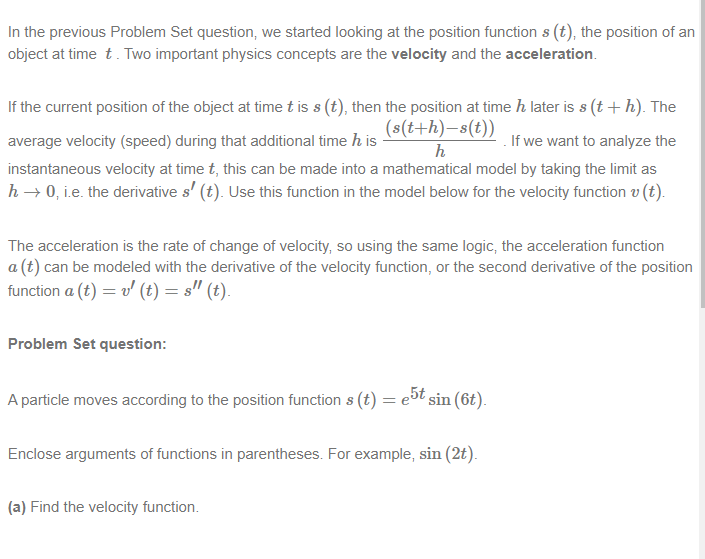
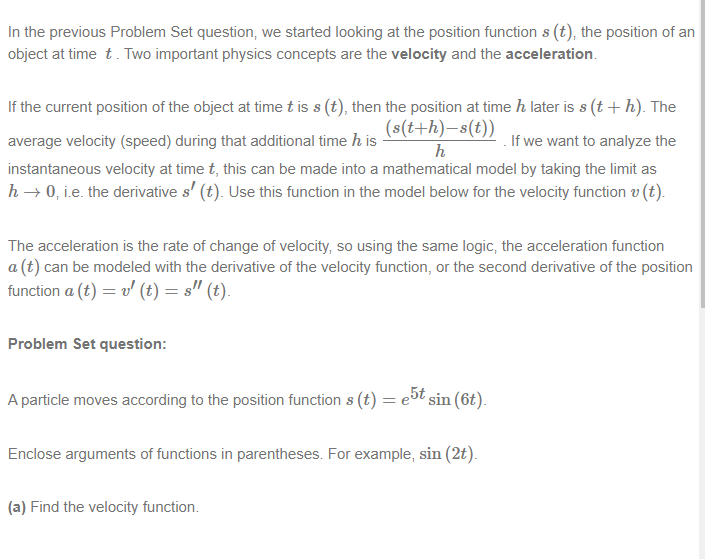
In the previous Problem Set question, we started looking at the position function 3 (t). the position of an object at time t . Two important physics concepts are the velocity and the acceleration. If the current position of the object at time t is a (t), then the position at time h later is a (t + h). The (3(t+h)8(t)) h instantaneous velocity at time i, this can be made into a mathematical model by taking the limit as h 'r 0, i.e. the derivative 3" (t). Use this function in the model below for the velocity function Mt). average velocity (speed) during that additional time h is . If we want to analyze the The acceleration is the rate of change of velocity. so using the same logic, the acceleration function a {t} can be modeled with the den'vative of the velocity function, or the second derivative of the position function o.(t) = of (t) = .5" [t]. Problem Set question: A particle moves according to the position function 3 (t) : est sin (6t). Enclose arguments of functions in parentheses. For example, sin (2t). [a] Find the velocity function
Step by Step Solution
There are 3 Steps involved in it

Get step-by-step solutions from verified subject matter experts
 Study Help