



Question: In the same spreadsheet, produce the following Compound Interest Table. Changing the Principle, Interest Rate, and/or Payment in the first row should cause the
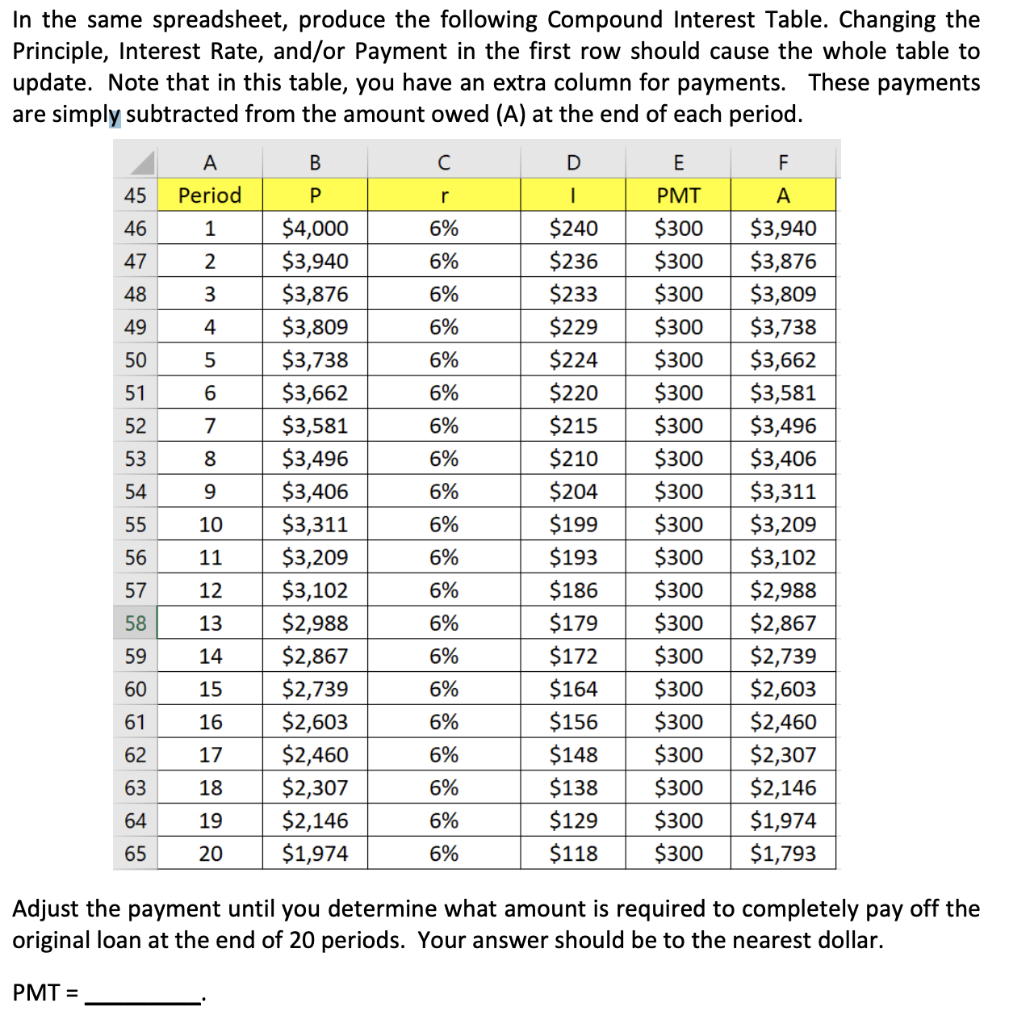
In the same spreadsheet, produce the following Compound Interest Table. Changing the Principle, Interest Rate, and/or Payment in the first row should cause the whole table to update. Note that in this table, you have an extra column for payments. These payments are simply subtracted from the amount owed (A) at the end of each period. A B C D E F 45 Period P r | PMT A 46 1 $4,000 6% $240 $300 $3,940 47 2 $3,940 6% $236 $300 $3,876 48 3 $3,876 6% $233 $300 $3,809 49 4 $3,809 6% $229 $300 $3,738 50 5 $3,738 6% $224 $300 $3,662 51 6 $3,662 6% $220 $300 $3,581 52 7 $3,581 6% $215 $300 $3,496 53 8 $3,496 6% $210 $300 $3,406 54 9 $3,406 6% $204 $300 $3,311 55 10 $3,311 6% $199 $300 $3,209 56 11 $3,209 6% $193 $300 $3,102 57 12 $3,102 6% $186 $300 $2,988 58 13 $2,988 6% $179 $300 $2,867 59 14 $2,867 6% $172 $300 $2,739 60 15 61 16 56 $2,739 6% $164 $300 $2,603 $2,603 6% $156 $300 $2,460 62 17 $2,460 6% $148 $300 $2,307 63 64 65 222 $2,307 6% $138 $300 $2,146 $2,146 6% $129 $300 $1,974 $1,974 6% $118 $300 $1,793 Adjust the payment until you determine what amount is required to completely pay off the original loan at the end of 20 periods. Your answer should be to the nearest dollar. PMT =
Step by Step Solution
There are 3 Steps involved in it

Get step-by-step solutions from verified subject matter experts