







Question: In the single-factor framework, the risk-free rate is rf= 0.01 = 1% and the expected market risk premium is E(rM-rf)=E(RM) = 0.1 = 10%.
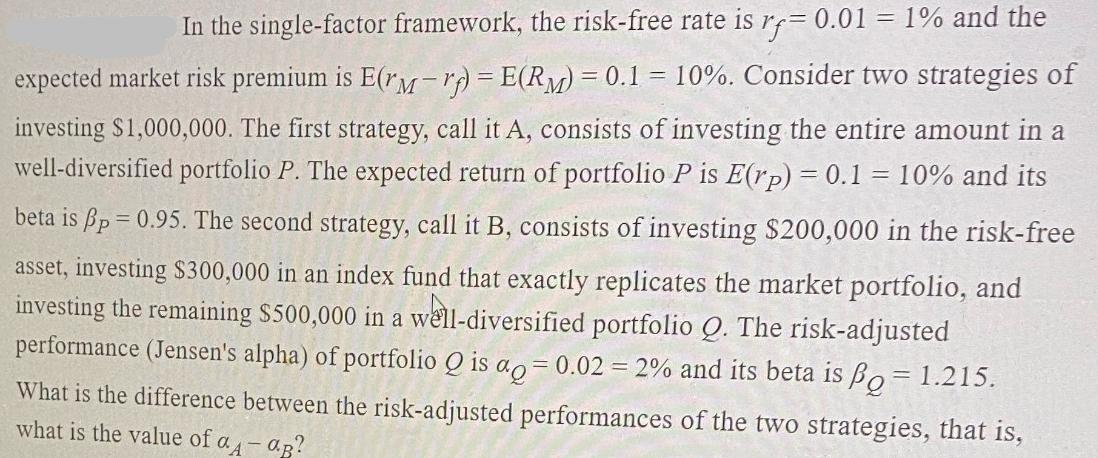
In the single-factor framework, the risk-free rate is rf= 0.01 = 1% and the expected market risk premium is E(rM-rf)=E(RM) = 0.1 = 10%. Consider two strategies of investing $1,000,000. The first strategy, call it A, consists of investing the entire amount in a well-diversified portfolio P. The expected return of portfolio P is E(rp) = 0.1 = 10% and its beta is pp = 0.95. The second strategy, call it B, consists of investing $200,000 in the risk-free asset, investing $300,000 in an index fund that exactly replicates the market portfolio, and investing the remaining $500,000 in a well-diversified portfolio Q. The risk-adjusted performance (Jensen's alpha) of portfolio Q is ao = 0.02 = 2% and its beta is Bo= 1.215. What is the difference between the risk-adjusted performances of the two strategies, that is, what is the value of a4-ag?
Step by Step Solution
3.40 Rating (150 Votes )
There are 3 Steps involved in it
SOLUTION We can use the formula for Jensens alpha to calculate the riskadjusted performan... View full answer

Get step-by-step solutions from verified subject matter experts
 Study Help