







Question: In the vertical right triangle shown in Fig. 3.14, a particle falls from A to B either along the hypotenuse, or along the two
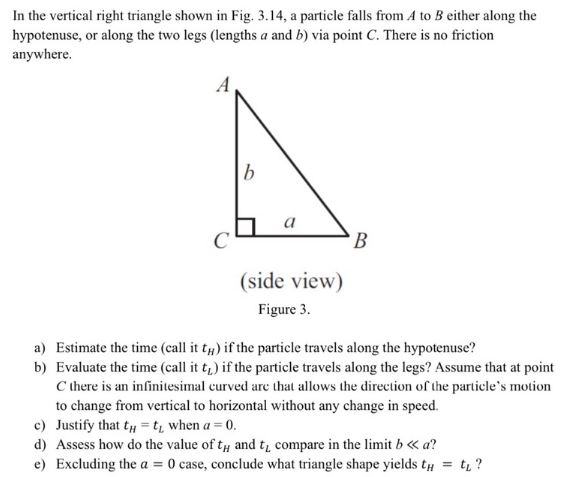
In the vertical right triangle shown in Fig. 3.14, a particle falls from A to B either along the hypotenuse, or along the two legs (lengths a and b) via point C. There is no friction anywhere. b B (side view) Figure 3. a) Estimate the time (call it t) if the particle travels along the hypotenuse? b) Evaluate the time (call it t) if the particle travels along the legs? Assume that at point C there is an infinitesimal curved are that allows the direction of the particle's motion to change from vertical to horizontal without any change in speed. c) Justify that t t when a = 0. d) Assess how do the value of t and t compare in the limit b < < a? e) Excluding the a=0 case, conclude what triangle shape yields th t?
Step by Step Solution
There are 3 Steps involved in it

Get step-by-step solutions from verified subject matter experts
 Study Help