







Question: Procedure I Data Table 1: Mass and Weight Object Wooden Friction block Glass/sandpaper friction block 50 g hanging mass 100 g hanging mass (assume
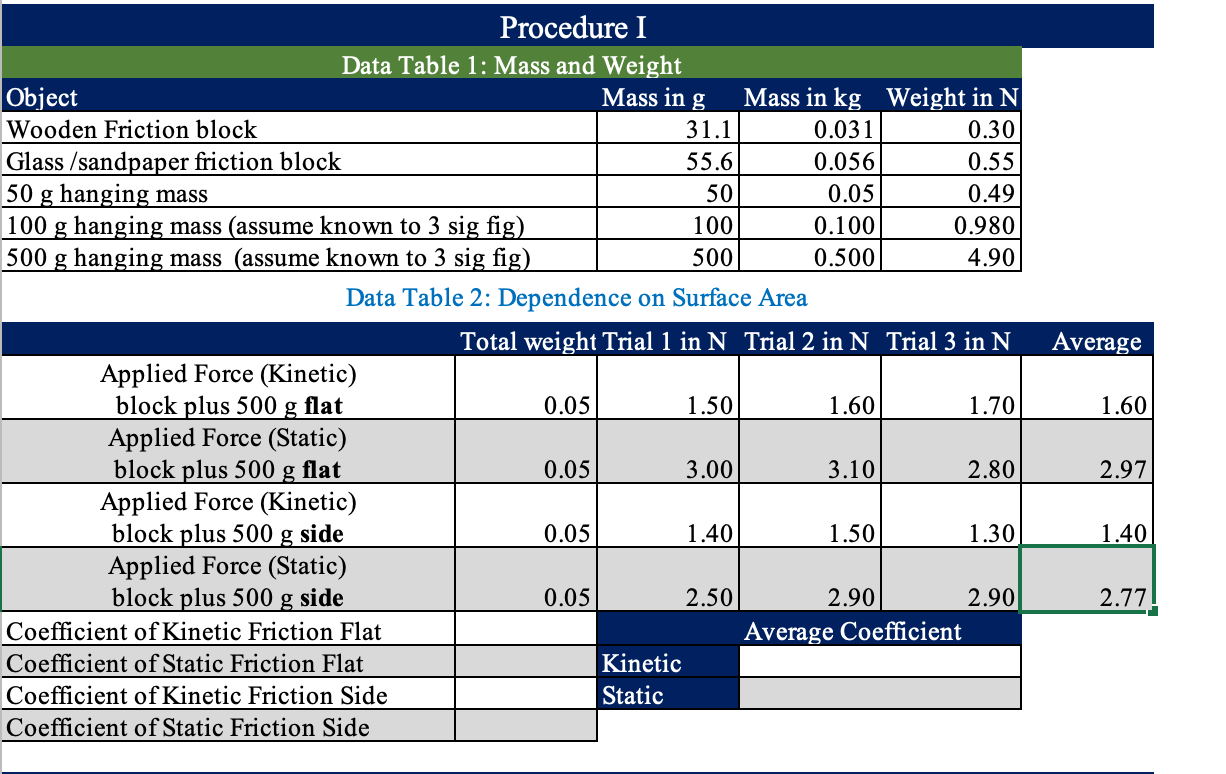

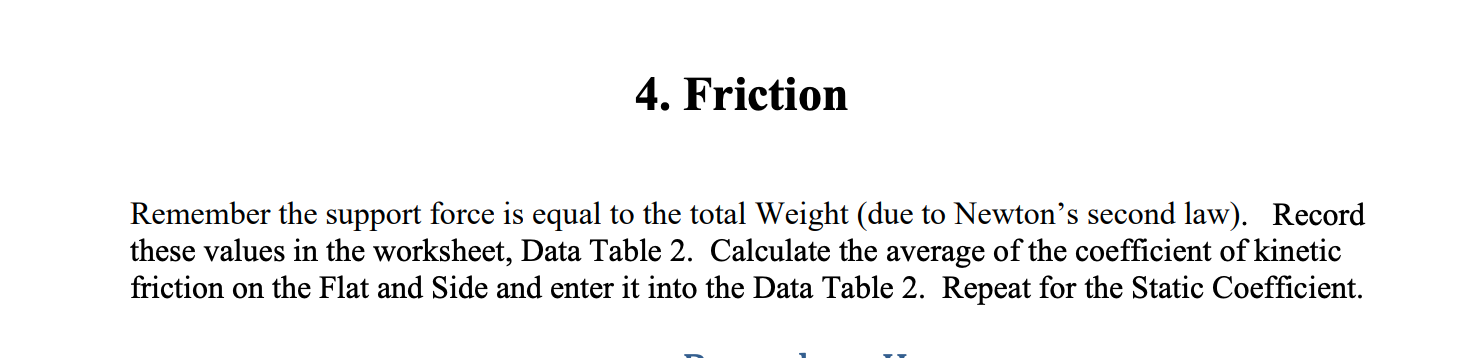
Procedure I Data Table 1: Mass and Weight Object Wooden Friction block Glass/sandpaper friction block 50 g hanging mass 100 g hanging mass (assume known to 3 sig fig) 500 g hanging mass (assume known to 3 sig fig) Mass in g Mass in kg Weight in N 31.1 0.031 0.30 55.6 0.056 0.55 50 0.05 0.49 100 0.100 0.980 500 0.500 4.90 Data Table 2: Dependence on Surface Area Total weight Trial 1 in N Trial 2 in N Trial 3 in N Average Applied Force (Kinetic) block plus 500 g flat 0.05 1.50 1.60 1.70 1.60 Applied Force (Static) block plus 500 g flat 0.05 3.00 3.10 2.80 2.97 Applied Force (Kinetic) block plus 500 g side 0.05 1.40 1.50 1.30 1.40 Applied Force (Static) block plus 500 g side 0.05 2.50 2.90 2.90 2.77 Coefficient of Kinetic Friction Flat Coefficient of Static Friction Flat Coefficient of Kinetic Friction Side Coefficient of Static Friction Side Average Coefficient Kinetic Static 18. Repeat steps 10-16 for the block in this position. 19. Calculate the coefficient of static and kinetic friction for the flat block and the block on its side using the corresponding average friction forces calculated in Step 18. Fapp Fapp Ms = , S = S 4. Friction Remember the support force is equal to the total Weight (due to Newton's second law). Record these values in the worksheet, Data Table 2. Calculate the average of the coefficient of kinetic friction on the Flat and Side and enter it into the Data Table 2. Repeat for the Static Coefficient.
Step by Step Solution
There are 3 Steps involved in it

Get step-by-step solutions from verified subject matter experts
 Study Help