







Question: In this activity, we will use some simple ideas about taxes and tax rates to investigate some basic properties about functions. Economists use the term
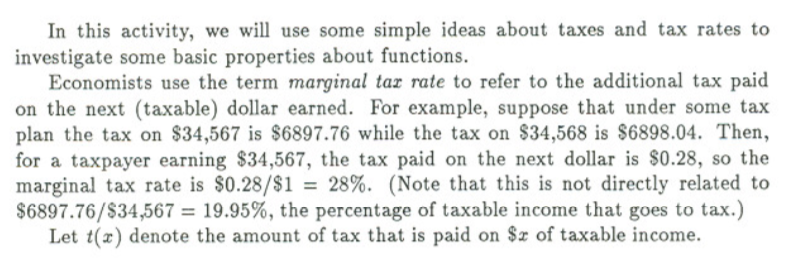
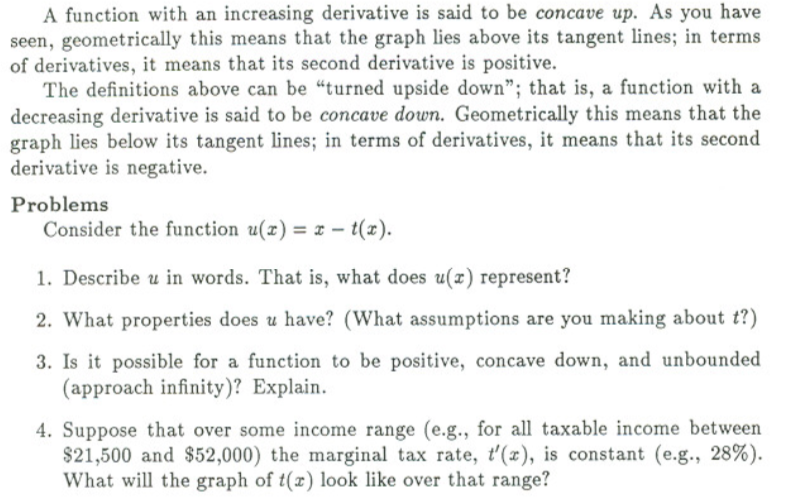
In this activity, we will use some simple ideas about taxes and tax rates to investigate some basic properties about functions. Economists use the term marginal tar rate to refer to the additional tax paid on the next (taxable) dollar earned. For example, suppose that under some tax plan the tax on $34,567 is $6897.76 while the tax on $34,568 is $6898.04. Then, for a taxpayer earning $34,567, the tax paid on the next dollar is $0.28, so the marginal tax rate is $0.28/$1 = 28%. (Note that this is not directly related to $6897.76/$34,567 = 19.95%, the percentage of taxable income that goes to tax.) Let t(*) denote the amount of tax that is paid on $x of taxable income. A function with an increasing derivative is said to be concave up. As you have seen, geometrically this means that the graph lies above its tangent lines; in terms of derivatives, it means that its second derivative is positive. The definitions above can be "turned upside down; that is, a function with a decreasing derivative is said to be concave down. Geometrically this means that the graph lies below its tangent lines; in terms of derivatives, it means that its second derivative is negative. Problems Consider the function u(x) = x - t(x). 1. Describe u in words. That is, what does u(x) represent? 2. What properties does u have? (What assumptions are you making about t?) 3. Is it possible for a function to be positive, concave down, and unbounded (approach infinity)? Explain. 4. Suppose that over some income range (e.g., for all taxable income between $21,500 and $52,000) the marginal tax rate, t'(x), is constant (e.g., 28%). What will the graph of t(2) look like over that range? In this activity, we will use some simple ideas about taxes and tax rates to investigate some basic properties about functions. Economists use the term marginal tar rate to refer to the additional tax paid on the next (taxable) dollar earned. For example, suppose that under some tax plan the tax on $34,567 is $6897.76 while the tax on $34,568 is $6898.04. Then, for a taxpayer earning $34,567, the tax paid on the next dollar is $0.28, so the marginal tax rate is $0.28/$1 = 28%. (Note that this is not directly related to $6897.76/$34,567 = 19.95%, the percentage of taxable income that goes to tax.) Let t(*) denote the amount of tax that is paid on $x of taxable income. A function with an increasing derivative is said to be concave up. As you have seen, geometrically this means that the graph lies above its tangent lines; in terms of derivatives, it means that its second derivative is positive. The definitions above can be "turned upside down; that is, a function with a decreasing derivative is said to be concave down. Geometrically this means that the graph lies below its tangent lines; in terms of derivatives, it means that its second derivative is negative. Problems Consider the function u(x) = x - t(x). 1. Describe u in words. That is, what does u(x) represent? 2. What properties does u have? (What assumptions are you making about t?) 3. Is it possible for a function to be positive, concave down, and unbounded (approach infinity)? Explain. 4. Suppose that over some income range (e.g., for all taxable income between $21,500 and $52,000) the marginal tax rate, t'(x), is constant (e.g., 28%). What will the graph of t(2) look like over that range
Step by Step Solution
There are 3 Steps involved in it

Get step-by-step solutions from verified subject matter experts
 Study Help