







Question: In this analysis, we will examine queuing theory and apply it to wait times at a call center. Review the discussion and sample problem. Srivastava,
In this analysis, we will examine queuing theory and apply it to wait times at a call center. Review the discussion and sample problem. Srivastava, T. (2016). Operational analytics case study for freshers: Call center optimizationNow we will perform an optimization using the same methodology but with different values. Use the values below and perform the optimization.
| Customers | |||||||||||
| 1 | 2 | 3 | 4 | 5 | 6 | 7 | 8 | 9 | 10 | ||
| Caller | 1 | 29 | 51 | 82 | 77 | 69 | 82 | 25 | 65 | 87 | 23 |
| 2 | 41 | 48 | 35 | 81 | 37 | 79 | 13 | 42 | 29 | 80 | |
| 3 | 84 | 90 | 67 | 31 | 43 | 24 | 41 | 55 | 23 | 60 | |
| 4 | 77 | 59 | 76 | 31 | 81 | 15 | 34 | 86 | 87 | 85 | |
| 5 | 16 | 66 | 48 | 19 | 20 | 57 | 11 | 11 | 35 | 76 | |
| 6 | 14 | 42 | 7 | 84 | 29 | 64 | 49 | 80 | 90 | 49 | |
| 7 | 58 | 35 | 77 | 74 | 16 | 65 | 72 | 11 | 13 | 56 | |
| 8 | 18 | 33 | 28 | 61 | 55 | 20 | 3 | 27 | 56 | 75 | |
| 9 | 43 | 32 | 10 | 86 | 13 | 72 | 11 | 5 | 30 | 56 | |
| 10 | 36 | 9 | 22 | 23 | 83 | 35 | 6 | 23 | 51 | 56 | |
Sample Problem Statement
You have 7 types of callers and 7 types of customers. Assume that all seven customers call at the same time, how do you assign callers to each of these customers so that the total time of the call center is least.
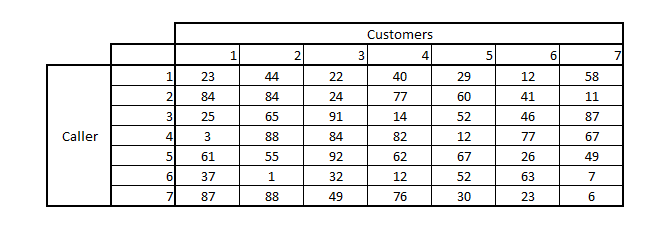
All numbers shown here represent time in minutes. Imagine this problem getting to an extent where 1000s of callers respond and 100000s of customers call. So, we probably need a more scientific way to do this problem.
Lets first see, what is the time if 1st caller gets assigned to 1st customer and 2nd to 2nd and so on. The total time becomes 23 + 84 + 91 + 82 + 67 + 63 + 6 = 416 which is 59.4 minutes/customer. Now, lets try to optimize this problem using something called assignment problem solution using Hungarian method. The steps are :
- Reduce every row with the minimum of the same row.
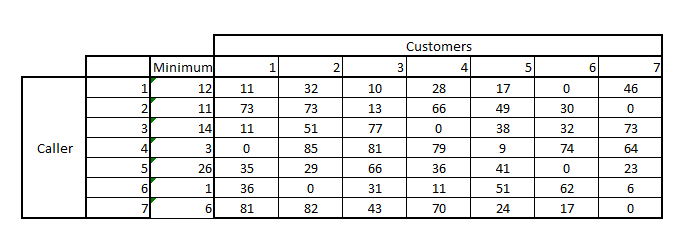
- Reduce every column with the minimum of the same column
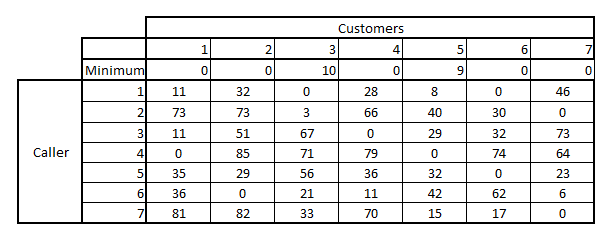
- Find a row which has only one zero and make the assignment. Also cancel all the zeros in the same column. In case two rows comes out to have zero in than same column, leave it to be assigned at the end.
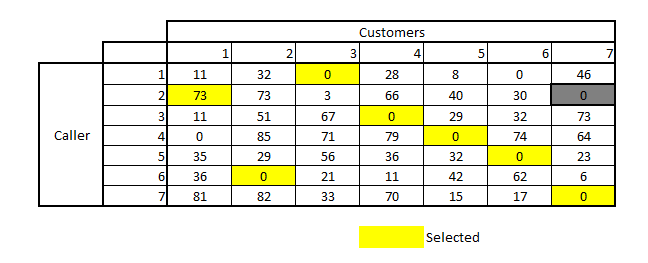
- Now select the same cells in the main grid and do the total time calculation.
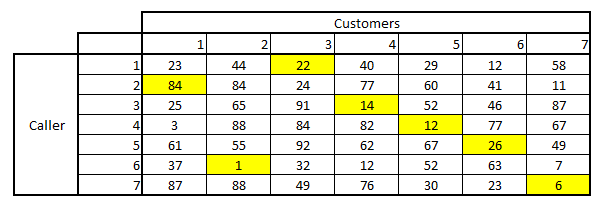
Doing the calculation, the total time now comes out as 165 which is just 23 minutes/ customer. This is a far better assignment than the random allotment.
Step by Step Solution
There are 3 Steps involved in it

Get step-by-step solutions from verified subject matter experts
 Study Help