Question: in this case what are 8. Is there relevant missing information? 7. How appropriate are the legal analogies? 6. What ethical norms are fundamental to
in this case what are
8. Is there relevant missing information?
7. How appropriate are the legal analogies?
6. What ethical norms are fundamental to the court's reasoning?
5. Does the legal argument contain significant ambiguity?
4. What are the relevant rules of law?
3. What are the reasons and conclusion?
2. What is the issue?
1. What are the facts?

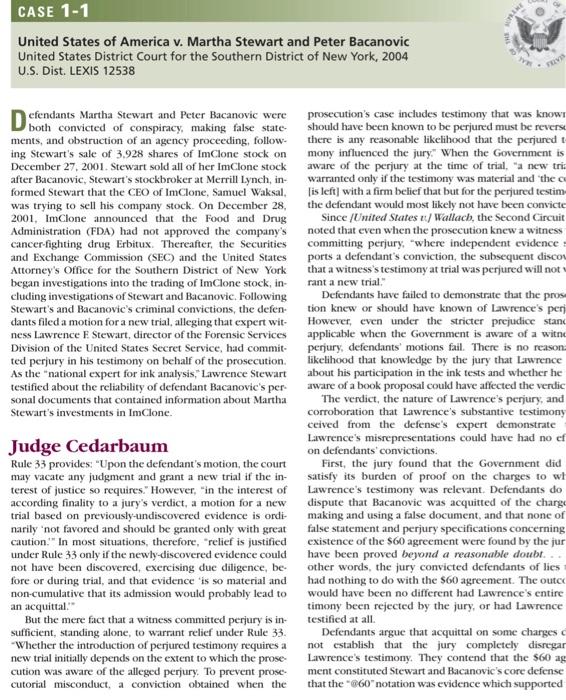
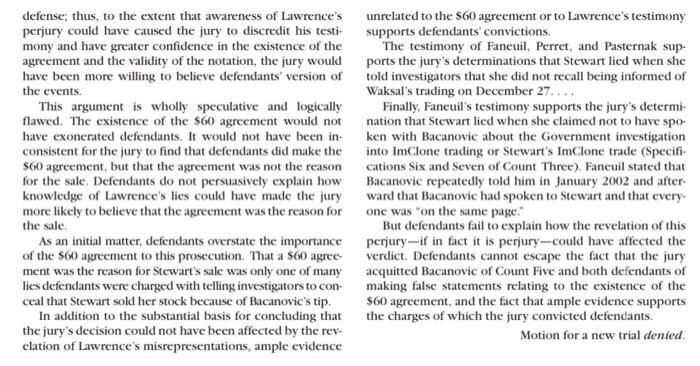
CASE 1-1 United States of America v. Martha Stewart and Peter Bacanovic United States District Court for the Southern District of New York, 2004 U.S. Dist. LEXIS 12538 CASE 1-1 United States of America v. Martha Stewart and Peter Bacanovic United States District Court for the Southern District of New York, 2004 U.S. Dist. LEXIS 12538 both convicted of conspiracy, making false state ments, and obstruction of an agency proceeding, follow- ing Stewart's sale of 3.928 shares of ImClone stock on December 27, 2001. Stewart sold all of her ImClone stock after Bacanovic, Stewart's stockbroker at Merrill Lynch, in formed Stewart that the CEO of ImClone, Samuel Waksal. was trying to sell his company stock. On December 28, 2001. ImClone announced that the Food and Drug Administration (FDA) had not approved the company's cancer-fighting drug Erbitux. Thereafter, the Securities and Exchange Commission (SEC) and the United States Attorney's Office for the Southern District of New York began investigations into the trading of ImClone stock, in- cluding investigations of Stewart and Bacanovic. Following Stewart's and Bacanovic's criminal convictions, the defen- dants filed a motion for a new trial, alleging that expert wit- ness Lawrence E Stewart, director of the Forensic Services Division of the United States Secret Service, had commit- ted perjury in his testimony on behalf of the prosecution As the national expert for ink analysis," Lawrence Stewart testified about the reliability of defendant Bacanovic's per sonal documents that contained information about Martha Stewart's investments in ImClone. prosecution's case includes testimony that was know should have been known to be perjured must be reverse there is any reasonable likelihood that the perjured mony influenced the jury." When the Government is aware of the perjury at the time of trial, a new tri warranted only if the testimony was material and the a lis left with a firm belief that but for the perjured testim the defendant would most likely not have been convicte Since United States / Wallach, the Second Circuit noted that even when the prosecution knew a witness committing perjury, "where independent evidence ports a defendant's conviction, the subsequent disco that a witness's testimony at trial was perjured will not rant a new trial Defendants have failed to demonstrate that the pros tion knew or should have known of Lawrence's per However, even under the stricter prejudice stand applicable when the Government is aware of a witne perjury, defendants' motions fail. There is no reason likelihood that knowledge by the jury that Lawrence about his participation in the ink tests and whether he aware of a book proposal could have affected the verdic The verdict, the nature of Lawrence's perjury, and corroboration that Lawrence's substantive testimony ceived from the defense's expert demonstrate Lawrence's misrepresentations could have had no ef on defendants' convictions. First, the jury found that the Government did satisfy its burden of proof on the charges to w Lawrence's testimony was relevant. Defendants do dispute that Bacanovic was acquitted of the charge making and using a false document, and that none of false statement and perjury specifications concerning existence of the $60 agreement were found by the jur have been proved beyond a reasonable doubt... other words, the jury convicted defendants of lies had nothing to do with the $60 agreement. The oute would have been no different had Lawrence's entire timony been rejected by the jury, or had Lawrence testified at all Defendants argue that acquittal on some charges not establish that the jury completely disregar Lawrence's testimony. They contend that the $60 ag ment constituted Stewart and Bacanovic's core defense that the "860" notation was evidence which supported Judge Cedarbaum Rule 33 provides: "Upon the defendant's motion, the court may vacate any judgment and grant a new trial if the in- terest of justice so requires." However, in the interest of according finality to a jury's verdict, a motion for a new trial based on previously-undiscovered evidence is ordi- narily 'not favored and should be granted only with great caution." In most situations, therefore, relief is justified under Rule 33 only if the newly-discovered evidence could not have been discovered, exercising due diligence, be fore or during trial, and that evidence is so material and non-cumulative that its admission would probably lead to an acquittal." But the mere fact that a witness committed perjury is in sufficient, standing alone, to warrant relief under Rule 33. Whether the introduction of perjured testimony requires a new trial initially depends on the extent to which the prose- cution was aware of the alleged perjury. To prevent prose cutorial misconduct, a conviction obtained when the defense; thus, to the extent that awareness of Lawrence's perjury could have caused the jury to discredit his testi- mony and have greater confidence in the existence of the agreement and the validity of the notation, the jury would have been more willing to believe defendants' version of the events. This argument is wholly speculative and logically flawed. The existence of the $60 agreement would not have exonerated defendants. It would not have been in- consistent for the jury to find that defendants did make the $60 agreement, but that the agreement was not the reason for the sale. Defendants do not persuasively explain how knowledge of Lawrence's lies could have made the jury more likely to believe that the agreement was the reason for the sale. As an initial matter, defendants overstate the importance of the $60 agreement to this prosecution. That a $60 agree ment was the reason for Stewart's sale was only one of many lies defendants were charged with telling investigators to con- ceal that Stewart sold her stock because of Bacanovic's tip In addition to the substantial basis for concluding that the jury's decision could not have been affected by the rev- clation of Lawrence's misrepresentations, ample evidence unrelated to the $60 agreement or to Lawrence's testimony supports defendants' convictions. The testimony of Faneuil, Perret, and Pasternak sup- ports the jury's determinations that Stewart lied when she told investigators that she did not recall being informed of Waksal's trading on December 27.... Finally, Faneuil's testimony supports the jury's determi- nation that Stewart lied when she claimed not to have spo ken with Bacanovic about the Government investigation into ImClone trading or Stewart's ImClone trade (Specifi- cations Six and Seven of Count Three). Faneuil stated that Bacanovic repeatedly told him in January 2002 and after ward that Bacanovic had spoken to Stewart and that every one was "on the same page." But defendants fail to explain how the revelation of this perjury--if in fact it is perjury-could have affected the verdict. Defendants cannot escape the fact that the jury acquitted Bacanovic of Count Five and both defendants of making false statements relating to the existence of the $60 agreement, and the fact that ample evidence supports the charges of which the jury convicted defendants. Motion for a new trial denied









 Study Help