







Question: In this example of optimal duality solution, how is the end up with y1 =2/7 and y3 =5/7 ?? could someone explain in detail, please?
In this example of optimal duality solution, how is the end up with
y1 =2/7 and y3 =5/7 ??
could someone explain in detail, please?
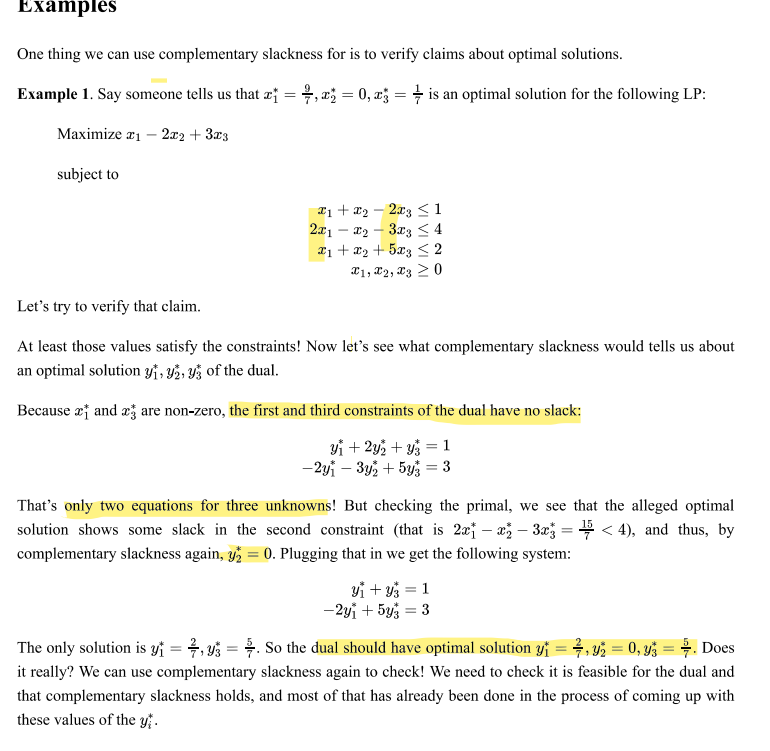
Examples One thing we can use complementary slackness for is to verify claims about optimal solutions. Example 1. Say someone tells us that x = 7, x2 = 0, x = + is an optimal solution for the following LP: Maximize x12x2 + 3x3 subject to - 12 2x3 1 2x1 x2 3x3 4 1+2+5x3 2 x1, x2, x30 Let's try to verify that claim. At least those values satisfy the constraints! Now let's see what complementary slackness would tells us about an optimal solution y, 2, 3 of the dual. Because x and x are non-zero, the first and third constraints of the dual have no slack: y + 2y + y 1 -2y-3y+5y= 3 15 That's only two equations for three unknowns! But checking the primal, we see that the alleged optimal solution shows some slack in the second constraint (that is 2x-x-3x3 =
Step by Step Solution
There are 3 Steps involved in it

Get step-by-step solutions from verified subject matter experts
 Study Help