







Question: In this exercise, we will investigate what happens when imaginary numbers are plugged into the function cos(m). (a) (b) (C) (d) (f) Write down the
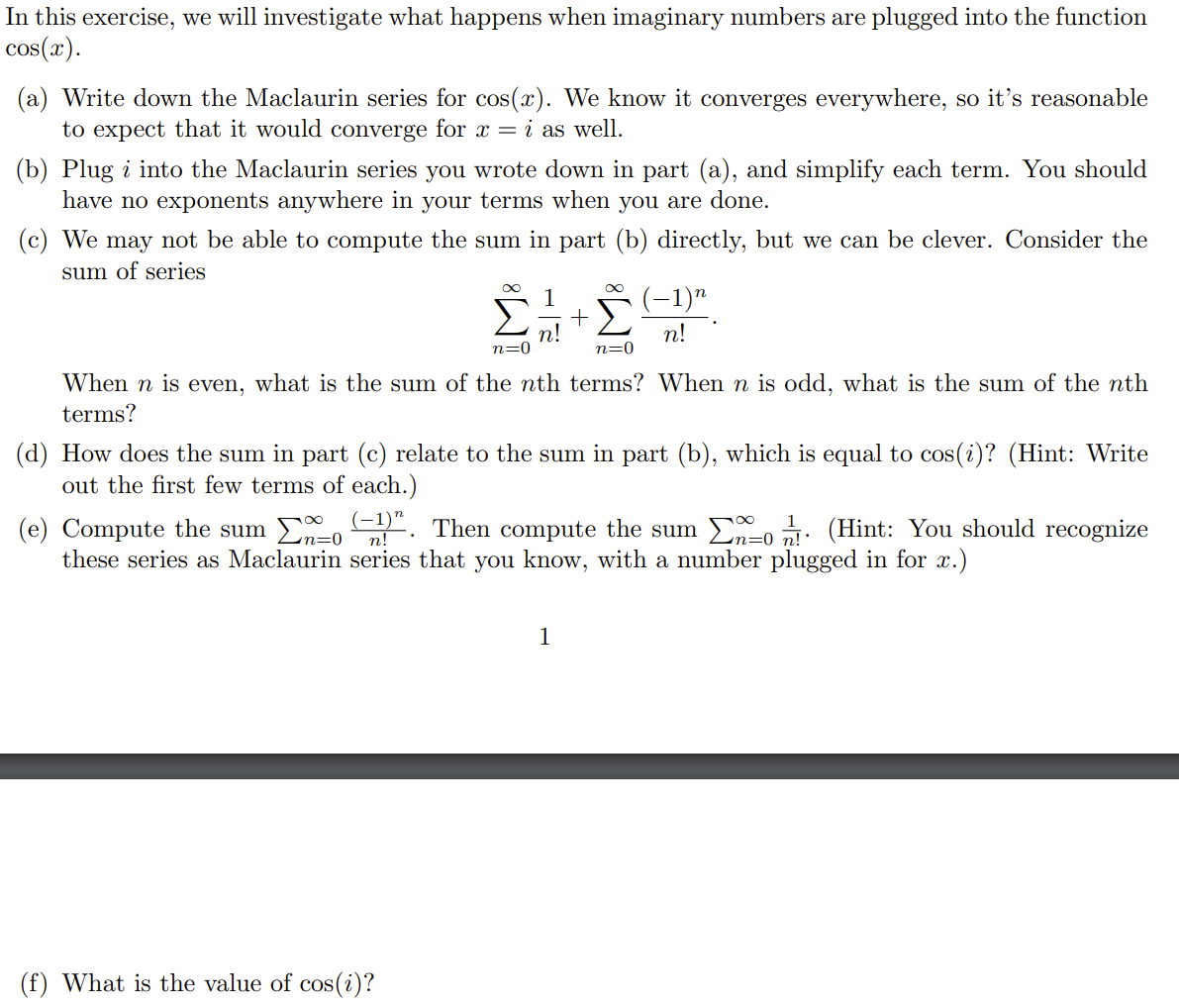
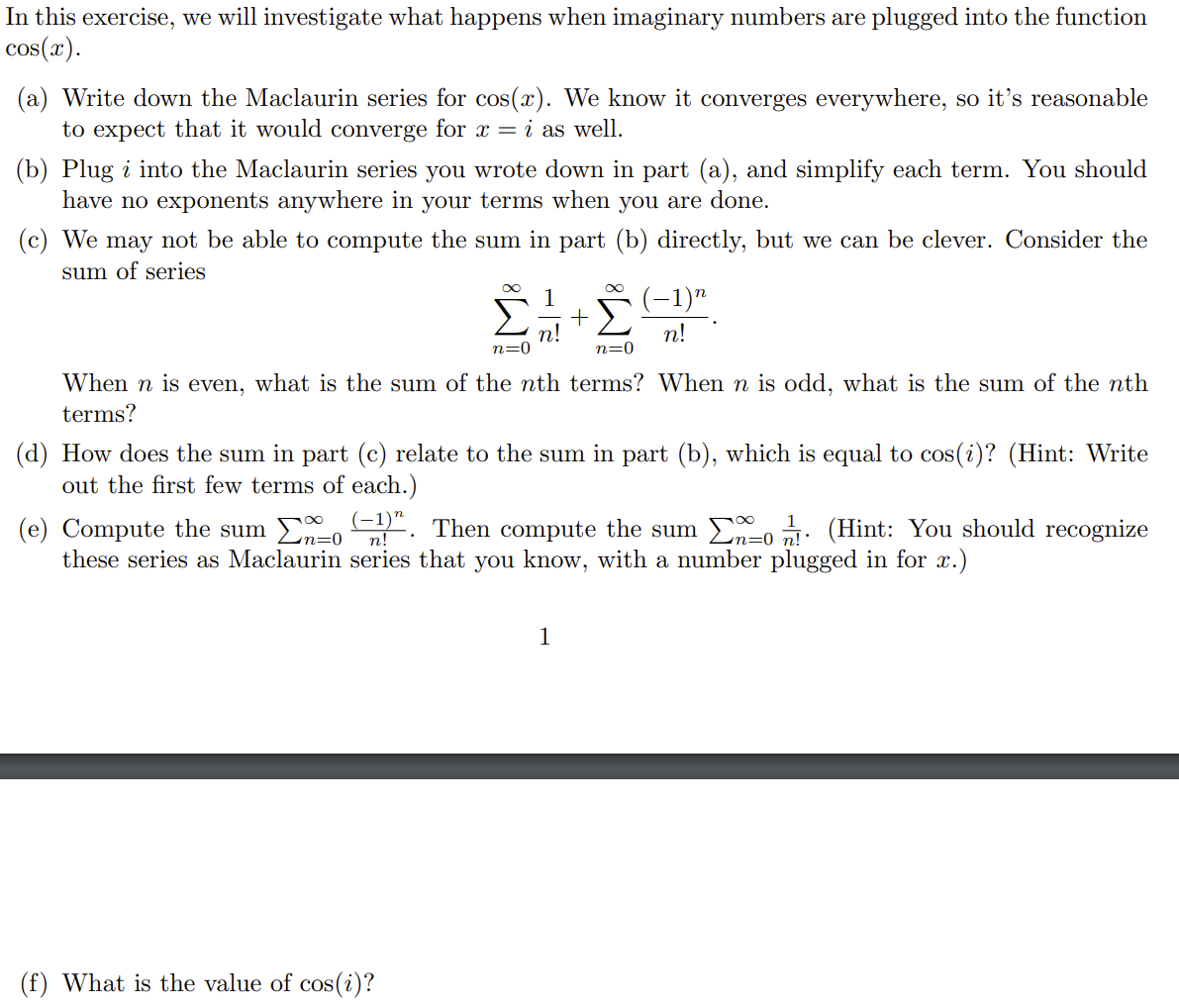
In this exercise, we will investigate what happens when imaginary numbers are plugged into the function cos(m). (a) (b) (C) (d) (f) Write down the Maclaurin series for cos(:r: ) We know it converges everywhere. so its reasonable to expect that it would converge for m = 1' as well. Plug 3' into the Maclaurin series you wrote down in part (a), and simplify each term. You should have no exponents anywhere in your terms when you are done. We may not be able to compute the sum in part (b) directly, but we can be clever. Consider the sum of series 1)\" Z + Z - 7;! When n is even, what is the sum of the nth terms? When n is odd, what is the sum of the nth terms? How does the sum in part (c) relate to the sum in part (b), which is equal to cos[i)? (Hint: Write out the rst few terms of each.) Compute the sum 2:020 (13,)\". Then compute the sum 2:020 %. (Hint: You should recognize these series as Maclaurin series that you know, with a number plugged in for m) What is the value of cos(t')
Step by Step Solution
There are 3 Steps involved in it

Get step-by-step solutions from verified subject matter experts
 Study Help