







Question: In this first phase, you will craft the Value Propositions for your new startup company by identifying and analyzing a problem, your competition, and your
In this first phase, you will craft the Value Propositions for your new startup company by identifying and analyzing a problem, your competition, and your target customers. Based on the pictures above, answer the questions below:
1. Define the Problem
The problem that you are defining is the basis of the technology-based startup company that you will design this semester. Be sure to consider problems that can be solved with technology-based products or services that you can create, or lead the creation of with a team that you can build. Startup ideas may include mobile apps, software, hardware, or related technologies that serve as the foundation, or key differentiation factor, of the startup. A cafe that has a website is not considered a technology-based startup. A startup company that is creating inventory management software for cafes would be considered a technology-based startup for the purposes of our course.
Focus on a problem for which you can develop and launch a solution within 12 months. Your solution should leverage your skills and relationships, and require initial funding of no more than $25,000 to bring the product to market.
What is the problem that your team aims to solve?
What evidence supports that the problem exists? List at least five articles, reports, or related research sources that support your claims in APA format.
Is the problem Urgent? Is it one of the top few priorities for your target customer(s)?
Is the problem Underserved? Is there an absence of viable solutions to the problem that you aim to solve?
Is the problem Unworkable? Does your solution fix a broken situation or process where there are real, measurable consequences to inaction?
Is fixing the problem Unavoidable? Is it driven by a mandate with implications associated with governance or regulatory control?
Is the problem Conspicuous? Why or why not?
Is the problem Critical? Why or why not?
2. Determine Your Target Customer
Who is your target customer(s)? This is the first step to defining your market and understanding the problem or desire. Analysis of industries, markets, and value innovations narrows the focus to real customers.
What are their needs and wants? Focus on customer value first. Why do they need your product? What benefits will they gain? Can they make money or save money with your product? Can they save time with your product Other benefits? .
Are there enough people who care about this problem for you to be financially successful by solving the problem? If you have a real customer, and if you can deliver real value, then ask how many people experience these problems now? In the future?
3. Define Your Value Proposition
What is unique about your solution to this problem? What unique combination of discontinuous innovation, defensible technology, and/or a disruptive business model are you bringing to market?
What gains are you providing to your target customer(s)?
What pains will your target customer(s) experience in adopting your product or service?
4. Design Your Minimum Viable Prototype
Who are your current competitors?
What market(s) do current competitors target?
What are your current competitors strengths?.
What are your current competitors weaknesses?
What are the minimum viable features of your product or service?
Why are these features highly valuable for customers, and rare among existing competitors?
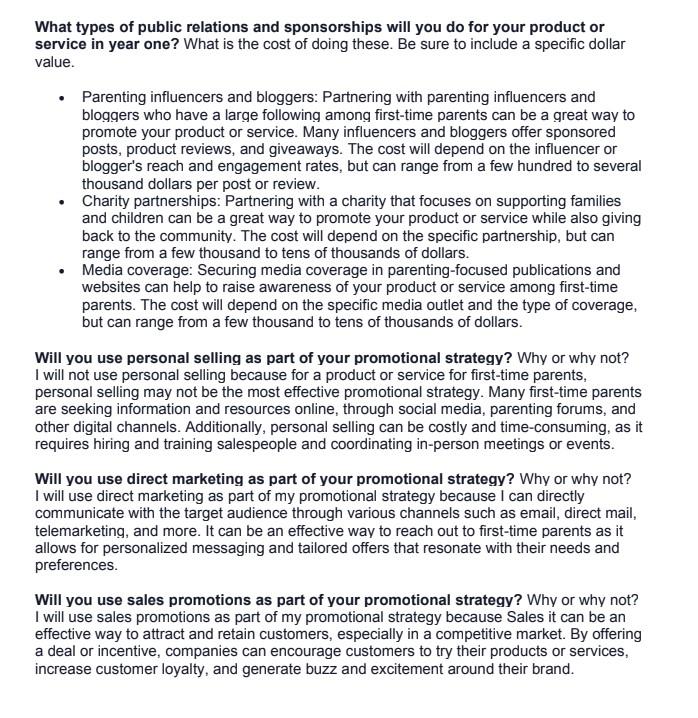
Product Who is your target customer? - My target customers are new parents or first time parents who values convenience, safety, and quality. This individual is likely to be a first-time parent who wants the best for their newborn. They are willing to spend more money on products that are safe and high-quality. What are the underserved needs of this target customer? The underserved needs of first time parents are: - Emotional Support: New parents may feel overwhelmed and stressed during the first few months of their baby's life. Businesses can provide emotional support through resources like online forums, support groups, and counseling services. - Educational Resources: First-time parents often have many questions about their baby's health and development. Providing educational resources like online classes, workshops, and webinars can help parents gain knowledge and confidence in caring for their newborn. - Time-saving Services: New parents are often pressed for time and may find it difficult to complete everyday tasks like grocery shopping, cooking, and cleaning. Offering time-saving services like meal delivery, house cleaning, and baby gear rental can help ease the burden on new parents. - Safe and Sustainable Products: New parents are increasingly concerned about the safety and sustainability of the products they use for their baby. Businesses can meet this need by offering non-toxic, eco-friendly, and sustainably sourced products that are safe for their baby and the environment. What is your value proposition? The value propositions are: - Convenience: First-time parents are often busy and may appreciate products and services that make their lives easier. Businesses can offer convenient solutions such as online shopping, home delivery, and subscription services to meet this need. - Quality and Safety: First-time parents want the best for their baby and may be willing to pay a premium for high-quality and safe products. Businesses can differentiate themselves by offering products that are rigorously tested and meet strict safety standards. - Multi-functionality: Products that serve multiple purposes can be very appealing to first-time parents who are looking for practical solutions. For example, a crib that can also be used as a changing table or a stroller that can convert into a car seat. - Customization: Every baby is unique, and products that can be customized to fit a baby's individual needs can be very appealing. For example, a baby carrier with adjustable straps and positions or a diaper bag with removable compartments. - Eco-friendliness: First-time parents are often concerned about the environment and the impact of products on their baby's health. Products that are eco-friendly, sustainable, and made with non-toxic materials can be very desirable. For example, cloth diapers made from organic cotton or a baby food maker that uses BPA-free materials. What is your MVP feature set? Some potential MVP features that could be included in a product or service aimed at firsttime parents: - Essential functions: The product or service should fulfill the most essential functions needed by first-time parents. For example, a stroller should have sturdy wheels, a comfortable handle, and a seat that reclines. - Safety features: Safety is a top priority for first-time parents, so the product or service should include basic safety features. For example, a baby carrier should have a secure harness and a weight limit. - Durability: The product or service should be durable and able to withstand the wear and tear of everyday use. For example, a diaper bag should be made from highquality materials that can withstand spills and heavy use. - Affordability: The product or service should be priced at a level that is accessible to first-time parents, who may be on a tight budget. For example, a baby carrier should be priced in the mid-range to be affordable for most first-time parents. What is your prototype? (refer to the explanation below, I cannot insert diagrams here.) Price What is the market size of the target market that you've selected? Be sure to quantify this in terms of users and their annual spending on the product or service that you will provide. Include at least 3 references to support your market size assessment. - According to a report by Zion Market Research, the global baby products market size was valued at USD 68.6 billion in 2019 and is expected to reach USD 121.0 billion by 2026 , with a compound annual growth rate (CAGR) of 8.1% during the forecast period (2020-2026) (1). The report notes that factors driving this growth include rising birth rates, increasing disposable incomes, and growing awareness of the importance of child safety and development. - In the United States, the baby products market is expected to reach USD 30.7 billion by 2025, with a CAGR of 5.5% during the forecast period, according to a report by Grand View Research (2). The report notes that factors driving this growth include increasing numbers of first-time parents, rising disposable incomes, and growing demand for premium and organic baby products. - Another report by Persistence Market Research estimates that the global baby care products market will reach USD 109.13 billion by 2027, with a CAGR of 5.5% from 2020 to 2027 (3). The report notes that factors driving this growth include rising birth rates, increasing disposable incomes, and growing demand for natural and organic baby care products. What are your costs to create, develop, and deliver the product or service? - The costs to create, develop, and deliver the product or service are: Research and development costs, Manufacturing costs, Marketing and advertising costs, Distribution and logistics costs, Overhead costs and Legal and regulatory costs. What are pricing strategies of your direct and indirect competitors? - Cost-plus pricing: This strategy involves adding a markup to the cost of producing the product or service to determine the final price. - Value-based pricing: This strategy involves setting prices based on the perceived value of the product or service to the customer. - Penetration pricing: This strategy involves setting a low initial price to gain market share and then increasing the price over time. - Skimming pricing: This strategy involves setting a high initial price to maximize profits from early adopters and then gradually lowering the price over time. - Competitive pricing: This strategy involves setting prices based on the prices of similar products or services offered by competitors. What is your pricing strategy for your product or service? My pricing strategy for my product or service is Value-based pricing because it involves setting prices based on the perceived value of the product or service to the customer. For example, if your product or service offers unique features or benefits that are not available from competitors, you could charge a higher price that reflects the added value to customers. Placement What types of Distribution Channels will you use? For a product or service for first-time parents, I will use a Direct Channel, it involves selling products or services directly to customers through an online store or website, without the need for intermediaries such as retail stores or distributors. There are several reasons why the Direct channel can be advantageous for a product or service for first-time parents. Firstly, it allows for a direct relationship between the brand and the customer, which can be particularly important for building trust and brand loyalty in a competitive market. By engaging directly with customers, brands can gain valuable insights into their preferences and needs, and tailor their products and marketing strategies accordingly. Secondly, the Direct channel can be a cost-effective way to reach a large audience and build brand awareness. By leveraging digital marketing tactics such as social media advertising, email marketing, and search engine optimization, brands can reach customers on a global scale without the need for expensive traditional advertising methods. Thirdly, the Direct channel can offer greater control over the customer experience, from product design and development to order fulfillment and customer service. By owning every step of the process, brands can ensure that their products are of the highest quality, and that their customers receive the best possible service and support. The Direct channel can be a way to differentiate a product or service in a crowded market. By offering a unique value proposition or brand experience, brands can stand out from their competitors and attract customers who are looking for something different. This can be particularly important in the first-time parent market, where there are many established players vying for attention. Overall, the Direct channel offers a number of advantages for a product or service for firsttime parents, including direct customer engagement, cost-effectiveness, and greater control over the customer experience. By leveraging this channel, brands can build strong relationships with their customers, drive sales, and ultimately, succeed in a competitive market. What types of Intermediaries will you use? The type of intermediaries that I will use is Distributor because it can be beneficial for a product or service for first-time parents, as they can help companies reach a wider audience and reduce the complexity and costs of the distribution process. Distributor intermediaries can help companies navigate complex regulations and compliance requirements in different regions or countries. This can be particularly important for companies that are looking to expand internationally or operate in heavily regulated industries, such as baby products. Distributors can also provide valuable logistical support, such as warehousing, transportation, and inventory management, which can help companies streamline their operations and reduce costs. Promotion What types of advertising will you do for your product or service in year one? What is the cost of doing these? Be sure to include a specific dollar value. The types of advertising that I will be using are: - Social media advertising: This can be an effective way to reach a large audience of first-time parents. The cost will vary depending on the platform and the targeting options chosen, but can range from $0.50 to $2.50 per click or $6 to $10 per thousand impressions. - Search engine advertising: Placing ads on search engine results pages for keywords related to first-time parenting can be an effective way to reach parents who are actively searching for information and products related to this topic. The cost will depend on the competitiveness of the keywords and the bidding strategy, but can range from $1 to $10 per click. - Parenting websites and blogs: Advertising on popular parenting websites and blogs can be a good way to reach first-time parents who are actively seeking advice and recommendations. The cost will depend on the website's traffic and the size and placement of the ad, but can range from a few hundred to several thousand dollars per month. What types of public relations and sponsorships will you do for your product or service in year one? What is the cost of doing these. Be sure to include a specific dollar value. - Parenting influencers and bloggers: Partnering with parenting influencers and bloggers who have a large following among first-time parents can be a great way to promote your product or service. Many influencers and bloggers offer sponsored posts, product reviews, and giveaways. The cost will depend on the influencer or blogger's reach and engagement rates, but can range from a few hundred to several thousand dollars per post or review. - Charity partnerships: Partnering with a charity that focuses on supporting families and children can be a great way to promote your product or service while also giving back to the community. The cost will depend on the specific partnership, but can range from a few thousand to tens of thousands of dollars. - Media coverage: Securing media coverage in parenting-focused publications and websites can help to raise awareness of your product or service among first-time parents. The cost will depend on the specific media outlet and the type of coverage, but can range from a few thousand to tens of thousands of dollars. Will you use personal selling as part of your promotional strategy? Why or why not? I will not use personal selling because for a product or service for first-time parents, personal selling may not be the most effective promotional strategy. Many first-time parents are seeking information and resources online, through social media, parenting forums, and other digital channels. Additionally, personal selling can be costly and time-consuming, as it requires hiring and training salespeople and coordinating in-person meetings or events. Will you use direct marketing as part of your promotional strategy? Why or why not? I will use direct marketing as part of my promotional strategy because I can directly communicate with the target audience through various channels such as email, direct mail, telemarketing, and more. It can be an effective way to reach out to first-time parents as it allows for personalized messaging and tailored offers that resonate with their needs and preferences. Will you use sales promotions as part of your promotional strategy? Why or why not? I will use sales promotions as part of my promotional strategy because Sales it can be an effective way to attract and retain customers, especially in a competitive market. By offering a deal or incentive, companies can encourage customers to try their products or services, increase customer loyalty, and generate buzz and excitement around their brand
Step by Step Solution
There are 3 Steps involved in it

Get step-by-step solutions from verified subject matter experts
 Study Help