







Question: In this investigation, you will use a computer simulation program (https://www.walterfendt.de/html5/phen/circularmotion_en.htm) to look at the relationships among the magnitude and direction of the centripetal acceleration
In this investigation, you will use a computer simulation program (https://www.walterfendt.de/html5/phen/circularmotion_en.htm) to look at the relationships among the magnitude and direction of the centripetal acceleration of an object moving in a circle, the magnitude and direction of the centripetal (net) force acting on the object, the speed of the object, and the radius of the circular motion. Note that in this simulation, you will consider an object that is attached to a string fixed in position at one end. We will not consider the force of gravity. The equation for calculating the centripetal acceleration is: Ac= V^2/r
where v is the speed of the object and r is the radius of the circle. The equation for calculating the centripetal force acting on an object is: Fc= mv^2/r
where m is the mass of the object. Questions (i) What is the mathematical relationship between the centripetal acceleration of an object in uniform circular motion and (a) the speed of the object and (b) the radius of the circle? (ii) What is the mathematical relationship between the centripetal acceleration of an object in uniform circular motion and the radius of the circle?
Hypothesis/prediction:
(a) What is the relationship between the centripetal acceleration and the speed of an object? the centripetal acceleration of an object and the radius of the circle?
(b) Sketch two graphs to illustrate your answers to (a).
Materials:
https://www.walter-fendt.de/html5/phen/circularmotion_en.htm
procedure:
Use the computer simulation program (the link) to simulate an object on a 1.0-m string, moving in a circle at a speed of 1.0 m/s. For each of the speeds in Table 1, determine the magnitude of the centripetal acceleration of the object.
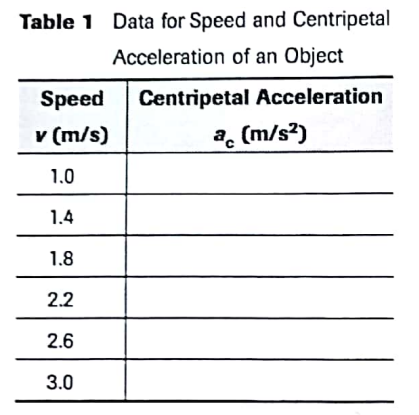
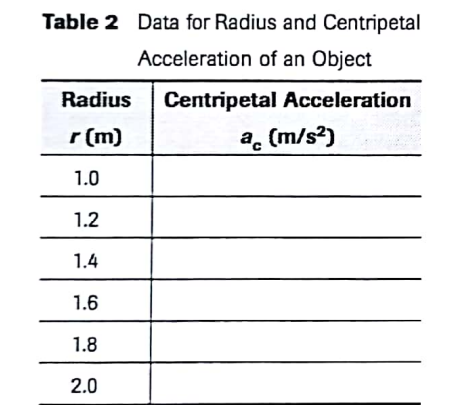
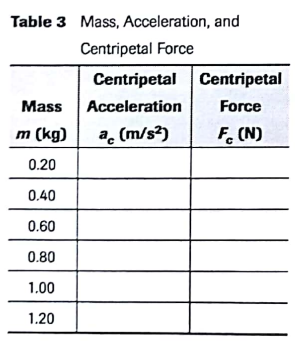
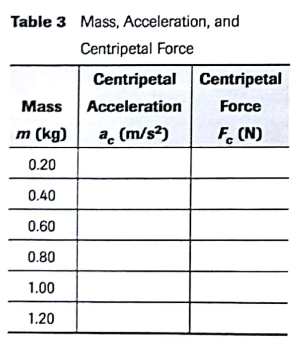
Table 1 Data for Speed and Centripetal Acceleration of an Object Speed Centripetal Acceleration v (m/s) a (m/s?) 1.0 1.4 1.8 2.2 2.6 3.0Table 2 Data for Radius and Centripetal Acceleration of an Object Radius Centripetal Acceleration r (m) a (m/s?) 1.0 1.2 1.4 1.6 1.8 2.0Table 3 Mass, Acceleration, and Centripetal Force Centripetal Centripetal Mass Acceleration Force m (kg) a (m/s?) F- (N) 0.20 0.40 0.60 0.80 1.00 1.20
Step by Step Solution
There are 3 Steps involved in it

Get step-by-step solutions from verified subject matter experts
 Study Help